


Real Dog
Real Dog sausas maistas suaugusiems, didelių-milžiniškų veislių, šunims su vištiena ir ryžiais 20kg
2,11 €/kg
42,15 € / 20 kg

Also known as: Bernhardiner, Alpine Spaniel, Saint bernard dog
At a monastery pass in the Swiss Alps, founded in the 11th century by Saint Bernard of Menthon, monks used this breed to search for travelers lost in avalanches and blizzards. The legendary dog Barry is credited with saving over forty people during his working life. A modern male can weigh up to 82 kilograms, ranking it among the heaviest breeds on the FCI list. The coat comes in short or long variants, both dense and cold resistant. Despite the massive size, the breed is known for a calm, patient temperament, particularly around children. Drooling and heavy shedding are simply part of owning a dog this size. Life expectancy runs 8 to 10 years, short given the weight it carries.
Browse dog food sized right for this breed
St. Bernard: how old in human years?
Energy level
Trainability
Family friendly
Grooming need
Males 70–90 cm
Females 65–80 cm
Males 64–82 kg
Females 54–64 kg
St. Bernard's average temperament and family-life score for this breed is moderate.
St. Bernard's energy and exercise needs are low.
St. Bernard's guarding and alertness traits are low.
St. Bernard's grooming needs are moderate.
Stretched out in the hallway, a St. Bernard fills all of it, and everyone coming home has to choose between stepping over and politely asking it to shift. The breed comes from the Swiss Alps, from the hospice at the Great St Bernard Pass, and brought down with it a calm, unhurried temperament: it doesn't fuss over nothing and barks only when it genuinely has something to say.
It needs to move, but not to race: a few leisurely walks a day with time to sniff the hedges suit it far better than running beside a bike. Keep a growing puppy off stairs at speed and away from long, tiring hikes while its bones and joints are still forming. Heat is hard on it, so walk early in the morning and in the evening in summer; snow, on the other hand, makes it as happy as a child. It is simply too big for a flat, and a house with a garden and room to sprawl suits it much better.
Start training early and patiently: a puppy pulling on the lead is sweet, an eighty-kilo adult doing the same is a problem. A St. Bernard is gentle with children and puts up with plenty of attention, but it can knock a toddler over with a swing of its side or tail, so stay close at first. It greets strangers calmly and with dignity, gets along with other dogs, and above all likes to be beside its family, preferably lying on your feet.
St. Bernards come in two coats, short-haired and long-haired, but both are dense and both moult heavily. The short coat needs brushing once or twice a week, the long one several times, especially behind the ears, on the "trousers" of the hind legs and on the tail, where it tangles. During the moult you will be brushing daily, and a bin bag of hair from one session is no exaggeration. As you brush, check the skin: a coat this thick can hide a red patch or a damp, smelly spot.
Drool is the St. Bernard's signature, so keep one towel by the door and another in the car, and wipe the lips and chin after meals and drinks so the folds of the lips don't stay damp. Wipe the eyes with a soft damp cloth when needed and watch for watering or redness. Those heavy, hanging ears shut the canal off from the air, so lift them weekly and look inside: it should be clean and free of any smell.
Like many giant dogs, the St. Bernard lives eight to ten years, shorter than its small neighbours. Its health questions mostly come with its size: joints, bones, the spine and the stomach, plus a couple to do with the eyes. A watchful owner catches many changes early, and if you are getting a puppy, ask the breeder about the parents' health testing.
This is general information, not veterinary advice. For your own dog's health, tests and treatment, see a vet.
Bloat is when the stomach fills with gas and can twist on itself, cutting off its own blood supply. You might see your dog restless and unable to settle, with a swollen, tight belly, retching without bringing anything up and drooling even more than its usual generous amount. A St. Bernard's deep chest makes this a real risk, so if you see these signs your dog needs a vet immediately.
Hip dysplasia is a fault in how the hip joint develops: the ball of the thigh bone sits badly in its socket and the joint wears over time. You may notice your dog struggling to get up after a nap, reluctant on the stairs, or bunny-hopping with both hind legs together at a run. A growing St. Bernard puts on weight month after month, which loads those joints heavily; ask the breeder about the parents' health testing.
Osteosarcoma is a malignant bone tumour that can develop, for example, in the long bones of the legs. The first sign may be a limp that rest doesn't fix, or a firm, painful swelling on a leg. In a dog as big and heavy as a St. Bernard it is easy to blame a limp on the joints or on age, so if it hasn't gone within a few days, have your vet see it.
Lymphoma is a cancer of the lymphocytes, the immune system's white blood cells, affecting the lymph nodes and sometimes other organs. Feeling under the jaw, in front of the shoulders or behind the knees you may find enlarged, painless lumps, and the dog may become listless and lose its appetite. You won't see them under all that St. Bernard coat, so let your hands check those spots now and then as you stroke, and show any changes to your vet.
Wobbler syndrome is a set of changes in the neck vertebrae and their joints that press on the spinal cord. The first thing you may notice is an unsteady, almost drunken walk, especially at the back end, scuffed nails, or reluctance to bend the neck down to the bowl. In a dog that ambles as unhurriedly as a St. Bernard it is easy to read this as clumsiness, but a vet should assess it.
Entropion is when an eyelid rolls inward and the lashes and hair rub against the surface of the eye. You may see your dog squinting, a watery or reddened eye, and pawing at its face or rubbing it along the carpet. A St. Bernard has a big head with loose skin around the eyes, so look at the eyes regularly and show any sign of irritation to your vet.
This list is chosen by the breed's weight (82 kg) rather than the breed itself: shops label food by dog size, so every breed of the same size gets the same list. Prices are updated daily.
≈ 685 g of dry food a day, from €37,56 a month For a neutered, normally active 66 kg dog. Calculate for your dog
Real Dog
2,11 €/kg
42,15 € / 20 kg

Sam's Field
2,56 €/kg
33,26 € / 13 kg
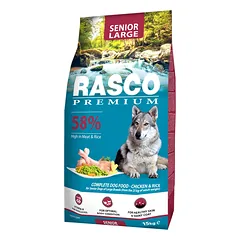
Rasco
2,67 €/kg
39,99 € / 15 kg
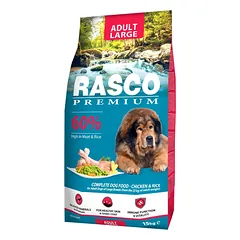
Rasco
2,67 €/kg
39,99 € / 15 kg
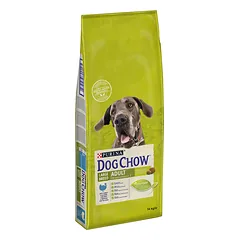
Purina
2,71 €/kg
37,96 € / 14 kg

Sam's Field
2,77 €/kg
35,99 € / 13 kg
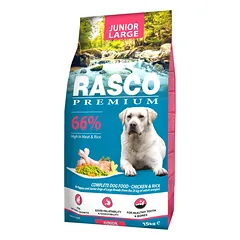
Rasco
2,80 €/kg
41,99 € / 15 kg

Sam's Field
2,85 €/kg
37,04 € / 13 kg