

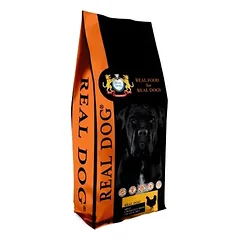
Real Dog
Real Dog sausas maistas suaugusiems, didelių-milžiniškų veislių, šunims su vištiena ir ryžiais 20kg
2,11 €/kg
42,15 € / 20 kg

Also known as: Rottie, Weily
The Rottweiler's ancestors trace back to Roman drover dogs that pushed cattle alongside the legions across the Alps, later settling in the German town of Rottweil, where the breed took its name driving cattle to market and pulling butchers' carts. The heavily muscled frame, with males reaching up to 60 kilograms, was built for pushing and pulling rather than speed. The short, dense coat needs minimal grooming but sheds heavily twice a year. Hip dysplasia is a serious health concern given the breed's mass, so joint screening in breeding lines matters a great deal. Temperament is calm and self-assured, though early socialisation is essential given a strong natural guarding instinct. Contrary to its tough reputation, a well-raised Rottweiler is often gentle with the family's children. Intelligence runs high, so boredom at home can turn into destructive behaviour. Life expectancy runs 9 to 10 years.
Browse dog food sized right for this breed
Rottweiler: how old in human years?
Energy level
Trainability
Family friendly
Grooming need
Males 61–68 cm
Females 56–63 cm
Males 50–60 kg
Females 42–52 kg
Rottweiler's average temperament and family-life score for this breed is moderate.
Rottweiler's energy and exercise needs are moderate.
Rottweiler's guarding and alertness traits are high.
Rottweiler's grooming needs are moderate.
When a Rottweiler leans its full weight against your legs, that is not an accident but a declaration of love, and you will certainly feel it. The breed comes from Germany, where it drove cattle and kept watch, and that working core is still there: clever, quick to learn and genuinely willing once it understands what you want. Training should be calm, consistent and started early, because a grown Rottweiler is far too strong to be corrected by force.
It is alert and takes its territory seriously, greeting strangers with reserve, and it is not a big barker; when it does speak up, it is worth going to see why. That makes early socialisation (new people, new noises, other dogs) a foundation rather than a luxury. With its own family it is devoted and gentle, and it can be patient with children, but a dog this size can bowl over a toddler out of sheer enthusiasm, so keep them together only under supervision.
A typical day means a proper walk in the morning, something for the brain (scent games, obedience, carrying and fetching) and another real outing in the evening. A flat is a tight fit; a house with a garden suits it much better, though not alone in the garden, because this dog wants to be wherever you are.
A Rottweiler's short, coarse coat with its undercoat asks for little: a weekly once-over with a rubber brush or grooming mitt, a bit more during the moult, when the undercoat comes out in dark tufts that roll across the floor. Brushing doubles as a skin check. Run your hand along the flanks, neck and belly and you will find a lump, a scrape or a sore patch far sooner by touch than by eye on that black coat.
Look at the eyes briefly but regularly: they should be clean, without constant tears or redness, and the corners can be wiped with a soft damp cloth. Lift the drop ears once a week and have a sniff; inside they should be clean and odour-free. Brush the teeth with a dog toothbrush and toothpaste, and start young: a Rottweiler taught as a puppy will open up calmly, whereas negotiating with sixty kilos of grown dog who has never liked it is nobody's idea of fun.
A Rottweiler is a big, heavily muscled dog with a lifespan of around nine to ten years, and a body like that asks a lot of its joints, ligaments and heart. The conditions below are not a prophecy, just a map: knowing where to look helps you notice early when something changes. If your dog is not acting like itself, your vet is the first stop and the one to decide what comes next.
This is general information, not veterinary advice. For your own dog's health, tests and treatment, see a vet.
Obesity simply means carrying more fat than the body can handle comfortably, and that extra load presses on the joints, heart and breathing every single day. You should be able to feel the ribs easily under your palm and see a waist from above; if both have quietly disappeared, it is time for a chat with your vet. A Rottweiler is already a heavy dog with very persuasive eyes at the dinner table, so every spare kilo costs it more than it would a smaller dog.
This is a problem with how the joints develop: as the puppy grows, the parts of the hip or elbow do not fit together quite right, so the joint moves unevenly and wears down over time. You might see a stiff, slow start after a nap, a limp on a front leg after a hard game, or a sudden reluctance to jump into the car. For a dog this big and heavy, sound joints matter a great deal, so ask the breeder about the parents' joint screening and show any limp to your vet.
The cruciate ligament keeps the knee stable, and when it tears the knee starts to wobble. The dog may suddenly go lame on a hind leg after a leap or a sharp turn, or sit with one back leg stuck out to the side. A Rottweiler's weight and its love of rough play give those ligaments plenty of work, so a hind-leg limp that hasn't eased within a day is worth a vet visit.
Osteosarcoma is a malignant bone tumour linked to large, tall dogs. It can show up as a limp that won't go away and doesn't match any knock you remember, or as a firm, painful swelling on a leg, sometimes near a joint. A Rottweiler's size puts it in that group, so a lingering limp in a grown dog deserves a vet's eye rather than a wait-and-see.
Bloat is when the stomach fills with gas and can twist on itself, pinching off its blood supply; it unfolds within hours and is life-threatening. The dog turns restless, retches without bringing anything up, drools, and the belly swells and goes hard. Rottweilers are big, deep-chested dogs, so know where your nearest out-of-hours clinic is before you ever need it: this needs a vet immediately.
Entropion is an eyelid that rolls inward, so the lashes and hair rub against the surface of the eye. You may notice squinting, a watery or reddened eye, or your dog rubbing its face along the carpet. A Rottweiler's eyes should look clear and calm, so an eye that keeps weeping or stays half-closed is one for the vet to look at.
This is a narrowing just below the aortic valve that the dog is born with, which makes the heart work harder to push blood out to the body. Sometimes the vet hears it first, as a murmur at a puppy check-up; later a dog may tire quickly or even faint during exercise. For a dog that loves to work and move, it is worth having the vet listen carefully to the heart from those very first visits.
This list is chosen by the breed's weight (60 kg) rather than the breed itself: shops label food by dog size, so every breed of the same size gets the same list. Prices are updated daily.
≈ 565 g of dry food a day, from €30,95 a month For a neutered, normally active 51 kg dog. Calculate for your dog
Real Dog
2,11 €/kg
42,15 € / 20 kg

Sam's Field
2,56 €/kg
33,26 € / 13 kg
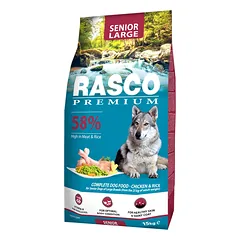
Rasco
2,67 €/kg
39,99 € / 15 kg
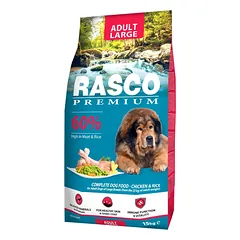
Rasco
2,67 €/kg
39,99 € / 15 kg
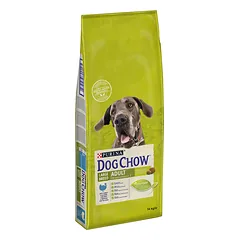
Purina
2,71 €/kg
37,96 € / 14 kg

Sam's Field
2,77 €/kg
35,99 € / 13 kg
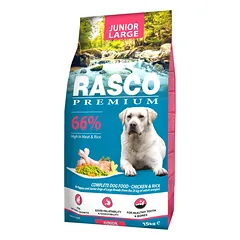
Rasco
2,80 €/kg
41,99 € / 15 kg

Sam's Field
2,85 €/kg
37,04 € / 13 kg