

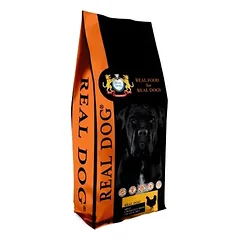
Real Dog
Real Dog sausas maistas suaugusiems, didelių-milžiniškų veislių, šunims su vištiena ir ryžiais 20kg
2,11 €/kg
42,15 € / 20 kg

Also known as: Bandog, Mastiff-type, Swinford Bandog
The Mastiff is among the oldest dog types on the British Isles, with roots tracing back to Roman times, when similarly giant dogs were used in arena combat. The modern breed was fixed in the 19th century as an estate guardian, and its sheer size still does most of the deterring on its own. A male can weigh up to 100 kilograms, making it one of the heaviest FCI-recognized breeds outright, so a growing puppy needs careful management of joint stress until the skeleton fully matures. The smooth, short coat needs little grooming, but drooling, especially after drinking or eating, is close to unavoidable. Temperament is gentle and calm indoors, though its bulk means even a playful lean can knock a small child over. Life expectancy runs 6 to 10 years, on the short end even by giant-breed standards.
Browse dog food sized right for this breed
Mastiff: how old in human years?
Energy level
Trainability
Family friendly
Grooming need
Males 76–90 cm
Females 70–85 cm
Males 73–100 kg
Females 54–77 kg
Mastiff's average temperament and family-life score for this breed is moderate.
Mastiff's energy and exercise needs are low.
Mastiff's guarding and alertness traits are moderate.
Mastiff's grooming needs are moderate.
The doorbell, heavy steps in the hallway, and a head appears in the doorway big enough to make the courier take a step back. Nothing more is needed: a Mastiff rarely barks for nothing, but its presence usually says enough. This English guardian was bred to protect rather than attack, and its calm is its greatest strength.
At home it is surprisingly lazy: a couple of easy walks a day, a long nap and a spot from which it can see the whole family is its ideal schedule. While the puppy is growing, spare it long runs and jumping, because bones and joints are still forming. Start training early and stay consistent: a Mastiff learns at its own unhurried pace, and good manners on the lead become essential once the dog outweighs you.
With its own family it is gentle and devoted, and patient with children, although its sheer size means it can knock a toddler over without noticing. It is reserved with strangers and other dogs, so early socialising is not an extra here but the foundation. A flat is cramped for a giant like this; it is happier in a house with a garden and a family that does not mind drool marks on the sofa.
A Mastiff's coat is short, dense and smooth, so brushing takes minutes: go over it once a week with a rubber mitt or brush, more often in moulting season, because a body this size drops a fair amount of hair. The real work is not the coat but the drool. Keep a towel by the door and another by the water bowl, because after every drink it ends up on the floor, the walls and your trousers. Wipe the muzzle and the lip folds daily, and keep the skin in the folds clean and dry.
Once a week, check the eyes and the drop ears: eyes clear, lids not red, ears clean and odour-free inside. Trim the nails regularly, since overlong nails change the gait of a dog this heavy, and get the puppy used to it early, because there is no persuading a seventy-kilo dog that does not want to give you its paw. The same goes for bathing: teach it to stand still while it still fits in the tub.
A dog that weighs as much as a grown adult lives a shorter life than its smaller cousins: a Mastiff's lifespan runs to six to ten years, which makes every one of them worth looking after. A big body means heavy loading on the joints, and a deep chest calls for special attention to the stomach. It is worth knowing about the skin, the eyes, the nervous system and lumps too, and when anything changes, let your vet draw the conclusions.
This is general information, not veterinary advice. For your own dog's health, tests and treatment, see a vet.
An allergy is the immune system overreacting to something in the surroundings or the food that should do no harm. You may notice your Mastiff licking its paws, scratching, rubbing its face on the carpet, or red skin between the toes, in the armpits or in its folds. A short coat shows these changes quickly, so raise them with your vet before the skin gets sore.
This covers a range of eye disorders, from eyelids that roll inward or sag outward to changes inside the eye itself. You may notice watering, redness, squinting or your dog pawing at an eye. A Mastiff's head is massive and its lids are heavy, so look at the eyes daily and show any change to your vet.
Cancer is the general name for diseases in which cells start multiplying out of control and form tumours. You may feel a new lump under the skin, notice limping with no obvious cause, weight loss or unusual tiredness. In a large breed, run your hands over the whole body regularly and show any new lump or change to your vet.
This is a fault in how the joint develops: as the puppy grows, the parts of the hip joint do not fit together properly, and the joint wears faster than it should. You might see your Mastiff struggling to get up, swaying at the rear, or reluctant to take the stairs. With so much weight resting on those joints, it is worth asking the breeder about joint screening of the parents and showing any change in gait to your vet.
This is a slowly progressing disease of the spinal cord that weakens the hind legs in older age. You may notice your Mastiff wobbling as it walks, its back paws scuffing the floor or occasionally landing knuckled over. In a dog this size, failing hind legs are easy to blame on the joints, so only your vet can tell whether this is the cause, and it is worth asking the breeder about the parents' health testing.
Epilepsy means repeated seizures, episodes in which the brain's electrical activity is disrupted. You may see your dog suddenly collapse, twitch or paddle its legs, drool more than usual or briefly lose consciousness, then seem confused afterwards. When a seizure happens, your dog needs a vet immediately.
Bloat is when the stomach fills with gas and can twist on itself, cutting off its own blood supply. The dog becomes restless, tries to vomit but brings nothing up, its belly swells and turns hard, and it drools heavily. This is an emergency that needs a vet immediately, even at night, so know in advance where your nearest out-of-hours clinic is.
This list is chosen by the breed's weight (100 kg) rather than the breed itself: shops label food by dog size, so every breed of the same size gets the same list. Prices are updated daily.
≈ 760 g of dry food a day, from €41,76 a month For a neutered, normally active 76 kg dog. Calculate for your dog
Real Dog
2,11 €/kg
42,15 € / 20 kg

Sam's Field
2,56 €/kg
33,26 € / 13 kg
Rasco
2,67 €/kg
39,99 € / 15 kg
Rasco
2,67 €/kg
39,99 € / 15 kg
Purina
2,71 €/kg
37,96 € / 14 kg

Sam's Field
2,77 €/kg
35,99 € / 13 kg
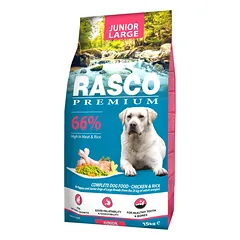
Rasco
2,80 €/kg
41,99 € / 15 kg

Sam's Field
2,85 €/kg
37,04 € / 13 kg