

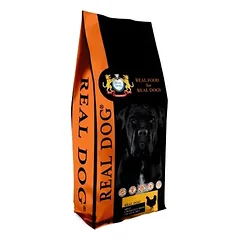
Real Dog
Real Dog sausas maistas suaugusiems, didelių-milžiniškų veislių, šunims su vištiena ir ryžiais 20kg
2,11 €/kg
42,15 € / 20 kg

The Leonberger was created in the mid nineteenth century in the German town of Leonberg by crossing Saint Bernards, Pyrenean Mountain Dogs and Newfoundlands, aiming for a majestic dog resembling a lion. An adult male can weigh up to 77 kilograms, making it one of the heaviest breeds recognised by the FCI, and it needs space along with solid, non-slip flooring to protect its joints while growing. The water-resistant double coat, inherited from its Newfoundland ancestry, makes it a capable swimmer. Despite its enormous size, temperament is notably gentle and patient, earning it the nickname 'gentle giant.' The breed nearly vanished in Europe during the Second World War and was rebuilt from a small surviving population. The coat sheds heavily, needing daily brushing for much of the year. Because of its size, average lifespan runs shorter than for smaller dogs. Life expectancy runs 8 to 9 years.
Browse dog food sized right for this breed
Leonberger: how old in human years?
Energy level
Trainability
Family friendly
Grooming need
Males 72–80 cm
Females 65–75 cm
Males 50–77 kg
Females 45–61 kg
Leonberger's average temperament and family-life score for this breed is high.
Leonberger's energy and exercise needs are low.
Leonberger's guarding and alertness traits are moderate.
Leonberger's grooming needs are high.
A wet nose on your knee, a heavy sigh, and a head placed so that you can no longer read the paper: that is how a Leonberger tells you it is time for a walk. Bred in Germany, this is a family giant through and through: patient with children, gentle with its people, calm indoors and always wherever life is going on. It will announce visitors loudly and with some dignity, but it is no aggressive guard: it looks newcomers over carefully and, if all is well, welcomes them into the pack.
It needs more exercise than its calm suggests: long walks, hills, woods and, whenever possible, water, which it wades into without ceremony. A Leonberger is clever and learns willingly, but start training early, while the puppy still fits in your arms; later on, good lead manners in a dog that weighs as much as you do stop being a nicety and become a necessity. With other dogs it gets along best when it has met plenty of them from puppyhood.
A flat is too tight for it; the best home has a garden where it can stretch out full length on cool grass. Be ready for hair on the sofa, drool on your trousers, and a dog that does not like being alone: a Leonberger is happiest with its family close by, even if everyone is just sitting in the kitchen.
A Leonberger wears a double coat of long, water-resistant outer hair over a dense undercoat, and males add a mane worthy of the lion in the breed's name. It sheds generously, and during the moult tufts of undercoat roll across the floor like tumbleweed. Brush right down to the skin with a brush and a wide-toothed comb a few times a week, and every day during the moult, paying special attention to the hair behind the ears, the trousers on the back legs and under the tail, where mats form. Feel the skin as you go: redness or a lump hides easily under that much coat.
Leonbergers drool, so keep a towel by the door and by the water bowl, and wipe the edges of the lips so the skin there doesn't get sore. After a swim, and this dog loves water, towel it down to the undercoat, not just the top layer. Check the drop ears once a week and after swimming: inside they should be clean and free of smell. Wipe the corners of the eyes with a damp cloth when needed; red or weepy eyes are a reason to see the vet.
A big body and a big heart describe the Leonberger well, but its life is shorter than a small breed's: around eight to nine years. Keep an eye on its joints, heart, eyes and stomach, and don't put off a vet visit when something changes. If you are choosing a puppy, ask the breeder about the parents' health testing.
This is general information, not veterinary advice. For your own dog's health, tests and treatment, see a vet.
Bloat is when the stomach fills with gas and can twist, cutting off its own blood supply, and without urgent help it is life-threatening. The dog grows restless, tries to vomit without bringing anything up, drools heavily, and the belly swells like a drum. A large, deep-chested Leonberger is one of the dogs at risk, so if you see these signs, get to a vet immediately.
This is a broad family of troubles affecting joints, bones and ligaments, from joints that develop badly to joints that wear out with age. You might notice a dog who gets up stiffly, hesitates before jumping into the car, or starts cutting walks short of its own accord. A grown Leonberger can weigh as much as a grown person, so every joint works hard, and any limp or stiffness should be assessed by your vet.
Cancer is the umbrella name for diseases in which cells start multiplying out of control and form tumours. Watch for a new lump under the coat, weight loss you can't explain, listlessness, or a limp that won't go away. A lump is easy to miss in a Leonberger's thick coat, so feel the skin as you brush, and show your vet anything new.
Heart disease covers several problems: faulty valves, a weakening heart muscle, or an irregular rhythm. The signs are quiet: a dog that tires sooner, coughs, or breathes harder even while lying down. A Leonberger is happy to lounge to begin with, so a slowdown is easy to blame on temperament, and regular check-ups with your vet help catch changes in time.
With cataracts the lens of the eye turns cloudy, lets less light through, and sight fades. You might notice a greyish or milky sheen in the pupil, or a dog that bumps into things at dusk and takes the stairs uncertainly. It is worth looking into your Leonberger's eyes in daylight now and then, and letting your vet assess any cloudiness.
This list is chosen by the breed's weight (77 kg) rather than the breed itself: shops label food by dog size, so every breed of the same size gets the same list. Prices are updated daily.
≈ 625 g of dry food a day, from €34,23 a month For a neutered, normally active 58,3 kg dog. Calculate for your dog
Real Dog
2,11 €/kg
42,15 € / 20 kg

Sam's Field
2,56 €/kg
33,26 € / 13 kg
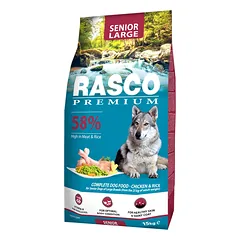
Rasco
2,67 €/kg
39,99 € / 15 kg
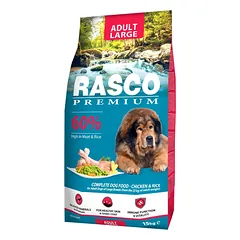
Rasco
2,67 €/kg
39,99 € / 15 kg
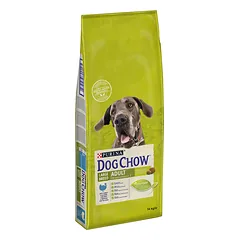
Purina
2,71 €/kg
37,96 € / 14 kg
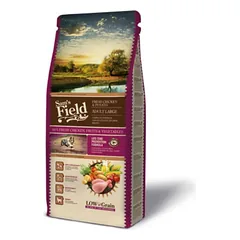
Sam's Field
2,77 €/kg
35,99 € / 13 kg
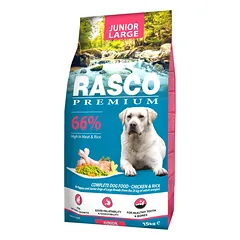
Rasco
2,80 €/kg
41,99 € / 15 kg
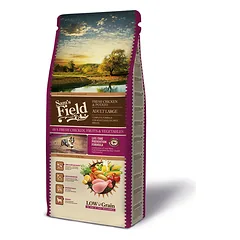
Sam's Field
2,85 €/kg
37,04 € / 13 kg