

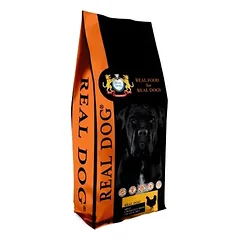
Real Dog
Real Dog sausas maistas suaugusiems, didelių-milžiniškų veislių, šunims su vištiena ir ryžiais 20kg
2,11 €/kg
42,15 € / 20 kg

Also known as: Mittelschnauzer, Shnowzer, Shnauser, Schnuazer, Schnowtser
The Giant Schnauzer grew out of the Standard in Bavaria, where breweries and slaughterhouses needed a larger dog to drive cattle and pull heavy carts. A male can reach 47 kilograms, and the wiry, dense coat with its bushy eyebrows and beard needs regular hand-stripping to hold its correct texture. In the early 20th century the breed was adopted by German police and military units for its size, strength, and trainability. It stays energetic well into adulthood and needs serious physical and mental work, or boredom tends to turn into household trouble. It is naturally reserved with strangers, so early socialization matters. Life expectancy runs 10 to 12 years.
Browse dog food sized right for this breed
Giant Schnauzer: how old in human years?
Energy level
Trainability
Family friendly
Grooming need
Males 65–70 cm
Females 60–65 cm
Males 35–47 kg
Females 25–34 kg
Giant Schnauzer's average temperament and family-life score for this breed is moderate.
Giant Schnauzer's energy and exercise needs are moderate.
Giant Schnauzer's guarding and alertness traits are high.
Giant Schnauzer's grooming needs are low.
The doorbell rings, and the house fills with a deep, serious bark that tells the courier, in no uncertain terms, that someone large lives here. The Giant Schnauzer comes from southern Germany, where it drove cattle and guarded yards before becoming a police and guard dog. It is born to work: clever, tireless and very energetic, so it needs not just long walks but jobs for its brain, such as obedience, tracking or a dog sport.
It learns superbly, but a mind like that has another side: if you don't decide what the house rules are, it will happily decide for you. It needs a calm, consistent owner and socialising from an early age, so that alertness doesn't tip over into suspicion. With strangers it is reserved on principle, with unfamiliar dogs not necessarily hospitable, and it takes guarding its home and people very seriously.
With its own family it is devoted, likes to be close and isn't happy left alone for long. It gets on with children, especially ones it grows up with, but a powerhouse of up to forty-odd kilos can bowl over a toddler without meaning to, so keep an eye on play. A flat is a squeeze for it; it is far happier in a house with a garden, with owners who like to be on the move together.
The Giant Schnauzer has a wire coat: a harsh, hard topcoat with a dense undercoat beneath. It barely sheds, but that doesn't mean it looks after itself: dead hair stays in the coat, so a few times a year it needs hand-stripping or clipping, and once or twice a week a thorough comb-through, especially the legs and beard, where the hair mats most easily. Stripping keeps the coat's harsh texture and colour; clipping is simpler but leaves the coat softer. While you comb, check the skin, because dry, flaky or reddened patches don't show from a distance in a coat this thick.
The beard is a chapter of its own. After every drink it will leave a wet trail across the floor, and after dinner it may carry some of dinner too, so give it a wipe and the occasional wash. Check the ears weekly: hair can grow inside them and trap moisture and dirt, and a bad smell or redness is your cue to see a vet. The eyebrows shouldn't get in the way of seeing, so check the eyes and trim the hair around them when needed.
Big dogs grow fast and for a long time, so for the Giant Schnauzer, a muscular working dog that lives about ten to twelve years, the health questions centre on bones, joints and metabolism. A large dog's puppyhood is when the joints are still forming, so it's worth keeping an eye on growth together with your vet, and asking the breeder about the parents' health testing before you take a puppy home. If anything starts to seem different from usual, a vet is the one to decide what it is.
This is general information, not veterinary advice. For your own dog's health, tests and treatment, see a vet.
The hip joint forms imperfectly, the ball of the thigh bone sits too loosely in its socket, and the joint wears over time. You might notice a dog that gets up more slowly after a walk, avoids stairs or sways a little through the hindquarters as it moves. A dog as heavy and powerful as the Giant Schnauzer puts real load on its joints, so changes in gait are worth showing to a vet sooner rather than later.
This is a growth disorder in which a crack or flap forms in the cartilage covering a joint, and the joint starts to hurt. It shows up in a young, fast-growing dog: the puppy begins to limp, especially after play or a long rest, and one leg may look stiff. A Giant Schnauzer does an enormous amount of growing in its first year, so any limp in an adolescent that doesn't settle within a few days is a reason to see a vet.
The thyroid gland makes too little hormone, and the dog's body slows down. You might notice weight gain without any extra food, tiring sooner, a liking for warm spots, and a harsh coat that thins, breaks or won't grow back after clipping. A Giant Schnauzer is alert and busy by nature, so that kind of sluggishness is out of character and worth discussing with a vet.
This list is chosen by the breed's weight (47 kg) rather than the breed itself: shops label food by dog size, so every breed of the same size gets the same list. Prices are updated daily.
≈ 430 g of dry food a day, from €23,42 a month For a neutered, normally active 35,3 kg dog. Calculate for your dog
Real Dog
2,11 €/kg
42,15 € / 20 kg

Sam's Field
2,56 €/kg
33,26 € / 13 kg
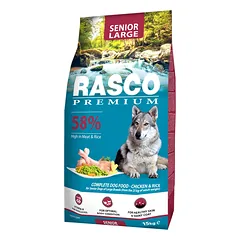
Rasco
2,67 €/kg
39,99 € / 15 kg
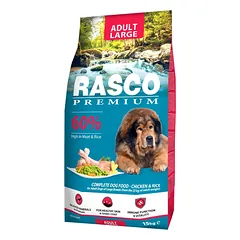
Rasco
2,67 €/kg
39,99 € / 15 kg
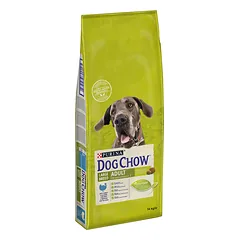
Purina
2,71 €/kg
37,96 € / 14 kg

Sam's Field
2,77 €/kg
35,99 € / 13 kg
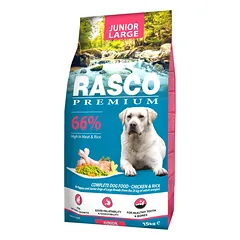
Rasco
2,80 €/kg
41,99 € / 15 kg
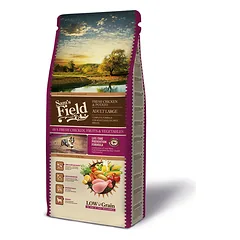
Sam's Field
2,85 €/kg
37,04 € / 13 kg