


VetExpert
Raw Paleo Dog Ultra Mini Puppy Beef 750 kg
0,02 €/kg
13,09 € / 750 kg

Also known as: Techichi, Chiwawau, Tea cup chihuahua, Hairless chihuahua, Deer head chihuahua
Named for the Mexican state where 19th-century traders first found small, short-coated dogs kept by local villagers, the Chihuahua is the smallest breed recognized by the FCI, with adults topping out around 3 kilograms. A smooth-coated and a long-coated variety both fall under one breed standard, and litters occasionally produce puppies of the "apple head" domed skull alongside flatter "deer head" types, though only the domed shape is shown competitively. Their small size makes them prone to a soft spot in the skull, called a molera, that can stay open into adulthood in some individuals, similar to a human infant's fontanelle. Despite the size, Chihuahuas often bond intensely with one person and can become genuinely anxious or defensive around strangers or other dogs if not socialized early. They're prone to shivering even in comfortable temperatures, partly from a fast metabolism and partly from stress, not always cold. The breed carries one of the longest average lifespans in the dog world, commonly 14 to 16 years, so a Chihuahua acquired as a puppy is a genuinely long-term commitment. Dental crowding is common given how much tooth has to fit in such a small jaw, making regular cleaning more important than in larger breeds. They travel well and often prefer a single-family household over a busy multi-pet one.
Browse dog food sized right for this breed
Chihuahua: how old in human years?
Energy level
Trainability
Family friendly
Grooming need
Males not specified
Females not specified
Males not specified
Females not specified
Chihuahua's average temperament and family-life score for this breed is moderate.
Chihuahua's energy and exercise needs are moderate.
Chihuahua's guarding and alertness traits are high.
Chihuahua's grooming needs are low.
The doorbell hasn't even finished ringing and your Chihuahua is already in the hallway, loudly explaining to the visitor who runs this house. Nobody told this little dog from Mexico that it is small: it is alert, bold and vocal, and treats strangers with suspicion first, accepting their compliments only later. It is clever and quick to work out what's in it for itself, so keep training short, consistent and treat-based, especially the lesson that not every passer-by is a threat.
Physically it needs little: a few short walks and some play indoors are plenty, which makes it an ideal flat dweller for whom a small home feels like a palace. There is more energy in there than you might expect, so short games and new smells keep it bright. On cold days it is more comfortable in a jumper, and a harness is the better choice over a collar.
A Chihuahua tends to bond with one person or a small family and regards your lap as its territory. It isn't the best match for small children: a dog this fragile is easily hurt, and it doesn't take kindly to rough handling. It can be choosy about other dogs, so introduce them carefully and early; its greatest joy is a warm spot next to you and a blanket to burrow under.
Chihuahuas come in two coats, smooth and long, and neither asks for much. Give a smooth coat a weekly once-over with a soft brush or mitt; comb a long coat a couple of times a week, paying attention behind the ears, on the trousers and the tail, where the soft hair likes to tangle. Shedding is light and baths can be few; after one, dry your dog thoroughly, because a body this small gets cold fast.
Those big eyes need attention: check daily that they are clean and wipe the corners with a soft damp cloth. Look at the large, upright ears once a week. Teeth are the main event here: small teeth crowded into a small jaw, so brush them with a dog toothbrush and toothpaste, ideally daily, and start while your Chihuahua is still a puppy.
The Chihuahua is the smallest recognised dog breed, weighing no more than three kilograms, yet it lives a long time, with a life expectancy of fourteen to sixteen years. A tiny body means some things, from teeth to blood sugar, matter more for this dog than for a bigger one, so it pays to know what to watch. Anything that raises a question is for your vet to assess.
This is general information, not veterinary advice. For your own dog's health, tests and treatment, see a vet.
Obesity means carrying too much body fat, which strains the joints, heart and breathing. For a Chihuahua even a few hundred grams is a lot, and almost impossible to see without scales; a vanishing waist and ribs you can no longer feel are the giveaways. A little lap dog easily collects a bite from every member of the family, so ask your vet what a healthy weight looks like for yours.
A luxating patella is a kneecap that slips out of its groove, so the knee briefly can't bend and straighten normally. It looks as if your dog suddenly lifts a hind leg, hops a few steps on three legs, then trots on as if nothing happened. Chihuahuas boldly jump off furniture that, for them, is the height of a first floor, so if you see that hop, mention it to your vet.
Periodontal disease is inflammation of the gums and the tissues holding the teeth, starting from plaque and tartar. You might notice bad breath, red gums, or a dog that chews gingerly or drops its treats. A Chihuahua's teeth are squeezed into a very small jaw, so make its mouth a regular part of vet visits.
The trachea is a tube of cartilage rings carrying air to the lungs; when the rings soften, the tube can flatten and get in the way of breathing. The telltale sign is a dry, honking cough, like a goose, especially with excitement or a tug on the lead. It matters in a dog this tiny, so have any cough checked by your vet, and if your dog is struggling to breathe or its tongue turns bluish, it needs a vet immediately.
Heart disease is an umbrella term for conditions in which the heart can no longer pump blood as well as it should, for example because of changes to its valves. You may notice your dog tiring sooner, coughing, especially at night, or breathing faster at rest than it used to. Chihuahuas live a long time, so make the heart part of every vet visit over the years, and if your dog suddenly struggles to breathe or collapses, it needs a vet immediately.
Hydrocephalus is a build-up of fluid inside the skull that presses on the brain. An affected puppy may have an unusually large, dome-shaped head, eyes that look slightly outward, and be clumsy, slow to learn or oddly behaved. A Chihuahua's head is round to begin with, so only your vet can tell a breed trait from a problem.
Eye problems is an umbrella term for anything from inflammation and injuries to conditions that slowly dim the eyesight. You might notice a red or cloudy eye, more discharge, a half-closed lid, or a dog pawing at its face. A Chihuahua's large, prominent eyes are very exposed, so show any change in them to your vet without delay.
In Legg-Calvé-Perthes disease, the head of the thigh bone, the ball of the hip joint, loses its blood supply and the bone starts to break down. It shows up in young dogs: a growing puppy begins to limp on one hind leg, spares it, or yelps when it is touched. It is a problem of small breeds, so if your young Chihuahua starts limping, let your vet find the cause.
Reproductive problems is a broad term for difficulties with breeding, pregnancy and birth. For such a small female, giving birth can be hard, and if she strains for a long time without a puppy arriving, she needs a vet immediately. If you are thinking of breeding a Chihuahua, plan it all with your vet well in advance.
Hypoglycemia means too little sugar in the blood, leaving the brain and muscles short of fuel. The dog suddenly turns listless, trembles, wobbles or seems confused, and in severe cases may collapse or have a seizure. A Chihuahua, a puppy above all, has tiny energy reserves, so if you see these signs your dog needs a vet immediately.
This list is chosen by the breed's weight (3 kg) rather than the breed itself: shops label food by dog size, so every breed of the same size gets the same list. Prices are updated daily.
≈ 67 g of dry food a day, from €3,68 a month For a neutered, normally active 3 kg dog. Calculate for your dog
VetExpert
0,02 €/kg
13,09 € / 750 kg

1,70 €/kg
17,02 € / 10 kg

Real Dog
1,78 €/kg
17,79 € / 10 kg
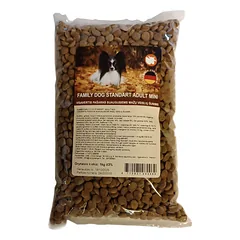
Family Dog
1,89 €/kg
1,89 € / 1 kg

Club 4 Paws
1,93 €/kg
26,99 € / 14 kg

Club 4 Paws
1,93 €/kg
26,99 € / 14 kg

Real Dog
1,94 €/kg
19,42 € / 10 kg

Real Dog
1,95 €/kg
19,49 € / 10 kg