


Advance
Advance Puppy Medium sausas maistas vidutinių veislių šuniukams, 12 kg
1,48 €/kg
17,76 € / 12 kg

Also known as: Frenchie
English lace workers migrating to Normandy in the 1800s brought their toy bulldogs along, and French breeders crossed them with local ratters until the compact, bat-eared dog we call French today took shape, in France despite the English foundation stock. Its flat face is the whole story with this breed: the short skull makes breathing, heat regulation and even sleep harder than in a longer-nosed dog, so summer walks need to happen early or late in the day. An adult rarely tops 14 kilograms, and the build is stocky rather than athletic, closer to a small brick than a runner. Bat ears sit permanently upright from a few months old, one of the easiest features to spot even at a distance. The coat needs almost no grooming, but the wrinkles around the face trap moisture and need wiping to avoid skin irritation. Frenchies can't swim due to their body proportions, a detail worth knowing before any trip near open water. Many can't give birth naturally because of the same broad head and narrow hips that give them their look, so C-sections are common in the breed. They tend to be comedians rather than guard dogs, more interested in an audience than in patrolling a yard. Lifespan runs a relatively short 10 to 12 years for a small dog.
Browse dog food sized right for this breed
French Bulldog: how old in human years?
Energy level
Trainability
Family friendly
Grooming need
Males not specified
Females not specified
Males 9–14 kg
Females 8–13 kg
French Bulldog's average temperament and family-life score for this breed is high.
French Bulldog's energy and exercise needs are low.
French Bulldog's guarding and alertness traits are low.
French Bulldog's grooming needs are low.
Seven in the morning, the kitchen, and something heavy, warm and snoring leans against your ankle. A French Bulldog will happily go for a walk, chase a ball down the hallway and act as if it never gets tired, and half an hour later it is asleep on your feet. It has no need for long hikes or running partners: a few unhurried walks a day and some play indoors cover it. In summer, walk early or late when it is cool, and keep a close eye near water, since a heavy body and a short muzzle do not make a swimmer.
It works out quickly what you want; whether it agrees is another matter. There is a stubborn streak in there, so short, cheerful sessions with a treat on hand get much further than a stern voice, which it will simply ignore with great dignity.
What a Frenchie needs most is you. It follows you from room to room, greets visitors like old friends, is patient with children and usually gets along with other dogs. It barks little but will let you know about the doorbell; as a guard dog it is hopeless, and a burglar is more likely to be welcomed than warned off. Apartment life suits it fine, but long hours alone do not, so if you spend your days at the office, think about a dog sitter or a neighbour who can drop by.
The short, fine coat practically looks after itself: run a rubber grooming mitt over it once a week and the loose hairs end up on the mitt rather than on your dark trousers. Shedding is moderate, so a hair-free home is not on the cards. The real work is the skin. Wipe the facial folds with a damp cloth and always dry them afterwards, because trapped moisture and grime are what irritate them most. Frequent baths aren't needed; for sensitive skin, an occasional wash with a mild shampoo beats a weekly bubble bath.
Those big, round eyes are among the breed's most charming features, and also fairly exposed. Glance at the corners daily and wipe away any gunk with a clean damp cloth; if an eye looks red, waters or is held half shut, it's time for the vet. The ears are wide and open, so nothing hides in them: once a week take a look inside, have a sniff, and clean the visible part with a cotton pad, but leave the ear canal itself alone.
You will usually hear a French Bulldog before you see one: the snorting and snoring from the next room are as much a part of the package as the upright ears. The same flat face that makes this dog so endearing is behind several of its health concerns, so it pays to know what to watch for. An observant owner and a vet you trust go a very long way with this breed.
This is general information, not veterinary advice. For your own dog's health, tests and treatment, see a vet.
A short muzzle squeezes the nostrils, throat and soft palate into very little space, so air has a harder time getting through. You may notice it as loud snorting, snoring in sleep, or a dog that tires quickly in warm weather or after rough play. How much it bothers an individual dog varies, so talk to your vet about how yours breathes, and on hot days choose shade and calm over adventure.
A Frenchie's skin is easily irritated: it reddens, itches, and the facial folds, where moisture collects, can become inflamed. You might see your dog licking its paws nonstop, rubbing its face along the carpet, or catch an unpleasant smell from the wrinkles. Whether food, surroundings or something else is behind it is for a vet to work out.
An ear infection is inflammation of the ear canal, usually driven by bacteria or yeast. The signs are fairly plain: head shaking, pawing at the ear, a sweetish or sour smell, or dark discharge. Those wide, upright bat ears are the breed's calling card and easy to look into, which is worth doing regularly, especially if your dog's skin is on the sensitive side.
A Frenchie's spine carries a compact, muscular body on short legs, which can leave the discs between the vertebrae vulnerable, and a leap off the sofa can end badly. Be suspicious if your dog suddenly refuses stairs or jumping, walks with a hunched back, yelps when picked up, or its hind legs start to wobble. Don't wait for it to pass on its own; a vet needs to see what is going on.
French Bulldog puppies have large heads and the females have narrow hips, so a natural birth can be difficult and risky in this breed. If you are planning a litter, it is not a weekend project: how the puppies come into the world is something to settle with your vet well in advance. If you are not planning to breed, it is one more good reason to avoid an accidental litter.
This list is chosen by the breed's weight (14 kg) rather than the breed itself: shops label food by dog size, so every breed of the same size gets the same list. Prices are updated daily.
≈ 180 g of dry food a day, from €9,76 a month For a neutered, normally active 11 kg dog. Calculate for your dog
Advance
1,48 €/kg
17,76 € / 12 kg

Sam's Field
1,80 €/kg
26,99 € / 15 kg

Country Dog
1,89 €/kg
28,29 € / 15 kg
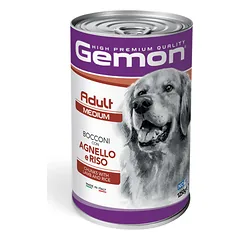
Gemon
1,94 €/kg
2,42 € / 1,3 kg

Gemon
1,94 €/kg
2,42 € / 1,3 kg

Sam's Field
2,11 €/kg
27,45 € / 13 kg

2,14 €/kg
30,00 € / 14 kg

Club 4 Paws
2,15 €/kg
42,99 € / 20 kg