

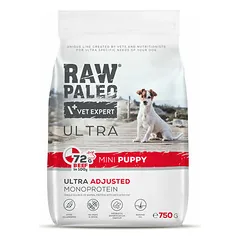
VetExpert
Raw Paleo Dog Ultra Mini Puppy Beef 750 kg
0,02 €/kg
13,09 € / 750 kg

Also known as: Xishi, Shitsu, Schitzu, Shit Zoo, Shih Tsoo
The name Shih Tzu means little lion in Chinese, and the breed was kept for centuries in the Chinese imperial court as a palace companion, likely descended from Tibetan dogs given as gifts to Chinese emperors. The long, dense, flowing double coat in its full show form needs either constant brushing or a shorter trim to avoid matting, since it is rarely left to grow untended. The short muzzle gives the breed its trademark chrysanthemum face, where the coat radiates outward from the nose in every direction. Despite its decorative role, the breed reaches up to 8 kilograms on a compact, sturdy frame rather than a fragile one. In temperament it is friendly and easygoing, better suited to life as a companion than as an active outdoor dog. Life expectancy runs 13 to 16 years.
Browse dog food sized right for this breed
Shih Tzu: how old in human years?
Energy level
Trainability
Family friendly
Grooming need
Males not specified
Females not specified
Males 4.5–8.1 kg
Females 4.5–8.1 kg
Shih Tzu's average temperament and family-life score for this breed is high.
Shih Tzu's energy and exercise needs are low.
Shih Tzu's guarding and alertness traits are low.
Shih Tzu's grooming needs are low.
Your Shih Tzu will know you're home before you've got your shoes off, and will greet you not with barking but with every round, hairy ounce of delight. The breed was made to be company, not a guard, a hunter or a worker, and it takes that job seriously: it likes to be near you and gets on well with the family, with visitors, with gentle children and with other dogs.
Flat life suits it down to the ground. A couple of unhurried walks a day and a bit of play indoors are enough, after which a Shih Tzu is glad to curl up beside you on the sofa and supervise the world from there. On hot days, move the walk to the cool of the morning or evening: a short nose works hard in the heat.
It can learn perfectly well; it simply has its own views on when the lesson is over. Short, cheerful sessions with treats and praise get further than firmness, and house-training in particular calls for patience. It won't wear out the neighbours with barking, but it won't guard the house either: a burglar would likely be welcomed as a new friend.
A Shih Tzu's coat is long, dense and double, and it stays beautiful only as long as someone looks after it: skip the brush for a few days and mats appear behind the ears and in the armpits, pulling at the skin and hiding what is going on underneath. In a full coat, brush every day, layer by layer, right down to the skin; in a short puppy cut, a few sessions a week plus a trip to the groomer every several weeks will do. Look at the skin as you go, because redness, flakes or a damp patch can stay hidden for a long time under that much hair. The good news is that this coat barely sheds, so your sofa stays surprisingly hair-free.
The hair above the nose grows straight into the eyes, which is why it gets tied up in a topknot or trimmed short; wipe the corners of the eyes daily with a soft damp cloth so tears don't dry into brown streaks. Check the ears weekly: inside they should be clean and odour-free, and hair in the canal is best left to a groomer or vet. Teeth sit close together in that small mouth, so brush them with a dog toothbrush and dog toothpaste, ideally every day; a dog used to it from puppyhood takes it as just another kind of petting.
With a life that can stretch to thirteen, fifteen, even sixteen years, a Shih Tzu's health is a marathon rather than a sprint. The flat face, big round eyes, small mouth and generous coat that make the breed so endearing are also the places worth keeping an eye on. Your job is to notice; deciding what a change means is the vet's.
This is general information, not veterinary advice. For your own dog's health, tests and treatment, see a vet.
A short muzzle packs the nostrils, throat and soft palate into less space, so air has a harder time getting through. You might hear snoring, snorting or a whistling breath, especially on a hot day or after a lively game. The Shih Tzu is a flat-faced breed, so its breathing noises are worth showing a vet, and if your dog struggles for air, its tongue turns bluish or it collapses, it needs a vet immediately.
Obesity means carrying more fat than the body can comfortably manage, and it puts extra load on the joints, heart and breathing. A long coat hides extra weight remarkably well, so run your hands along the ribs: if you can no longer feel them, take note. On a dog this small, who is happy on the sofa and has perfected the pleading look at your plate, every extra kilo counts, and a vet can tell you what the right weight is.
The kneecap, a small bone at the front of the knee, can slip out of its groove and then pop back in. It looks odd: your dog is trotting along, suddenly hops for a few steps on three legs with one hind leg held up, then carries on as if nothing happened. A Shih Tzu's legs are short and hidden under hair, so if you catch that little skip, film it and show the vet.
Plaque builds up on the teeth and hardens into tartar, which irritates the gums until the inflammation reaches the tissue holding each tooth in place. It announces itself by smell: if a kiss on the nose smells less like dog and more like pond, look inside the mouth. In a Shih Tzu's short little jaw the teeth sit close together, which gives plaque plenty of corners to hide in, so let a vet check the mouth.
Hip dysplasia is a fault in how the hip joint forms: the ball of the thigh bone sits loosely in its socket, so the joint wears faster than it should. You might see your dog rising stiffly after a nap, avoiding stairs or no longer jumping onto the sofa it used to conquer in one bound. A Shih Tzu is small and no athlete, so the signs are easy to mistake for laziness; when in doubt, let a vet take a look.
This is an umbrella term for a range of eye troubles, from an irritated or scratched cornea to inflammation. Watch for tears, squinting, redness or a paw rubbing at the eye. A Shih Tzu's eyes are large and prominent, framed by hair that is only too happy to poke straight into them, so any change in an eye deserves a prompt visit to the vet.
A liver shunt is a blood vessel that routes blood from the gut around the liver instead of through it, so substances the liver should have cleared stay in circulation. A puppy may grow more slowly than its littermates and seem dull, confused or oddly behaved after meals. In a Shih Tzu puppy, signs like these are a reason to see a vet soon, and the vet will work out what is going on.
An ear infection is inflammation of the ear canal that itches and hurts, and a warm, damp, poorly aired ear suits bacteria and yeast very nicely. Your dog shakes its head, scratches at the ear or holds its head tilted, and the ear may smell unpleasant. A Shih Tzu's ears hang down under long hair that also grows inside the canal, so leave signs like these to a vet to assess.
The kidneys filter the blood, and when they start to falter, waste builds up in the body. The first sign can be entirely ordinary: the water bowl empties faster and your dog keeps asking to go out. A Shih Tzu has a long life ahead, so changes in drinking, peeing or appetite are worth noting and taking to a vet, who will decide whether tests are needed.
This list is chosen by the breed's weight (8 kg) rather than the breed itself: shops label food by dog size, so every breed of the same size gets the same list. Prices are updated daily.
≈ 115 g of dry food a day, from €6,42 a month For a neutered, normally active 6,3 kg dog. Calculate for your dog
VetExpert
0,02 €/kg
13,09 € / 750 kg
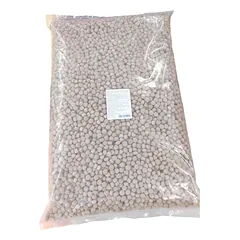
1,70 €/kg
17,02 € / 10 kg
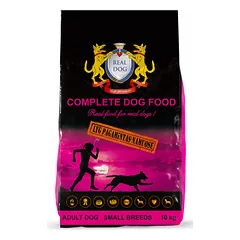
Real Dog
1,78 €/kg
17,79 € / 10 kg
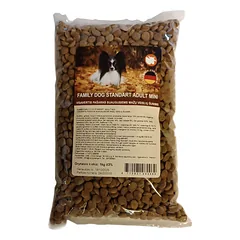
Family Dog
1,89 €/kg
1,89 € / 1 kg
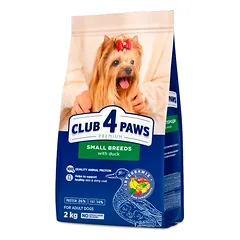
Club 4 Paws
1,93 €/kg
26,99 € / 14 kg
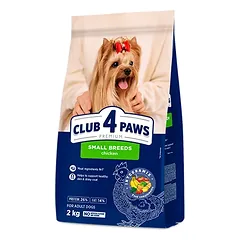
Club 4 Paws
1,93 €/kg
26,99 € / 14 kg
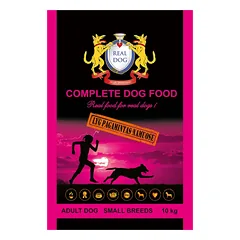
Real Dog
1,94 €/kg
19,42 € / 10 kg
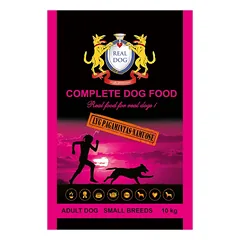
Real Dog
1,95 €/kg
19,49 € / 10 kg