


Real Dog
Real Dog sausas maistas suaugusiems, didelių-milžiniškų veislių, šunims su vištiena ir ryžiais 20kg
2,11 €/kg
42,15 € / 20 kg

Also known as: German Mastiff, Boarhound, Brindlequin, Grand danois
The Great Dane, despite the English name, is a purely German breed, developed to hunt large game including wild boar before becoming an estate guardian and a symbol of status among nobility. A male can weigh up to 90 kilograms and the breed is officially recognized as one of the tallest in the world, with some individuals taller than a person when standing on their hind legs. That size brings a shorter lifespan and a higher risk of heart disease and bloat, so feeding schedules need careful planning rather than free feeding. The short, smooth coat needs little grooming. Temperamentally it earns its nickname, the gentle giant, and tends to bond closely with its family. Life expectancy runs 8 to 10 years, among the shortest of any breed.
Browse dog food sized right for this breed
Great Dane: how old in human years?
Energy level
Trainability
Family friendly
Grooming need
Males 80–90 cm
Females 72–84 cm
Males 54–90 kg
Females 45–59 kg
Great Dane's average temperament and family-life score for this breed is high.
Great Dane's energy and exercise needs are low.
Great Dane's guarding and alertness traits are moderate.
Great Dane's grooming needs are low.
A Great Dane will never sit next to you on the sofa; it will sit on you, still convinced it fits on your lap the way it did as a puppy. Indoors this giant is surprisingly calm: after a walk and a good game it stretches out across half the room and stays there for a large part of the day. It has energy, but not a frantic kind, so long, easy walks are enough each day, and long runs beside a bicycle can wait until the bones have finished growing.
Danes learn willingly and thoughtfully, but training needs to start early, while the dog still weighs less than you do. Good lead manners and a firm no to jumping up are essential: what looks sweet in a ten-kilo puppy can knock a guest flat when it comes from a grown Dane. It will always let you know someone is at the door, yet it doesn't bark for the sake of it, and it greets visitors with reserve rather than hostility.
The real question is space. A Dane doesn't suit a small flat, and not because it is nervous: it simply needs room to turn around without its tail sweeping the mugs off the coffee table, plus a very large bed. With children in the family it is a gentle, patient friend, just remember it can bowl a toddler over by accident simply by turning round. And make peace with drool: a towel by the door becomes as essential as the lead.
A Great Dane's coat is short, sleek and glossy, so a weekly once-over with a rubber brush or grooming mitt is enough, even if there is quite a lot of dog to cover. Bathing a dog this size is a logistics exercise, so save it for when it has genuinely found something to roll in. Check the skin wherever it meets the floor: a Dane that lies on hard surfaces can wear thick, hairless calluses on its elbows and other bony points, which makes a big, soft bed a necessity rather than a luxury. Wipe the drool from the lips so the folds there don't stay permanently damp.
The eyes should be clear and free of redness, and the corners can be wiped with a soft damp cloth. Hanging ears cover the ear canal, so once a week lift each ear and look inside: the skin should be pale, with no discharge or smell, and if it isn't, let a vet take a look. Since a Dane's head sits at roughly the height of your kitchen table, at least this check is easy on your back.
Time runs faster with a Great Dane than you would like: a dog this size lives eight to ten years, and its body carries an enormous load every day. The weak spots, stomach, heart, spine and joints, are the price of all that size, but if you know what to watch for you can catch a lot early and, with your vet, make sure those years are good ones.
This is general information, not veterinary advice. For your own dog's health, tests and treatment, see a vet.
The stomach suddenly fills with gas and can then twist, sealing off both its exit and its own blood supply; it is one of the true emergencies in dogs. The dog can't settle, retches without bringing anything up, drools heavily, and the belly swells tight as a drum. A Great Dane's deep, narrow chest is precisely the build this threatens, so if you see these signs, go to a vet immediately rather than waiting to see if it passes.
The hip joint forms loosely, the ball moves around in its socket, and the joint wears down over time. Look for a dog that struggles to get up off the floor, sways at the hips as it walks, or thinks twice before jumping into the car. Great Danes grow astonishingly fast, so sparing a puppy's joints from too much jumping and pounding makes sense, and a vet is the one to assess the hips.
Wobbler syndrome is a change in the neck vertebrae or discs that squeezes the spinal cord. It shows first in the walk: the back legs move clumsily and the dog sways as if slightly tipsy, especially when turning or on a slippery floor, and some carry the head low and are reluctant to lift it. It is a known condition in giant dogs like the Great Dane, and only a vet can confirm it after examining your dog.
A slowly progressing disease of the spinal cord that appears in older dogs and isn't painful. It starts with weakening back legs: the dog scuffs its back toenails along the ground, drifts to one side or stumbles on turns. In an ageing Dane those changes are easy to put down to the years or the hips, so let a vet work out what is really going on.
Happy tail is a wound at the tip of the tail that a dog gives itself through sheer joy, whacking it against walls, door frames and furniture. You will know it by the spatter of blood along the hallway walls and a split tail tip that never gets the chance to heal, because the wagging never stops. A Great Dane's long, thin, powerful tail becomes a whip in a narrow hallway, so it pays to notice the tight spots at home, and to have a vet look at the wound.
In dilated cardiomyopathy the heart muscle stretches and thins, and the heart can no longer pump strongly. It can develop quietly for a long time, then show as tiring early on walks, coughing, fast breathing at rest or even sudden fainting. It is a known heart problem in Great Danes, and because the start is silent, regular heart checks are worth discussing with your vet.
This list is chosen by the breed's weight (90 kg) rather than the breed itself: shops label food by dog size, so every breed of the same size gets the same list. Prices are updated daily.
≈ 650 g of dry food a day, from €35,85 a month For a neutered, normally active 62 kg dog. Calculate for your dog
Real Dog
2,11 €/kg
42,15 € / 20 kg

Sam's Field
2,56 €/kg
33,26 € / 13 kg
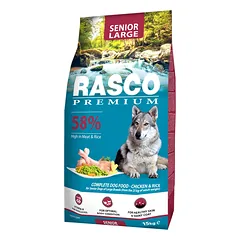
Rasco
2,67 €/kg
39,99 € / 15 kg
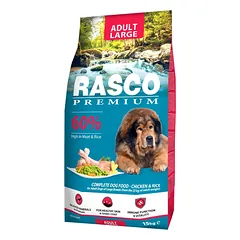
Rasco
2,67 €/kg
39,99 € / 15 kg
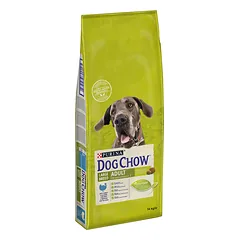
Purina
2,71 €/kg
37,96 € / 14 kg

Sam's Field
2,77 €/kg
35,99 € / 13 kg
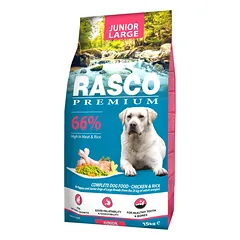
Rasco
2,80 €/kg
41,99 € / 15 kg

Sam's Field
2,85 €/kg
37,04 € / 13 kg