

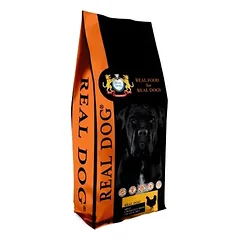
Real Dog
Real Dog sausas maistas suaugusiems, didelių-milžiniškų veislių, šunims su vištiena ir ryžiais 20kg
2,11 €/kg
42,15 € / 20 kg

Also known as: Dogo, Argentine Dogo, Argentine Mastiff, Antonio Nores Martínez, Argentinian Fighting Dog
The Dogo Argentino was developed in Argentina in 1928 by Dr. Antonio Nores Martinez, aiming for a strong, courageous hunting dog capable of taking on boar and puma alongside a pack of hunters. He started from the old Cordoba fighting dog and crossed in Bull Terrier, Great Dane, Boxer and other powerful breeds until the line settled into a solid white, smooth coat that became the breed's signature. A male can weigh up to 45 kilograms, densely muscled and built to work as part of a pack rather than alone. The all-white coat carries a higher risk of deafness than most breeds, so responsible breeders run hearing tests on puppies. Many countries restrict ownership under dangerous-breed rules. Life expectancy runs 9 to 15 years.
Browse dog food sized right for this breed
Dogo Argentino: how old in human years?
Energy level
Trainability
Family friendly
Grooming need
Males 60–68 cm
Females 60–65 cm
Males 40–45 kg
Females 35–40 kg
Dogo Argentino's average temperament and family-life score for this breed is moderate.
Dogo Argentino's energy and exercise needs are high.
Dogo Argentino's guarding and alertness traits are high.
Dogo Argentino's grooming needs are low.
When a white dog well over sixty centimetres at the shoulder stands at the garden gate, passers-by slow down. The Dogo Argentino was developed in Argentina to hunt big game, and its courage, strength and stamina haven't gone anywhere. It needs a lot of exercise every day: long walks, running, tug games or weight-pulling, not a single short loop of the block. A flat is too small for it; it is happiest in a house with a securely fenced garden.
Training starts on day one and stays calm, consistent and never harsh. The Dogo is clever and devoted to its people, but it has opinions of its own, and a strong prey drive means a cat or a hare can instantly outrank any command. It finds other dogs hard going, especially those of the same sex, so early socialisation and a sturdy lead are a necessity, not an option.
With its family it is gentle and likes to be close, but its strength and guarding nature mean it needs supervising around small children, and visitors should be introduced calmly. It is reserved with strangers and takes its territory seriously. Some countries restrict ownership of the breed; that reflects its power rather than its temperament in good hands. For an experienced, calm owner with time and patience, a Dogo Argentino repays the effort with loyalty that never takes a day off.
The Dogo Argentino's short, dense, smooth coat takes a few minutes a week: a rubber brush or grooming mitt once a week is all it needs. It sheds moderately, but white hairs on dark trousers will still remind you who lives with you. Bath only when the dog is properly dirty; a white coat shows every speck of mud, but dried mud just falls off.
Give the skin more of your attention. Under the white coat it is pale, so redness, scratches or rashes on the belly, nose and ear edges are easy to spot, and on a blazing summer day your dog needs shade rather than sunbathing. Look into the ears once a week: they should be clean and free of smell. Check the eyes after a walk through undergrowth; redness, watering or a squinting eye are reasons to see a vet.
The Dogo Argentino was bred to hunt boar and puma, so this is a powerful, sturdily built dog, with a lifespan of roughly nine to fifteen years. Its white coat, big frame and deep chest shape the health issues worth knowing about, from hearing to the stomach. Ask the breeder about the parents' health testing before you take a puppy home, and let a vet judge anything that worries you.
This is general information, not veterinary advice. For your own dog's health, tests and treatment, see a vet.
The hip joint develops imperfectly, the ball sits looser in its socket than it should, and the joint wears over time. You may notice your dog getting up stiffly after a long walk, hesitating to jump into the car, or running with both hind legs together in a bunny hop. On a heavy, muscular Dogo Argentino every joint carries a lot of work, so a change in gait is worth showing to a vet.
Plaque and tartar build up on the teeth, the gums become inflamed and slowly pull away from them. The first signs tend to be bad breath, reddened gums or a brown rim of tartar along the gumline. A Dogo's jaws are big and strong, but they stay healthy only if you look inside regularly, not just when your dog starts chewing on one side.
The stomach fills with gas, swells and can twist on itself, pinching off its blood supply. The dog becomes restless, tries to vomit but brings nothing up, drools heavily, and its belly looks swollen and tight. The large, deep-chested Dogo Argentino is one of the dogs at risk, and this is an emergency: if you see these signs, get to a vet immediately.
A dog can be born deaf in one ear or both; in white-coated dogs this is linked to missing pigment in the inner ear. A deaf puppy may sleep through you calling it, ignore the rattle of the food bowl, or simply seem unusually stubborn. Before taking a Dogo Argentino puppy home, ask the breeder about hearing tests for the parents and the puppy; a dog deaf in one ear can seem almost normal in everyday life.
The muscles of the larynx weaken and the vocal folds no longer open as wide as they should, so breathing gets harder. You may hear noisy, rasping breathing, especially on a hot day or after exercise, a changed bark, or coughing while drinking. In an active Dogo it tends to show in summer; if your dog is struggling for breath, its gums turn blue or it collapses, it needs a vet immediately.
The thyroid gland makes too little hormone, and the whole body seems to slow down. The dog may become sluggish, put on weight without eating more, seek out warm spots, and its short white coat may thin or turn dry. In a Dogo Argentino such a change is easy to put down to age or laziness, so if an energetic dog suddenly can't be bothered to go out, talk to a vet.
This list is chosen by the breed's weight (45 kg) rather than the breed itself: shops label food by dog size, so every breed of the same size gets the same list. Prices are updated daily.
≈ 470 g of dry food a day, from €25,71 a month For a neutered, normally active 40 kg dog. Calculate for your dog
Real Dog
2,11 €/kg
42,15 € / 20 kg

Sam's Field
2,56 €/kg
33,26 € / 13 kg
Rasco
2,67 €/kg
39,99 € / 15 kg
Rasco
2,67 €/kg
39,99 € / 15 kg
Purina
2,71 €/kg
37,96 € / 14 kg
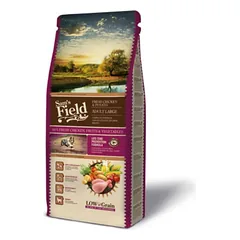
Sam's Field
2,77 €/kg
35,99 € / 13 kg
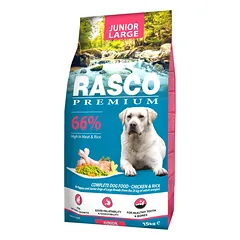
Rasco
2,80 €/kg
41,99 € / 15 kg
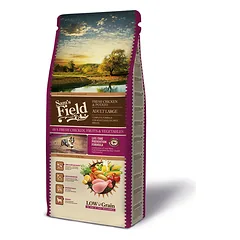
Sam's Field
2,85 €/kg
37,04 € / 13 kg