

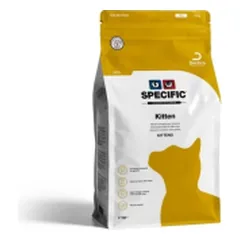
Specific
Specific FPD Kitten sausas maistas augantiems kačiukams, 400 kg
0,01 €/kg
5,59 € / 400 kg

Also known as: NFC, Wegie, Skaukatt, Skogkatt, Fairy cat
The Norwegian Forest Cat comes from the forests of Scandinavia, and its name in Norwegian simply means forest cat. The long double coat with a woolly undercoat protects against cold and damp, with a full ruff around the neck and a bushy tail. The body is large and sturdy, the head triangular with a straight profile, and the legs are long with strong claws, which makes the cat an excellent climber. Males typically weigh around 4.5 to 7.5 kilograms. In the twentieth century Norwegian breeders rebuilt and organised the breed. The temperament is friendly and calm, though the cat likes to move about and explore. Life expectancy is typically around 12 to 16 years.
Norwegian Forest Cat: how old in human years?
Energy level
Playfulness
Family friendly
Grooming need
Males 4.5–7.5 kg
Females 3.5–5.5 kg
Norwegian Forest Cat: average score for sociability and trainability is high.
Norwegian Forest Cat: average score for activity and living space is moderate.
Norwegian Forest Cat: average score for personality and communication is moderate.
Norwegian Forest Cat: grooming and shedding demands are high.
The 1–5 trait scores are editorial estimates, not measurements. Every cat is an individual, so treat them as a general guide.
This cat likes height. If your home has a wardrobe with a view of the whole room, it will soon be hers, so put up a tall, sturdy cat tree and a heavy scratching post that does not wobble under a big tom. She has energy to spare and a strong hunting streak: a feather wand or a cork that rolled into a corner sets off a proper hunt, though she does not ask to play all day.
She gets along well with family, children and calm dogs, and looks strangers over from a safe distance first. Attached but not clingy, she would rather lie beside you on the sofa than on your lap, and a working day on her own is no great hardship. She talks little, and quietly.
A flat suits her if there is somewhere to climb; better still is a safely netted balcony or garden where she can sniff the wind. Just remember that with a hunter's nature like hers, a cat left to roam will be no friend to the birds.
The Norwegian Forest Cat's coat was made for a northern winter: a dense woolly undercoat beneath long, glossy, water-resistant guard hairs. For much of the year a comb-through once or twice a week is enough, but in spring the cat drops its winter undercoat in whole tufts, and then the comb should live within reach every day.
The ruff, the armpits and the "breeches" on the back legs tangle first, so start there with a wide-toothed comb and work any knot loose with your fingers. Afterwards glance at the corners of the eyes and into the ears with their tufted tips: inside they should be clean, without smell or brown residue.
Under that much fur it is hard to see how a cat breathes or carries its hips, so with a Norwegian Forest Cat you watch habits rather than outlines: does it still reach the top shelf, does it still play the way it did? It can live twelve to sixteen years, and inherited heart, hip and metabolic conditions are known in the breed, so ask the breeder about the parents' health testing before you bring a kitten home.
This is general information, not veterinary advice. For your own cat's health, tests and treatment, see a vet.
The wall of the heart muscle thickens and the heart pumps blood less easily. Fast breathing at rest is easy to miss under a thick coat, so now and then watch your cat's flanks rise and fall while it sleeps, and show any change to a vet. If it suddenly breathes with its mouth open or loses the use of its back legs, it needs a vet immediately.
The hip joint forms imperfectly, so it wears over time and can hurt. A Norwegian Forest Cat is a keen climber, so the first hint may be that it stops jumping to the top of its cat tree or takes the stairs more slowly. Show that change to a vet rather than putting it down to age.
An inherited metabolic disease in which the body cannot properly use its stored energy, glycogen, so the muscles and nerves suffer. It shows itself in young cats: if a kitten that should be full of beans grows weak, trembles or tires quickly, show it to a vet. Ask the breeder about the parents' health testing before you take a kitten.
This list is the same on every cat breed page. Shops do not label cat food by breed, so it simply shows the cheapest cat food we track per kilogram. Check the label for your cat's age and health needs. Prices are updated daily.
≈ 76 g of dry food a day, from €4,37 a month For a neutered, normally active 5,3 kg cat. Calculate for your cat
Specific
0,01 €/kg
5,59 € / 400 kg
Brit Premium
0,33 €/kg
0,80 € / 2,4 kg
0,55 €/kg
1,05 € / 1,9 kg

0,55 €/kg
1,05 € / 1,9 kg

Tigerino
0,87 €/kg
20,89 € / 24 kg

Gourmet
0,94 €/kg
0,96 € / 1,0 kg
Fitmin for Life
1,00 €/kg
0,80 € / 0,8 kg
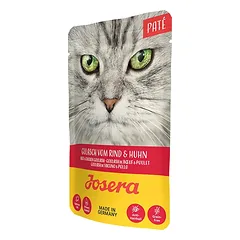
Josera
1,10 €/kg
1,49 € / 1,4 kg