


Specific
Specific FPD Kitten sausas maistas augantiems kačiukams, 400 kg
0,01 €/kg
5,59 € / 400 kg

Also known as: Siberian forest cat, Siberian house cat
The Siberian is an old Russian breed that lived for centuries in forests and villages, and it is often regarded as one of the country's symbols. Males typically weigh around 5 to 9 kilograms, with a large, rounded, muscular body, and the powerful hind legs make it a good jumper. The semi-long, dense coat with a thick undercoat gives protection from cold, so it needs more frequent brushing in spring and autumn when it is being shed. The breed is known for being friendly, playful and attached to its family. It reaches maturity more slowly than many breeds. Life expectancy is typically around 11 to 15 years.
Siberian: how old in human years?
Energy level
Playfulness
Family friendly
Grooming need
Males 5–9 kg
Females 3.5–6 kg
Siberian: average score for sociability and trainability is high.
Siberian: average score for activity and living space is high.
Siberian: average score for personality and communication is moderate.
Siberian: grooming and shedding demands are moderate.
The 1–5 trait scores are editorial estimates, not measurements. Every cat is an individual, so treat them as a general guide.
Put up a new shelf near the ceiling and a Siberian will test it that same evening. It is strong, agile and playful: it will chase a ball down the hallway, happily learn to fetch, and when it is tired it lies down close by, not necessarily in your lap, but where it can see you.
A sturdy cat tree and several scratching posts are essential, because it has plenty of energy and prefers to spend it up high. It can manage a working day alone if there is something to climb and something to hunt, but when you get home it will want attention and a game, not just its bowl.
In a family it behaves as if it had been born there: patient with children, friendly with dogs and other cats, and with strangers it watches first and comes over later. It doesn't say much, a quiet purr or a short chirp. If you want it to go outside, an enclosed balcony or garden is the safe choice, since outdoors it meets exactly the injuries described in the health section.
A Siberian's coat is long and double: a dense undercoat beneath glossy, water-resistant top hairs that once kept out snow and sleet. For all its length it tangles less than you would think, so for most of the year a comb-through once or twice a week is enough; in spring, when the winter undercoat comes out, there is so much hair that daily combing becomes a necessity.
Mats form first behind the ears, on the chest where the ruff grows, and in the long hair on the back legs, so work through those spots carefully while holding the skin. As you go, check the skin for redness or scabs, wipe the corners of the eyes if matter collects there, and look into the ears: their furry insides should be clean and odourless.
Russian winters shaped the Siberian: a heavy coat, solid bones and a calm self-assurance, and it lives eleven to fifteen years. Its list is an odd mix, a heart muscle disease, injuries, excess weight and dental disease, and two of those have more to do with everyday life than with genes. Ask the breeder about the parents' health testing before you take a kitten; the rest depends largely on your keeping an eye out.
This is general information, not veterinary advice. For your own cat's health, tests and treatment, see a vet.
A thickened heart wall makes it harder for the heart to fill with blood and push it out. A Siberian is lively and playful, so if its games get shorter and it breathes fast or hard at rest, show it to a vet. Back legs that suddenly go weak or stop working mean it needs a vet immediately.
A Siberian is a superb jumper with a taste for heights, and curiosity sometimes takes it somewhere harder to get down from than up to. Cats hide pain, so limping, licking one spot over and over or hiding is already a reason to see a vet. After a fall from a height or a road accident, or if the cat is bleeding or struggling to breathe, it needs a vet immediately.
When too much fat builds up, moving gets harder and the joints and organs carry an extra load. A Siberian's thick coat hides a thickening waist very well, so now and then run your palms along its sides: you should be able to feel the ribs. If you no longer can, ask a vet what weight is right for your cat.
Plaque and tartar inflame the gums, and inflamed gums hurt, a pain a cat can bear in silence for a long time. If your Siberian starts chewing on one side, drops food or has bad breath, take it to a vet. A look in the mouth belongs in every routine check-up.
This list is the same on every cat breed page. Shops do not label cat food by breed, so it simply shows the cheapest cat food we track per kilogram. Check the label for your cat's age and health needs. Prices are updated daily.
≈ 83 g of dry food a day, from €4,74 a month For a neutered, normally active 5,9 kg cat. Calculate for your cat
Specific
0,01 €/kg
5,59 € / 400 kg

Brit Premium
0,33 €/kg
0,80 € / 2,4 kg

0,55 €/kg
1,05 € / 1,9 kg

0,55 €/kg
1,05 € / 1,9 kg

Tigerino
0,87 €/kg
20,89 € / 24 kg

Gourmet
0,94 €/kg
0,96 € / 1,0 kg

Fitmin for Life
1,00 €/kg
0,80 € / 0,8 kg
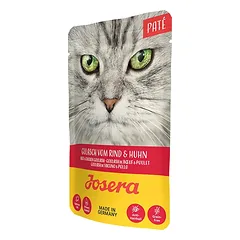
Josera
1,10 €/kg
1,49 € / 1,4 kg