

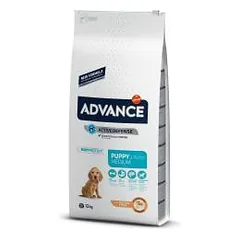
Advance
Advance Puppy Medium sausas maistas vidutinių veislių šuniukams, 12 kg
1,48 €/kg
17,76 € / 12 kg

Also known as: SCWT, Wheaton terrier
In Ireland this terrier served as a farmer's all-purpose worker: hunting vermin, herding livestock and guarding the farmstead, bred as a working class terrier at a time when only the gentry were permitted to keep hunting dogs. The soft, silky, wavy coat, which gives the breed its wheaten name for its golden color, feels more like wool than typical dog hair and needs regular trimming. A male can weigh up to 20.5 kilograms on a sturdy but elegant frame. Unlike most terriers, the Wheaten sheds very little, which is why it's often mentioned among the more allergy friendly breeds. Puppies are born a darker shade, and the coat only reaches its full wheaten color by around the second year. Its temperament tends to be friendly and energetic, less combative toward other dogs than many terriers. Life expectancy runs 12 to 14 years.
Browse dog food sized right for this breed
Soft Coated Wheaten Terrier: how old in human years?
Energy level
Trainability
Family friendly
Grooming need
Males 46–49 cm
Females 43–46 cm
Males 16–20.5 kg
Females 14–18 kg
Soft Coated Wheaten Terrier's average temperament and family-life score for this breed is high.
Soft Coated Wheaten Terrier's energy and exercise needs are moderate.
Soft Coated Wheaten Terrier's guarding and alertness traits are low.
Soft Coated Wheaten Terrier's grooming needs are low.
The door hasn't even closed and it is already bouncing up like a spring, trying to reach your face to tell you how terribly it missed you, though you were gone ten minutes. This greeting is the Soft Coated Wheaten Terrier's calling card, and it is worth teaching a puppy early to say hello sitting down, or your guests will go home with paw prints on their trousers. Bred in Ireland as a farm all-rounder, the Wheaten still likes having something to do.
It is lively and clever and learns fast, especially when training feels like a game, but it has its share of terrier stubbornness too. It needs at least a couple of active walks and some play every day, and a squirrel or a cat dashing past can quickly win out over every lesson, so keep it on the lead near traffic.
It can live in a flat if it gets enough exercise and attention. With children it is a cheerful and patient playmate, it is friendly with other dogs and strangers alike, and it will bark to announce visitors, though you couldn't call it a guard. What it wants above all is to be with its people: on the sofa, at the table or out in the garden, where anything is more fun with a Wheaten involved.
The Wheaten's coat is soft, silky and wavy, the colour of ripe wheat, and hardly any of it ends up on your floor. That is not a gift without strings: hair that doesn't fall out stays on the dog and tangles. A few times a week, and ideally every day, go through it with a brush and a metal comb right down to the skin, especially behind the ears, in the armpits, on the chest and down the legs, where mats form fastest. Check the skin as you go and feel along the sides: under that fluffy coat it is easy to miss both redness and weight loss. Every couple of months a groomer can shorten and shape the coat.
The beard collects food and water after every meal and drink, so wipe it with a damp cloth, and keep the fringe short enough that it doesn't poke into the eyes; wipe the corners of the eyes with a soft cloth when needed. Hair grows inside the ears, so look into them once a week: they should be clean, pale and free of smell, and if your dog shakes its head or scratches, let the vet take a look.
A medium-sized, sturdy dog with a life expectancy of around twelve to fourteen years, the Wheaten carries a health list made up mainly of internal conditions you cannot see from the outside. That makes regular vet check-ups worth more than any guesswork at home, and your vet will decide whether any tests are needed. If you are choosing a puppy, ask the breeder about the parents' health testing.
This is general information, not veterinary advice. For your own dog's health, tests and treatment, see a vet.
In Addison's disease the adrenal glands make too little of some vital hormones, and the body struggles to cope with stress or illness. The signs come and go in a vague, wave-like way: listlessness, a poor appetite, vomiting or diarrhoea that clears up and then returns. Such ups and downs are out of character for a cheerful, lively Wheaten, so talk them over with your vet, and if your dog suddenly weakens or collapses, it needs a vet immediately.
In renal dysplasia a puppy's kidneys develop abnormally and, over time, get worse at cleaning the blood. You might notice a dog that drinks a lot and pees a lot, grows poorly or loses weight, and plays less eagerly. If your young Wheaten keeps emptying the water bowl, that is not something to just keep an eye on; it is a reason to see your vet.
In protein-losing enteropathy a damaged gut wall lets too much protein through, and it is lost in the stool instead of staying in the blood. You might notice diarrhoea that drags on, vomiting, weight loss and later a swollen belly or legs. A Wheaten's fluffy coat hides weight loss very well, so feel for the ribs as you brush, and talk to your vet about any change in the stool.
Here protein escapes through the kidneys and is washed out in the urine. For a long time the dog can seem perfectly healthy, and only later come thirst, weight loss, listlessness or swelling. Because it stays hidden for so long, ask your vet which check-ups make sense for your Wheaten.
Hypothyroidism means the thyroid gland makes too little hormone, and the whole body shifts into a slower gear. The dog puts on weight without eating more, tires sooner, seeks out warmth, and the coat may thin or lose its silky sheen. In a Wheaten that normally races to greet everyone, that kind of drowsiness stands out, and the diagnosis is a job for your vet.
This list is chosen by the breed's weight (21 kg) rather than the breed itself: shops label food by dog size, so every breed of the same size gets the same list. Prices are updated daily.
≈ 250 g of dry food a day, from €13,60 a month For a neutered, normally active 17,1 kg dog. Calculate for your dog
Advance
1,48 €/kg
17,76 € / 12 kg
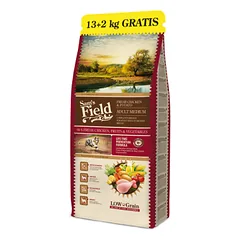
Sam's Field
1,80 €/kg
26,99 € / 15 kg

Country Dog
1,89 €/kg
28,29 € / 15 kg
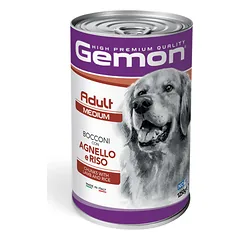
Gemon
1,94 €/kg
2,42 € / 1,3 kg
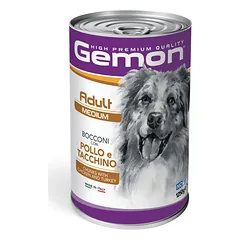
Gemon
1,94 €/kg
2,42 € / 1,3 kg
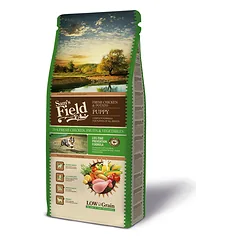
Sam's Field
2,11 €/kg
27,45 € / 13 kg

2,14 €/kg
30,00 € / 14 kg

Club 4 Paws
2,15 €/kg
42,99 € / 20 kg