

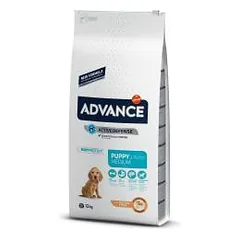
Advance
Advance Puppy Medium sausas maistas vidutinių veislių šuniukams, 12 kg
1,48 €/kg
17,76 € / 12 kg

Among Hungary's herding breeds the Puli specialized not in guarding but in moving the flock, a quick, agile dog reportedly known to run across the backs of sheep to get where it needed to go faster. The corded coat resembles the Komondor's but is darker and finer, forming naturally as the outer and undercoat mat together. The frame is compact, under 15 kilograms, and built for fast direction changes. It's a genuinely high-energy breed that needs constant mental and physical work, or it turns to digging and nonstop barking instead. The cords need regular hand-separating to keep them from fusing into one mass. It bonds closely with its family, often to the point of following a person room to room. Life expectancy runs 12 to 16 years.
Browse dog food sized right for this breed
Energy level
Trainability
Family friendly
Grooming need
Males 39–45 cm
Females 36–42 cm
Males 13–15 kg
Females 10–13 kg
Puli's average temperament and family-life score for this breed is moderate.
Puli's energy and exercise needs are moderate.
Puli's guarding and alertness traits are high.
Puli's grooming needs are low.
On the Hungarian plains the Puli herded sheep, sometimes leaping across their backs when there was no other way through. Today that same springy agility means the back of the sofa, a chair or a baby gate is just a step to it. This is an energetic, tireless, quick dog that needs not only long walks but jobs too: obedience, tricks, agility or search games.
It is clever and learns fast, but has opinions of its own, so short, cheerful, consistent sessions work best. With its family a Puli is devoted and wants to be wherever something interesting is happening, while it greets strangers with reserve. Its guarding instinct is strong and its voice loud, so teach it to manage the barking from puppyhood, especially if you live in a flat with neighbours on the other side of the wall.
It gets on with children who know that cords are not ropes to pull. A good Puli day is a morning walk, a job for the brain, an afternoon on watch at the window and, in the evening, at last, a warm heap of cords where it is still hard to tell which end is the head.
A Puli's coat isn't a hairstyle, it's an ongoing project. Puppies are born fluffy, and over roughly the first year the soft undercoat and outer hair begin to felt naturally into cords, which you separate by hand so they don't fuse into one big rug. It must not be brushed out, since a brush would undo the cords, and you will find almost no hair on the floor. Bath day is a whole day: the cords soak up a lot of water and take ages to dry, and they need drying thoroughly or they start to smell.
Every week, run your fingers between the cords right down to the skin: burrs, ticks and damp easily get trapped there, and red skin can hide underneath. It helps to trim the hair around the eyes and the ear openings so the dog can see and the ears get air; wipe the corners of the eyes with a damp cloth and look into the ears once a week. Trim the hair between the pads too, so mud and snow don't build up in it.
The Puli is one of those dogs that keeps its spring for a long time: it can live twelve to sixteen years, and an older Puli can be hard to tell from a youngster. A few conditions of the joints, eyes and spinal cord are linked to the breed, some of them showing only later in life. Under the cords changes are harder to see, so watch how your dog moves and sees, and if you are getting a puppy, ask the breeder about the parents' health testing.
This is general information, not veterinary advice. For your own dog's health, tests and treatment, see a vet.
The hip joint develops out of shape, and over time it wears and becomes painful. A Puli's gait is all but hidden under its long cords, so look for other signs: getting up more slowly, reluctance to jump, or walks it wants to cut short. This nimble, bouncy dog hides pain well, so changes are worth showing to a vet.
The kneecap slips out of place and for a moment the leg stops obeying. You may notice your Puli suddenly lifting a hind leg mid-run, hopping on three legs for a few strides, then running on as if nothing had happened. A skip like that which keeps coming back is a reason to see a vet.
This is an inherited disease in which the retina slowly wastes away, and the dog's sight fades, first in dim light. A Puli's eyes are hidden under cords, so behaviour gives it away rather than looks: reluctance to go out into the dark, bumping into things in the evening, or seeming lost in a new place. Discuss signs like these with a vet.
This is a slowly progressing disease of the spinal cord that shows up in older dogs and gradually weakens the hind legs. At first a dog may wobble, drag its paws so the nails wear down, or struggle with balance, without seeming to be in pain. If an older Puli's hind legs start to stop doing what they are told, have it seen by a vet.
This list is chosen by the breed's weight (15 kg) rather than the breed itself: shops label food by dog size, so every breed of the same size gets the same list. Prices are updated daily.
≈ 200 g of dry food a day, from €10,94 a month For a neutered, normally active 12,8 kg dog. Calculate for your dog
Advance
1,48 €/kg
17,76 € / 12 kg
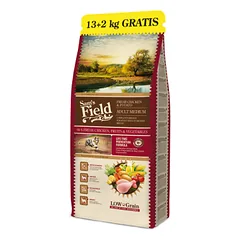
Sam's Field
1,80 €/kg
26,99 € / 15 kg

Country Dog
1,89 €/kg
28,29 € / 15 kg
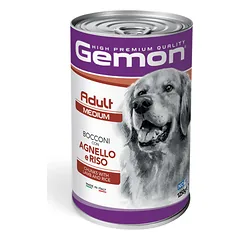
Gemon
1,94 €/kg
2,42 € / 1,3 kg
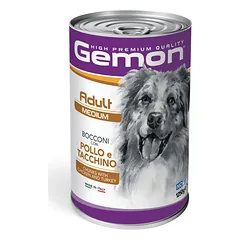
Gemon
1,94 €/kg
2,42 € / 1,3 kg
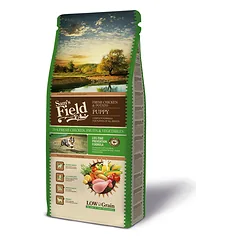
Sam's Field
2,11 €/kg
27,45 € / 13 kg

2,14 €/kg
30,00 € / 14 kg

Club 4 Paws
2,15 €/kg
42,99 € / 20 kg