

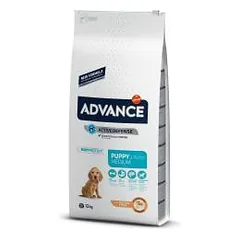
Advance
Advance Puppy Medium sausas maistas vidutinių veislių šuniukams, 12 kg
1,48 €/kg
17,76 € / 12 kg

The Mudi is a Hungarian herding breed that emerged naturally in the early 20th century from a mix of Puli and other local sheepdogs, and it was only formally recognized in 1936. The wavy to curly medium-length coat differs from the denser, corded coat of its closer relatives. Weighing only around 13 kilograms, the Mudi is remarkably versatile as a working dog, herding livestock, guarding the farm and even serving in search and rescue. It needs consistent mental work, without which it can become noisy or destructive. Despite its modest size, this is not a decorative lapdog, it needs a real task. Life expectancy runs 12 to 14 years.
Browse dog food sized right for this breed
Energy level
Trainability
Family friendly
Grooming need
Males 41–47 cm
Females 38–44 cm
Males 8–13 kg
Females 8–13 kg
Mudi's average temperament and family-life score for this breed is moderate.
Mudi's energy and exercise needs are high.
Mudi's guarding and alertness traits are high.
Mudi's grooming needs are low.
A Hungarian shepherd didn't keep a dog that waits for instructions: a Mudi sees for itself where a sheep has strayed and brings it back. At home the same dog watches your shoes by the door and knows a walk is coming before you have thought of it yourself. It has plenty of energy and even more brain.
A gentle stroll round the block won't do. Every day it needs both running and jobs for its head: obedience, agility, scent games. It learns at lightning speed, often faster than you can invent new exercises, and a Mudi without work will find some, not necessarily the kind you'd choose. It barks readily and announces every visitor loudly, which can make a flat with thin walls hard going.
With its own family a Mudi is devoted and attentive, and it gets on well with children who respect its space. It doesn't throw itself at strangers; it watches first, sometimes for quite a while. A good Mudi day is a morning run, an afternoon training session and an evening at your feet, with one eye still open.
The Mudi's wavy, curly coat looks as though someone set it in rollers, yet it needs very little from you. A weekly brush is enough, paying attention behind the ears and on the back legs where hair likes to tangle; shedding is light. Mud and burrs from the field mostly dry and drop out on their own, so frequent baths aren't needed. While you brush, check the skin for redness, flakes or ticks that have dug in.
Look inside the pricked ears once a week: they should be clean and odour-free, and after walks through meadows check that no grass seeds have caught there. Wipe the corners of the eyes with a damp cloth, and show a red, cloudy or watering eye to the vet.
The Mudi was bred to work flocks on the Hungarian plains, so it is generally a sturdy, light and tireless dog that can be with you for twelve to fourteen years. A few joint, nervous-system and eye conditions are linked to the breed, and they are worth knowing about in advance. If something worries you, show your dog to a vet, who will decide what to do.
This is general information, not veterinary advice. For your own dog's health, tests and treatment, see a vet.
This is a fault in how the hip or elbow joints develop: the parts don't fit together properly, so the joint wears over time. You might notice your Mudi limping after a busy day, getting up stiffly or avoiding jumps. For a dog whose job is running circles round a flock, sound joints are everything, so if you are getting a puppy, ask the breeder about the parents' health testing.
The kneecap sometimes slips out of its groove and the leg briefly locks. Mid-run, a Mudi may lift a hind leg for a few strides, then carry on as if nothing happened. If you notice that skip, describe it to your vet.
Epilepsy means repeated seizures caused by a disturbance in the brain's activity. A dog may suddenly fall, paddle its legs, drool and not respond to your voice. A seizure is an emergency: your dog needs a vet immediately.
A cataract is a clouding of the lens of the eye that makes sight gradually worse. You may see a greyish or bluish tinge in the pupil, or notice your dog bumping into things at dusk or losing track of a thrown toy. A Mudi lives through its eyes and its movement, so show any change in the eyes to a vet promptly.
This list is chosen by the breed's weight (13 kg) rather than the breed itself: shops label food by dog size, so every breed of the same size gets the same list. Prices are updated daily.
≈ 170 g of dry food a day, from €9,43 a month For a neutered, normally active 10,5 kg dog. Calculate for your dog
Advance
1,48 €/kg
17,76 € / 12 kg
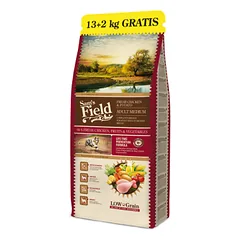
Sam's Field
1,80 €/kg
26,99 € / 15 kg

Country Dog
1,89 €/kg
28,29 € / 15 kg
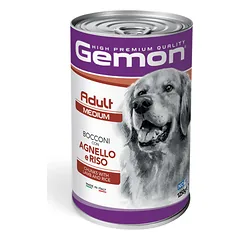
Gemon
1,94 €/kg
2,42 € / 1,3 kg
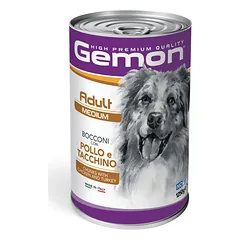
Gemon
1,94 €/kg
2,42 € / 1,3 kg
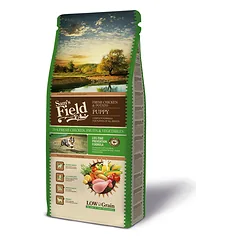
Sam's Field
2,11 €/kg
27,45 € / 13 kg

2,14 €/kg
30,00 € / 14 kg
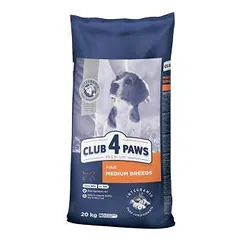
Club 4 Paws
2,15 €/kg
42,99 € / 20 kg