

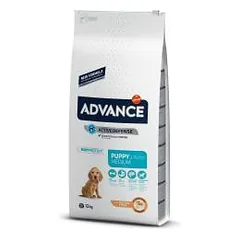
Advance
Advance Puppy Medium sausas maistas vidutinių veislių šuniukams, 12 kg
1,48 €/kg
17,76 € / 12 kg

Also known as: Brilliant Border Collies
Border Collies take their name from the England-Scotland border country where shepherds bred them purely for one skill: moving sheep exactly where told, using a low, silent stare called "the eye" rather than barking or nipping. That single-minded focus is why the breed dominates sheepdog trials worldwide and why it makes an exhausting pet for anyone without livestock or an equivalent job to offer. An adult rarely exceeds 20 kilograms, light enough to cover rough hillside terrain all day without tiring. The coat comes in a moderate double layer that sheds year-round with a heavier blowout twice a year, so a slick brush earns its keep. Many owners underestimate how much mental work substitutes for physical exercise; a Collie given puzzle toys and scent games can settle faster than one just run in circles. Herding instinct doesn't stay confined to sheep. It shows up as nipping at joggers, cyclists, or children's ankles if never given a legitimate outlet. Life expectancy runs 12 to 15 years, long for a dog this athletic. Working-line and show-line Collies can differ sharply in both build and drive, worth knowing before choosing a breeder.
Browse dog food sized right for this breed
Border Collie: how old in human years?
Energy level
Trainability
Family friendly
Grooming need
Males 48–56 cm
Females 46–53 cm
Males 14–20 kg
Females 12–19 kg
Border Collie's average temperament and family-life score for this breed is high.
Border Collie's energy and exercise needs are moderate.
Border Collie's guarding and alertness traits are moderate.
Border Collie's grooming needs are low.
You sit down at the computer, and a minute later there's a head on your knee and a pair of eyes asking, quite clearly, 'What next?' The Border Collie was bred in the hills along the English–Scottish border to work sheep all day, and it needs to think as well as run. Without a job it will invent one: herding the children, chasing bicycles or investigating how the kitchen cupboard opens.
It is one of the most trainable dogs you'll ever meet: it picks up a cue from half a word and happily learns commands, tricks, obedience or agility. The flip side is that it learns just as fast the things you never meant to teach. A typical day means a long active walk, a game or training session, something for the brain and another outing in the evening; without that schedule, a flat is far too small for it.
With its family it is devoted and gentle and gets on with children and other dogs, although the herding instinct sometimes tells it to round up running kids into a tidy group. With strangers it is reserved rather than hostile and will announce every arrival, which makes it a good watchdog, if not a guard.
Border Collies come in two coats, a moderate length and a short smooth one, but both are double, with an undercoat that sheds all year round and more heavily in spring and autumn. Brush a moderate coat a couple of times a week, paying attention behind the ears, on the trousers and on the tail, where hair loves to tangle; a smooth coat needs only a quick going-over. After a run through fields or woods, sweep a hand over the whole coat, because burrs, ticks and scratches on the skin all hide easily in thick hair.
Check eyes and ears weekly, ideally after a long run: grass seeds and dust like to lodge right there, and a watering eye or a head that keeps shaking is your cue to visit the vet. Nails wear down on tarmac, but a dog that does its running mostly on grass can grow them too long, so when you hear them clicking on the floor, it's time to trim. Don't forget the dewclaw on the inside of the leg, which never touches the ground and so never wears down.
With a Border Collie, health questions start before the puppy even comes home: several of the breed's inherited conditions can be identified with DNA tests, so it's worth asking the breeder which tests the parents have had. The dog itself is tough, tireless and lives twelve to fifteen years. And if you notice anything unusual, a vet is the one to decide what it is.
This is general information, not veterinary advice. For your own dog's health, tests and treatment, see a vet.
The hip joint forms imperfectly, the ball of the thigh bone sits loosely in its socket, and the joint wears over time. You might notice stiffness after hard work or play, a reluctance to jump, or sitting slightly skewed with one leg kicked out to the side. A Border Collie can hide discomfort behind sheer enthusiasm and keep chasing the frisbee anyway, so show any change in gait to a vet sooner rather than later.
Epilepsy means repeated seizures, a kind of electrical storm in the brain. A dog may suddenly fall onto its side, paddle or jerk its legs, drool and not respond to you, and afterwards be dazed and confused for a while. If your Border Collie has a seizure, see a vet; if a seizure goes on for long or one follows another, it needs a vet immediately.
This is an inherited fault in how the back of the eye develops, and its severity varies enormously: some dogs' sight is barely touched, while others' can be badly reduced. Mild changes are visible only to a vet examining the back of the eye, but more serious ones you may notice yourself, in a dog that moves more cautiously or bumps into things. The Border Collie belongs to the collie family the condition is named after, so it's worth asking about the parents' DNA tests.
This is an inherited gene change that makes the body worse at clearing certain substances out of the brain, so some medicines can affect such a dog far more strongly than others. You won't see it in daily life, as the dog looks perfectly healthy; the first sign may be an unexpected reaction to a medicine, such as wobbliness or unusual sleepiness. The Border Collie is one of the herding breeds in which this gene is known, so a DNA test is worth doing in advance, and the result worth telling every vet who sees your dog.
TNS is an inherited immune disorder: neutrophils, the white blood cells that fight infection, are made in the bone marrow but can't get out into the blood. It shows up in puppyhood, when the pup grows more slowly than its littermates and catches one infection after another, each slow to clear. The condition is linked to the Border Collie and a DNA test can identify it, so ask the breeder about the parents' results before you take a puppy home, and have a vet see any pup that keeps falling ill.
In this inherited disease, substances the body can't break down build up inside nerve cells, and the brain gradually works less well. The first signs appear in a young dog and can look like a change of personality: restlessness, fearfulness or forgetting things it knew well, followed later by trouble with coordination and sight. There is a DNA test for it in Border Collies, and any unusual change in a young dog's behaviour is for a vet to assess.
This list is chosen by the breed's weight (20 kg) rather than the breed itself: shops label food by dog size, so every breed of the same size gets the same list. Prices are updated daily.
≈ 240 g of dry food a day, from €13,12 a month For a neutered, normally active 16,3 kg dog. Calculate for your dog
Advance
1,48 €/kg
17,76 € / 12 kg
Sam's Field
1,80 €/kg
26,99 € / 15 kg

Country Dog
1,89 €/kg
28,29 € / 15 kg
Gemon
1,94 €/kg
2,42 € / 1,3 kg
Gemon
1,94 €/kg
2,42 € / 1,3 kg
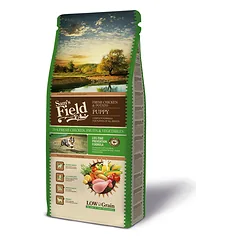
Sam's Field
2,11 €/kg
27,45 € / 13 kg

2,14 €/kg
30,00 € / 14 kg

Club 4 Paws
2,15 €/kg
42,99 € / 20 kg