

Josera
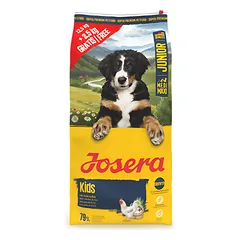
Josera Kids 12,5kg + 2,5kg = 15 kg
1,38 €/kg
37,89 € / 27,5 kg

Also known as: Aussie
Despite the name, the Australian Shepherd actually took shape in the United States during the 19th and 20th centuries, among herding dogs brought over by Basque shepherds who had passed through Australia on their way to California ranches. A male can weigh up to 32 kilograms on a muscular, athletic frame, and the medium-length wavy or straight double coat often shows the merle pattern, tied to a gene that can cause health problems in its double copy, which is why breeding needs care. Ranches still use the breed to work cattle and sheep, and it's now a fixture in agility and other dog sports thanks to its quickness and sharp reflexes. Without enough physical and mental work, it tends to turn destructive or start herding cars and cyclists as a substitute outlet. It's playful with children but needs training started early. Life expectancy runs 12 to 15 years.
Browse dog food sized right for this breed
Australian Shepherd: how old in human years?
Energy level
Trainability
Family friendly
Grooming need
Males 51–58 cm
Females 46–53 cm
Males 25–32 kg
Females 16–25 kg
Australian Shepherd's average temperament and family-life score for this breed is high.
Australian Shepherd's energy and exercise needs are moderate.
Australian Shepherd's guarding and alertness traits are moderate.
Australian Shepherd's grooming needs are moderate.
An Australian Shepherd fixes its eyes on you and waits. Not for food, not for a cuddle, but for a job, and if none is offered it will assign itself one. Despite the name, the breed was developed in the United States to herd livestock, and that working mind is fully intact: this is one of the brightest and most trainable dogs you will ever meet, and it asks a great deal in return. Obedience, tricks, agility, scent games: anything that engages both legs and brain suits it.
With its own family it is devoted and affectionate, and patient with children, though it may try to herd them, circling and nudging the flock with its nose. It meets strangers with reserve until introductions are made, and reports on everything that happens beyond the fence. It gets along with other dogs well enough, especially when socialised from an early age.
A typical day starts with a long, active morning (a run, games or a training session), then a brain task around midday and another proper outing in the evening. A flat and a stroll around the block are not nearly enough; a bored Aussie quickly finds itself work, and you may not like its choices. But if you enjoy moving and learning together, you will struggle to find a better partner.
An Aussie's medium-length coat, straight or wavy over a dense undercoat, looks easy until the moult begins, at which point there is enough undercoat to build a second dog. Brush right down to the skin once or twice a week, paying special attention behind the ears, on the breeches and under the tail, where hair likes to tangle, and daily while the dog is shedding. Check the skin as you go, and after a run in the woods look for burrs and ticks hiding in the coat.
Look at the ears and eyes weekly: ears clean and odour-free inside, eyes clear with no cloudiness or constant weeping, the corners wiped with a soft damp cloth when needed. Trim the nails once you hear them clicking on the floor; even a dog that runs a lot doesn't always wear them down enough. And brush the teeth with a dog toothbrush and toothpaste, ideally every day, until it is as much of a ritual as the evening walk.
The Australian Shepherd is a sturdy dog built for work, with a lifespan of around twelve to fifteen years. Its long health list is mostly about eyes and genes, which is good news in disguise: many of these things can be checked before you ever bring a puppy home, by asking the breeder about the parents' eye, joint and DNA results. The rest is everyday attentiveness and a vet visit whenever something seems off.
This is general information, not veterinary advice. For your own dog's health, tests and treatment, see a vet.
This is a problem with how the joints develop: as the puppy grows, the parts of the elbow or hip don't fit together quite right, so the joint moves unevenly and wears down over time. You might notice a limp on a front leg after a busy day, a stiff start after a nap, or reluctance to jump into the car. For a dog that would happily run all day, sound joints are the foundation, so ask the breeder about the parents' joint screening and show any limp to your vet.
This is an inherited disease in which the retina, the light-sensitive layer at the back of the eye, slowly wastes away and sight fades. It first shows at dusk: the dog grows wary of a dark room, bumps into things in the evening, or pauses longer before jumping off a step. There is a DNA test for this breed, so ask the breeder about the parents' results, and talk any change in sight over with your vet.
This is an inherited fault in how the back of the eye develops, which can be barely noticeable or can affect sight. From the outside you may see nothing at all, which is why it is found by the vet examining the back of a puppy's eyes. There is a DNA test for it in Australian Shepherds, so before you take a puppy home, ask the breeder about the parents' results.
A cataract is a clouding of the eye's lens: the clear lens turns milky, and light struggles to get through to the retina. You might notice a bluish-white or grey sheen in the pupil, or a dog that seems less sure of itself in unfamiliar places or starts missing a thrown toy. An inherited form is known in Australian Shepherds, so any cloudiness in the eye should be examined by your vet.
This is a gap or notch in the iris that the dog is born with, so the pupil may look oddly shaped and the eye is less able to control how much light comes in. You might notice your dog squinting in bright sun, or one pupil looking different from the other. Australian Shepherds come with eyes in all sorts of colours and patterns, which makes something in the iris easy to miss, so it is worth having the vet look closely at a puppy's eyes.
Epilepsy means repeated seizures, caused by bursts of uncontrolled electrical activity in the brain. A seizure can look like a fall onto the side with paddling legs, drooling and loss of consciousness, but sometimes it is no more than a strange blank stare or a twitching face. If your Aussie has a first seizure, or a seizure goes on for long or comes back in a cluster, it needs a vet immediately.
This is an inherited gene fault that stops certain substances from being pumped out of the brain the way they should be, so some medicines can affect the dog much more strongly than they would others, even at a normal amount. Nothing in your dog's looks or behaviour gives it away; a simple DNA test does. For an Australian Shepherd that test makes a lot of sense, so find out your dog's result and tell every vet who sees your dog before any medication is given.
Deafness can be present from birth in one or both ears, and it is linked to the genes that govern coat colour. You might notice a puppy that doesn't respond to its name or a knock when it can't see you, sleeps through everything, or startles when touched from behind. Your vet can check hearing with a dedicated test, and a deaf Aussie learns hand signals beautifully; it certainly has the brains for it.
Lymphoma is a cancer of lymphocytes, one type of white blood cell, affecting the lymph nodes and other organs. Sometimes you find it first yourself: painless, enlarged lumps under the jaw, in front of the shoulders or behind the knees, sometimes with tiredness and a smaller appetite. When you're running your hands through that thick coat, make a habit of checking those spots too, and show any swelling to your vet.
This is a malignant tumour that grows from the cells lining blood vessels, in internal organs among other places, and it can suddenly start to bleed. It may give no sign for a long time, and then the dog abruptly becomes very weak, its gums turn pale, its belly swells or it collapses. Sudden weakness like that is an emergency: your Aussie needs a vet immediately.
This list is chosen by the breed's weight (32 kg) rather than the breed itself: shops label food by dog size, so every breed of the same size gets the same list. Prices are updated daily.
≈ 325 g of dry food a day, from €17,80 a month For a neutered, normally active 24,5 kg dog. Calculate for your dog
Josera
1,38 €/kg
37,89 € / 27,5 kg
Sam's Field
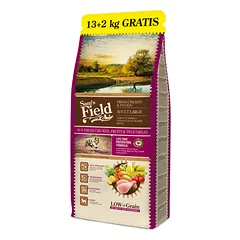
1,80 €/kg
26,99 € / 15 kg

Country Dog
1,89 €/kg
28,29 € / 15 kg
Club 4 Paws
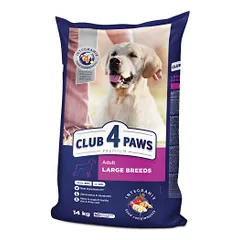
1,92 €/kg
26,94 € / 14 kg
Diamant
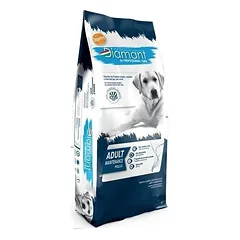
1,93 €/kg
28,99 € / 15 kg
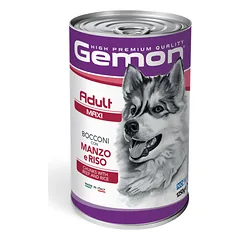
Gemon
1,94 €/kg
2,42 € / 1,3 kg

BIO FORM
2,00 €/kg
40,00 € / 20 kg

BIO FORM
2,00 €/kg
40,00 € / 20 kg