

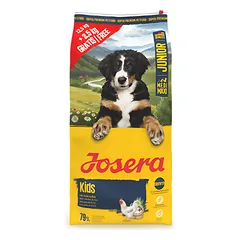
Josera
Josera Kids 12,5kg + 2,5kg = 15 kg
1,38 €/kg
37,89 € / 27,5 kg

Also known as: Portuguese Cattle Dog
The Cão de Castro Laboreiro takes its name from a remote village in northern Portugal, where for centuries it guarded flocks against wolves in rugged mountain terrain. This molossoid-type dog can reach 35 kilograms, and its short to medium, dense coat let it work through damp, cold weather with little grooming. Bred in isolation for generations, it kept a strongly independent streak and a natural wariness of strangers, which makes it an effective guardian but means early socialization matters. At home it tends to bond tightly with one family and stays reserved with outsiders. It is a rugged, low-maintenance worker built for full days outdoors. Life expectancy runs 10 to 12 years.
Browse dog food sized right for this breed
Portuguese Watchdog: how old in human years?
Energy level
Trainability
Family friendly
Grooming need
Males 55–61 cm
Females 50–57 cm
Males 30–35 kg
Females 25–30 kg
Portuguese Watchdog's average temperament and family-life score for this breed is moderate.
Portuguese Watchdog's energy and exercise needs are moderate.
Portuguese Watchdog's guarding and alertness traits are high.
Portuguese Watchdog's grooming needs are low.
Its bark is hard to mistake: low, starting on a deep note and rising, like an echo in a mountain valley. The Portuguese Watchdog comes from the mountains of northern Portugal, where it guarded flocks and villages against wolves, and that job still seems to it the most important one in the world. It is alert, calm and takes its territory very seriously.
Its energy is moderate, but it does like to move: a long daily walk and a roomy, securely fenced yard matter more to it than fast games. It can learn, but it thinks for itself, so it needs a calm, consistent and confident owner. Early socialisation is essential: it is wary and distrustful of strangers, and doesn't always get on with other dogs, especially of the same sex. It knows how to bark and uses the talent freely.
It is devoted to its own people and can be gentle with them, but its sense of duty never switches off: every visitor will be checked. A flat is not for this dog. It is happiest on a farm or in a house with a large yard, with an experienced owner who needs a real guardian rather than a sofa companion.
A coat made for mountain wind and rain asks surprisingly little of you. The Portuguese Watchdog's hair is short, dense and slightly harsh, lying close to the body, so it doesn't trap heat in summer or let the cold through in winter. Once a week go over it with a stiff brush or a rubber curry brush; it sheds little and hardly ever needs a bath, unless it finds something truly fragrant to roll in.
A big dog that spends much of its time outdoors needs its paws, the spaces between the toes and the ears checked every week; redness, discharge or a bad smell in the ears means it's time for the vet. Check the nails every few weeks, and get it used to nail trims and having its teeth looked at as a puppy, because persuading a grown guardian of thirty-odd kilos will be much harder.
How to do it:
By age:
We don't have reliable health information specific to this breed, so we don't list conditions here. Keep up regular vet check-ups, and if you are getting a puppy, ask the breeder about the parents' health testing.
This is general information, not veterinary advice. For your own dog's health, tests and treatment, see a vet.
This list is chosen by the breed's weight (35 kg) rather than the breed itself: shops label food by dog size, so every breed of the same size gets the same list. Prices are updated daily.
≈ 380 g of dry food a day, from €20,73 a month For a neutered, normally active 30 kg dog. Calculate for your dog
Josera
1,38 €/kg
37,89 € / 27,5 kg

Sam's Field
1,80 €/kg
26,99 € / 15 kg

Country Dog
1,89 €/kg
28,29 € / 15 kg

Club 4 Paws
1,92 €/kg
26,94 € / 14 kg

Diamant
1,93 €/kg
28,99 € / 15 kg

Gemon
1,94 €/kg
2,42 € / 1,3 kg

BIO FORM
2,00 €/kg
40,00 € / 20 kg

BIO FORM
2,00 €/kg
40,00 € / 20 kg