

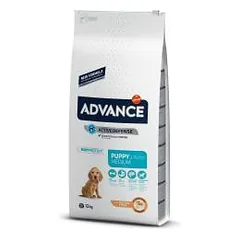
Advance
Advance Puppy Medium sausas maistas vidutinių veislių šuniukams, 12 kg
1,48 €/kg
17,76 € / 12 kg

Also known as: NSDTR, Duck dog, Duck Toller, Duck tolling, Yarmouth Toller
The smallest of the retrievers, this breed took shape in early 19th century Nova Scotia, where hunters used it in an unusual way: the dog plays along the shoreline, its russet coat and bouncy gait mimicking a fox, until curious ducks paddle in close enough to shoot. That decoy behavior, called tolling, is where the breed's name comes from. An adult male tops out around 23 kilograms on a compact, muscular frame built for cold-water swimming. The water-repellent double coat sheds heavily twice a year and needs regular brushing through those stretches. The breed kept a strong play and retrieve drive, so it does better with a ball or a bumper to chase than with quiet time on the sofa. Canadian hunters still use it in the field today, not just at dog shows. It tends to be reserved with strangers at first, then warms up quickly. Life expectancy runs 12 to 14 years.
Browse dog food sized right for this breed
Nova Scotia Duck Tolling Retriever: how old in human years?
Energy level
Trainability
Family friendly
Grooming need
Males 48–51 cm
Females 45–48 cm
Males 20–23 kg
Females 17–20 kg
Nova Scotia Duck Tolling Retriever's average temperament and family-life score for this breed is high.
Nova Scotia Duck Tolling Retriever's energy and exercise needs are high.
Nova Scotia Duck Tolling Retriever's guarding and alertness traits are moderate.
Nova Scotia Duck Tolling Retriever's grooming needs are low.
A lakeshore, the thirtieth throw of the ball, and your russet dog is still looking at you as if the game had only just begun. The Nova Scotia Duck Tolling Retriever comes from Canada, where it would play along the shore to catch the curiosity of ducks and lure them closer to the hunters, then fetch the birds from the water. That work demanded boundless energy and a love of play, and both have stayed.
It needs a lot of exercise every day, with long walks, swimming, a ball or a frisbee, and its mind needs jobs too: it learns superbly and enjoys obedience, agility or tracking. When excited it can let out a loud, high-pitched scream that Toller owners know well, so if you live in a flat with thin walls, it's worth knowing in advance. The hunting instinct is strong, so train recall from day one.
With its family it is affectionate and playful, and it gets on well with children who never say no to one more throw. With strangers it is reserved and likes to watch from a distance first, so introduce your puppy to as many people and places as you can. It is happiest with an active family for whom a weekend without a walk in the countryside isn't a weekend.
The Toller's coat is a medium-length, water-repellent double coat: a dense, soft undercoat keeps out the cold and the topcoat keeps out the water. It sheds all year round, and heavily in spring and autumn when the undercoat changes, so at those times the brush comes out almost daily. The rest of the year, once or twice a week is enough, with attention to the feathering behind the ears, on the trousers and on the tail, where tangles like to start. Don't bathe it more than you need to: shampoo strips the natural oils that make the coat water-repellent.
The ears hang down and the dog loves water, so check and dry them after every swim; a bad smell, redness or a head that keeps shaking is your cue to see a vet. Look at the eyes after a run through bushes or reeds, where seeds and dust lodge easily. Ticks hide well in a thick coat too, so after a walk in the countryside, run a hand over the whole dog.
The smallest of the retrievers is also one of the toughest: with good care, a Nova Scotia Duck Tolling Retriever lives twelve to fourteen years and wants to spend nearly all of them in the water. Its list of inherited conditions touches the joints, the eyes, the nervous system and the hormones, but a list is not a prophecy: before you take a puppy home, it's worth asking the breeder about the parents' health testing, and afterwards, watching your dog and showing any unusual change to a vet.
This is general information, not veterinary advice. For your own dog's health, tests and treatment, see a vet.
The hip or elbow joints form imperfectly, the bones don't fit together as they should, and the joints wear over time. You might notice a dog that gets up stiffly after a swim or a long session with the ball, limps on a front leg, or hesitates before jumping into the car. A Toller wants to work so badly that it can easily hide discomfort behind enthusiasm, so changes in the way it moves are worth showing to a vet.
In this inherited disease the retina at the back of the eye gradually wastes away, and the dog slowly loses its sight. It starts with poorer vision in dim light: hesitating on the stairs in the evening or losing the ball in a dark garden, while in daylight everything still seems fine. There is a DNA test for it in Tollers, so ask the breeder about the parents' results, and have a vet assess any change in sight.
This is a slowly progressing disease of the spinal cord that weakens the hind legs. It shows in an older dog: it starts to wobble, its back legs cross, its nails scuff the ground, and it may show no sign of pain at all. If your Toller's back legs are becoming less reliable, have a vet see it, and before taking a puppy home, ask the breeder about the parents' health testing.
In this disease the adrenal glands make too little of some vital hormones, and the dog copes less well with stress. Its signs are vague and come and go: the dog is listless for a while, off its food, vomiting or with diarrhoea, then seems well again, which makes it easy to miss. If you notice ailments that keep coming and going like this, discuss them with a vet, and if your dog suddenly becomes weak or collapses, it needs a vet immediately.
This list is chosen by the breed's weight (23 kg) rather than the breed itself: shops label food by dog size, so every breed of the same size gets the same list. Prices are updated daily.
≈ 280 g of dry food a day, from €15,29 a month For a neutered, normally active 20 kg dog. Calculate for your dog
Advance
1,48 €/kg
17,76 € / 12 kg
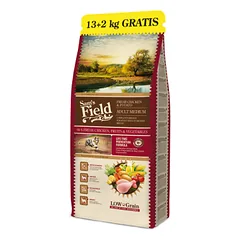
Sam's Field
1,80 €/kg
26,99 € / 15 kg

Country Dog
1,89 €/kg
28,29 € / 15 kg
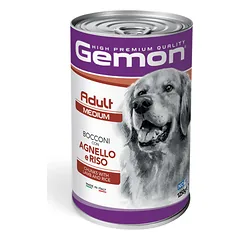
Gemon
1,94 €/kg
2,42 € / 1,3 kg
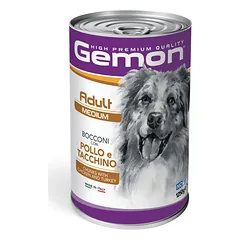
Gemon
1,94 €/kg
2,42 € / 1,3 kg
Sam's Field
2,11 €/kg
27,45 € / 13 kg
2,14 €/kg
30,00 € / 14 kg
Club 4 Paws
2,15 €/kg
42,99 € / 20 kg