

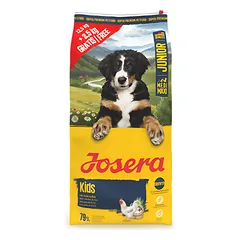
Josera
Josera Kids 12,5kg + 2,5kg = 15 kg
1,38 €/kg
37,89 € / 27,5 kg

Also known as: Lab, Labrador, Lab Mix, Yellow lab, Golden lab
The breed's ancestors worked the icy waters off Newfoundland, hauling fishing nets and retrieving anything that fell overboard, before English sportsmen refined the type into the Labrador Retriever we know today. That original job explains almost everything about the dog: the short, dense coat sheds water rather than soaking it up, and an adult male can reach 36 kilograms of dense muscle built for swimming, not sprinting. Labradors were bred to carry things in their mouths without damaging them, so a soft-mouthed retrieve instinct shows up even in dogs that never see a bird, usually aimed at a shoe or a sock instead. Food motivation runs unusually high in this breed, which makes it easy to train and just as easy to overfeed. The coat blows out twice a year in dense clumps, on top of a steady year-round shed. Labradors were the UK's registered top breed for three decades running, so most vets and trainers have seen dozens of them. They tend to stay puppyish in temperament well past physical maturity, which is part of the appeal and part of why a young one can be a handful indoors. Average lifespan sits at 10 to 14 years.
Browse dog food sized right for this breed
Labrador Retriever: how old in human years?
Energy level
Trainability
Family friendly
Grooming need
Males 56–57 cm
Females 54–56 cm
Males 29–36 kg
Females 25–32 kg
Labrador Retriever's average temperament and family-life score for this breed is high.
Labrador Retriever's energy and exercise needs are high.
Labrador Retriever's guarding and alertness traits are low.
Labrador Retriever's grooming needs are moderate.
Mornings with a Labrador begin with a tail drumming against the kitchen cupboard. The breed was developed in the United Kingdom from dogs that worked in the water, bred to bring back shot birds, and the urge to carry things never left: a ball, a slipper, a stick twice its own length. There is a lot of energy in that body, and it needs more than a lap of the block. Think swimming, running, fetch and nose games. A flat can work, but only if you are out for long, purposeful stretches every day; an under-exercised Labrador will invent its own hobbies, and you will not enjoy them.
It loves to learn and learns fast: bright, keen to cooperate and willing to do almost anything for a scrap of food. That is a big part of why Labradors make such good guide and assistance dogs. The same appetite means treats belong in the daily ration and food belongs on a high shelf. The hunting instinct runs strong, too, so a duck in the park or a cat behind the fence can wipe out every lesson until a solid recall is in place.
With children a Labrador is usually patient and kind, with other dogs easy-going, and a visitor is likely to be greeted with a toy in its mouth. Do not expect a guard dog: a burglar would probably be shown where the fridge is. What it needs most is you, a job to do, and a spot by your feet in the evening once it has finally run out of steam.
The Labrador coat is short, dense and water-resistant, with a thick undercoat that shrugs off a November lake and a muddy forest alike. A brush once or twice a week with a rubber curry or undercoat rake keeps it tidy, but in spring and autumn, when the coat turns over, the hair will be everywhere: on the sofa, on your dark trousers and, somehow, in the butter. Baths can be rare, since frequent washing strips the natural oils that protect the skin. While you brush, run your hands over the skin for redness, lumps or dry patches, and show a vet anything new.
After every swim or rainy walk, dry the ears, and look inside once a week: a healthy ear is pale pink and smells of nothing much. Wipe the corners of the eyes with a damp cloth when needed, and have a vet look at eyes that are red or weepy. Brush the teeth a few times a week with dog toothpaste. Your Labrador will not thank you for it, but will happily accept payment in treats afterwards.
Labradors are generally sturdy, purpose-built dogs, and you can reasonably hope for ten to fourteen years together. The breed does carry a few known weak spots in the joints, heart, eyes and muscles, and it pays to know them before you fall for a puppy. Several can be screened for with health and DNA tests, so a good first question for any breeder is what the parents have been checked for.
This is general information, not veterinary advice. For your own dog's health, tests and treatment, see a vet.
An inflammation of the outer ear canal, where bacteria or yeast take hold in a warm, damp space. You might see head shaking, scratching at one ear, or catch a sour, yeasty smell when your dog leans in for a cuddle. Floppy ears plus a love of swimming make the Labrador ear a cosy place for trouble, so check ears after a swim and let a vet decide what is going on if something looks off.
A heart defect present from birth, where the valve between the right atrium and right ventricle is malformed and does not close properly. Mild cases may never show a sign, while more serious ones can mean tiring quickly, laboured breathing or a swollen belly. It is a recognised problem in Labradors, so if a vet hears a murmur at a puppy check, that is worth following up.
A developmental problem in the elbow joint, where the bones do not grow into a perfect fit and the joint wears out too early. You might notice a young dog limping on a front leg, especially after a nap or a wild game in the garden. Labradors are solid, busy dogs, which is why breeders screen parents' elbows, and why any limp deserves a vet's eye.
A malformation of the hip joint, where the ball does not sit snugly in its socket, so the joint grinds and wears over time. Signs include reluctance to jump into the car, stiffness getting up, or a bunny-hop run with both back legs pushing together. Keeping a Labrador lean and letting a puppy grow at a sensible pace both matter here, and a vet can assess the hips properly.
An inherited muscle disease in which muscle fibres develop abnormally, leaving the dog weak and low on stamina. It shows up early: a puppy that tires fast, walks with a stiff, odd gait, and looks worse in the cold or when excited. There is a DNA test for it in Labradors, so a careful breeder can show you that neither parent carries it.
An inherited condition where, after a stretch of intense, exciting exercise, the dog's back legs suddenly go weak and wobbly. Picture a few minutes of non-stop ball chasing, then a dog that staggers and sits down while clearly still wanting to run. Labradors rarely stop on their own, which makes the DNA test for this worth asking about, and any episode worth talking through with a vet.
A malignant tumour that grows from the cells lining blood vessels, for example in the spleen or heart. It can grow quietly for a long time, then show itself as sudden weakness, pale gums or a swollen belly. It is mainly a concern in older dogs, which is one good reason to keep up regular vet visits as your Labrador greys around the muzzle.
An inherited disease in which the retina slowly wastes away, and with it the dog's sight. The first hint may come at dusk: a dog that hesitates on the stairs or bumps into things it dodges easily in daylight. Labradors can be DNA tested for it, and dogs who lose their sight gradually can cope remarkably well in a home they know.
This list is chosen by the breed's weight (36 kg) rather than the breed itself: shops label food by dog size, so every breed of the same size gets the same list. Prices are updated daily.
≈ 385 g of dry food a day, from €20,99 a month For a neutered, normally active 30,5 kg dog. Calculate for your dog
Josera
1,38 €/kg
37,89 € / 27,5 kg

Sam's Field
1,80 €/kg
26,99 € / 15 kg

Country Dog
1,89 €/kg
28,29 € / 15 kg
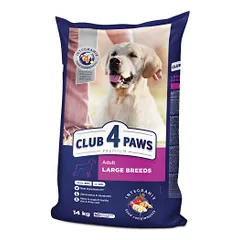
Club 4 Paws
1,92 €/kg
26,94 € / 14 kg
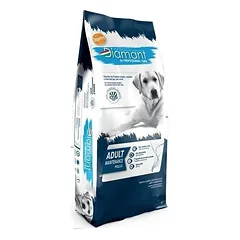
Diamant
1,93 €/kg
28,99 € / 15 kg
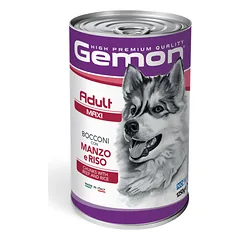
Gemon
1,94 €/kg
2,42 € / 1,3 kg

BIO FORM
2,00 €/kg
40,00 € / 20 kg

BIO FORM
2,00 €/kg
40,00 € / 20 kg