

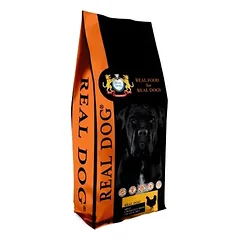
Real Dog
Real Dog sausas maistas suaugusiems, didelių-milžiniškų veislių, šunims su vištiena ir ryžiais 20kg
2,11 €/kg
42,15 € / 20 kg

On Canada's island of Newfoundland this giant worked alongside fishermen, hauling nets, pulling people from the water and carrying heavy loads. Webbed feet and a water-resistant coat let it work for hours in freezing seas. An adult male can weigh up to 69 kilograms, making it one of the heaviest breeds on the FCI list. Despite the size, it's known for a calm, gentle temperament that earned it the old nickname of nanny dog. The heavy coat needs regular brushing and sheds in volume. Drooling comes with the breed, more or less regardless of the individual dog. Life expectancy runs 9 to 10 years, short for a dog so often described as gentle.
Browse dog food sized right for this breed
Newfoundland: how old in human years?
Energy level
Trainability
Family friendly
Grooming need
Males 71–74 cm
Females 66–69 cm
Males 64–69 kg
Females 45–54 kg
Newfoundland's average temperament and family-life score for this breed is high.
Newfoundland's energy and exercise needs are low.
Newfoundland's guarding and alertness traits are low.
Newfoundland's grooming needs are high.
A Newfoundland looks at the world with the calm of an old sailor who has seen it all. He has no use for sprints or agility jumps: long, unhurried walks, and better still a swim, are everything his heart desires, because these dogs were bred to work in water and even have webbing between their toes. In summer he'd rather rest in the shade, while a cold winter's day suits him perfectly. A small flat is cramped for a giant like this, and not only because of his size: the coat, the drool and a tail that clears the coffee table in one sweep all need room.
Training a Newfoundland is a pleasure: he is clever, keen to please and responds well to a calm, friendly voice, while harshness only confuses him. Start while you can still lift him, especially loose-lead walking, because a grown dog weighs as much as a grown person. Young Newfoundlands grow slowly, so long hikes and lots of stairs are too much for a puppy's bones and joints.
In the family he is a born nanny: patient, gentle and especially fond of children, watching over their games like a lifeguard on a beach. He tends to be friendly, or at least calmly polite, with other dogs and with strangers, and he barks rarely, though when that voice does come out the whole street hears it. What he needs most is your company: long hours alone are hard on this family dog, and his best days end with his head resting on your feet.
A Newfoundland's coat is proper workwear: a coarse, oily outer layer that sheds water and a dense, soft undercoat beneath that keeps him warm even in icy water. That undercoat is about to become the main resident of your home. Hair comes out all year round, and in spring and autumn there's enough of it to knit yourself a second dog. Brush a few times a week and daily while he's shedding, with a brush plus an undercoat rake, paying extra attention to the armpits, behind the ears and the trousers, where tangles form fastest. There will be plenty of drool too, so a towel by the door and another by the water bowl are not a luxury but standard equipment.
After a swim, dry him right down to the skin, because a damp, matted undercoat is an ideal spot for skin trouble; part the hair as you brush and check that the skin isn't red or flaky. Floppy ears stay damp after a swim, so look inside once a week: they should be clean and not smell. Check the corners of his eyes for redness or discharge, trim the hair between his paw pads, and keep his nails short, since a calm giant doesn't wear much off on his own.
A Newfoundland wades into a lake with the dignity of a lifeboat and comes out carrying half of it in his coat. That enormous frame is both his strength and his burden: joints, heart, stomach and bones deserve a closer eye in this breed, and giants in general don't live as long as small dogs. Know what to look for and you'll catch changes early and get to your vet in good time.
This is general information, not veterinary advice. For your own dog's health, tests and treatment, see a vet.
The stomach fills with gas and can twist on itself, pinching off its own blood supply, which makes this one of the true emergencies in a dog's life. The dog turns restless, paces, tries to vomit with nothing coming up, and his belly looks swollen and drum-tight. Deep-chested giants like the Newfoundland are known to be at risk, so keep the number of your nearest out-of-hours clinic handy: he needs a vet immediately.
Osteosarcoma is a malignant bone tumour that can strike the long bones of the legs and causes real pain. The first sign may be a limp that doesn't ease with rest, or even gets worse, or a hard, sore swelling on a leg. In a big dog a limp is easy to put down to the joints or to age, so if your Newfoundland is still limping after a few days, take him to your vet.
A developmental problem of the hip: as the puppy grows, the ball and socket don't form quite right, so the joint moves unevenly and wears over time. You might notice your dog struggling to get up after a long sleep, hesitating at the stairs or swaying his hindquarters as he walks. A dog this heavy loads his joints with every step, so ask the breeder about the parents' health testing and talk to your vet about how much exercise a growing puppy should get.
A developmental problem of the elbow in which the bones don't meet precisely as the puppy grows, so the joint wears and becomes sore. A first sign can be a limp in a front leg after rest or a longer hike, or a dog who stands with his elbows turned outwards. A Newfoundland's thick coat can hide changes in his gait, so watch how he moves and share any doubts with your vet.
In dilated cardiomyopathy the heart muscle thins and stretches, so each beat is weaker and the heart struggles more and more to move blood around the body. You may notice your dog tiring sooner, resting longer, coughing, or breathing faster than before while he sleeps. A placid Newfoundland is easy to write off as simply lazy, so your vet listens to his heart at check-ups, and if he ever collapses or faints, he needs a vet immediately.
This list is chosen by the breed's weight (69 kg) rather than the breed itself: shops label food by dog size, so every breed of the same size gets the same list. Prices are updated daily.
≈ 620 g of dry food a day, from €34,10 a month For a neutered, normally active 58 kg dog. Calculate for your dog
Real Dog
2,11 €/kg
42,15 € / 20 kg

Sam's Field
2,56 €/kg
33,26 € / 13 kg
Rasco
2,67 €/kg
39,99 € / 15 kg
Rasco
2,67 €/kg
39,99 € / 15 kg
Purina
2,71 €/kg
37,96 € / 14 kg

Sam's Field
2,77 €/kg
35,99 € / 13 kg
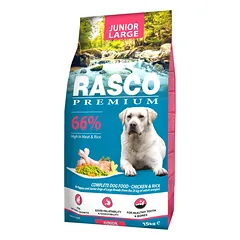
Rasco
2,80 €/kg
41,99 € / 15 kg

Sam's Field
2,85 €/kg
37,04 € / 13 kg