

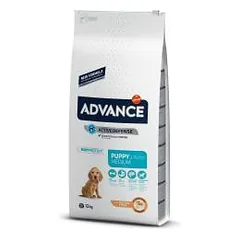
Advance
Advance Puppy Medium sausas maistas vidutinių veislių šuniukams, 12 kg
1,48 €/kg
17,76 € / 12 kg

The Irish Terrier is one of Ireland's oldest terrier breeds, used on farms to control vermin, as a watchful guard, and in the First World War as a messenger dog running between trenches under fire. Its fiery red coat earned it the nickname 'the daredevil' for a temperament that matches the colour. The coat is dense and wiry, needing hand-stripping rather than simple clipping to keep its texture. An adult male weighs around 12 kilograms, compact but fearless enough to stand up to animals many times its size. Courage bordering on stubbornness is part of the package, so early socialisation with other dogs matters a great deal. It was among the first terrier breeds formally recognised by the English Kennel Club in the nineteenth century. At home it can be affectionate and gentle, but it needs clear boundaries. Life expectancy runs 13 to 15 years.
Browse dog food sized right for this breed
Irish Terrier: how old in human years?
Energy level
Trainability
Family friendly
Grooming need
Males not specified
Females not specified
Males not specified
Females not specified
Irish Terrier's average temperament and family-life score for this breed is moderate.
Irish Terrier's energy and exercise needs are high.
Irish Terrier's guarding and alertness traits are moderate.
Irish Terrier's grooming needs are low.
The neighbour's cat, a crow landing on the fence, another male across the street: an Irish Terrier spots it all first and immediately has an opinion. In Ireland it was a farm dog, killing rats, guarding the yard and going out with its owner to hunt, a job that called for courage to spare. The courage stayed: this is an energetic, tireless dog that needs long walks, running and jobs for its brain, or it will invent its own.
It is clever and learns fast but hates being bored, so short, cheerful sessions suit it far better than ten identical repetitions. With other dogs, especially of the same sex, it can be hot-headed, and small animals wake the hunter in it, so a lead and early socialisation are not a formality here. A flat can work, as long as it gets a real outlet every day.
Indoors the same firebrand becomes a devoted, cheerful member of the family who follows you from room to room and loudly announces every ring at the door. It gets on with children who respect its space, and in the evening it will happily settle beside you on the rug, one ear still pricked, just in case.
An Irish Terrier's coat is dense and wiry, lying close to the body like armour against rain and nettles. Hardly any of it ends up on your sofa, because the dead hair stays in the coat, so a couple of times a year it needs hand-stripping, by a groomer or, once you've learned, by you. Clippers spoil the look: the coat goes soft, fades in colour and loses some of its weatherproofing. Between strips, a weekly brush is enough, plus a comb through the beard, which likes to keep a souvenir of dinner.
After a walk through fields, run your hand down to the skin: a thick wiry coat easily hides a tick or a burr, and under it a red, itchy patch. Once a week, look into and sniff the folded ears, and wipe the corners of the eyes with a damp cloth. While you are at it, check the footpads too: they should be smooth, without deep cracks.
Red, lean, stubborn and nearly always ready: an Irish Terrier knows how to age with dignity and can live thirteen to fifteen years. A few conditions are linked to the breed, two of them rather particular to it: one affects the footpads, the other the urinary tract. Knowing what to watch for lets you catch them in good time, and if you are getting a puppy, ask the breeder about the parents' health testing.
This is general information, not veterinary advice. For your own dog's health, tests and treatment, see a vet.
The skin of the footpads thickens and hardens far more than it should, until it becomes rough and cracked, sometimes with horn-like growths. You might notice your dog limping on hard ground or licking its paws more, with pads that look like an old axe handle. For an Irish Terrier, who does everything at a run, sore feet are a real nuisance, so show changes like these to a vet.
This is an inherited disorder in which the kidneys fail to hold back an amino acid called cystine, so it passes into the urine, where it can form crystals and stones. There may be blood in the urine, or a dog that keeps squatting or lifting its leg but produces only a few drops. If an Irish Terrier, especially a male, strains and cannot pass urine, it needs a vet immediately: a blocked urethra is an emergency.
The hip joint develops out of shape: the ball of the thigh bone does not sit snugly in its socket, and the joint wears over time. You might notice your dog getting up more slowly after a nap, jumping less willingly, or running with both hind legs pushing together like a rabbit. An Irish Terrier tends to hide pain stoically, so small changes in how it moves are worth showing to a vet.
This list is chosen by the breed's weight (12 kg) rather than the breed itself: shops label food by dog size, so every breed of the same size gets the same list. Prices are updated daily.
≈ 190 g of dry food a day, from €10,37 a month For a neutered, normally active 11,9 kg dog. Calculate for your dog
Advance
1,48 €/kg
17,76 € / 12 kg
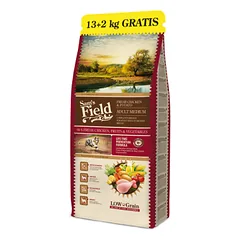
Sam's Field
1,80 €/kg
26,99 € / 15 kg

Country Dog
1,89 €/kg
28,29 € / 15 kg
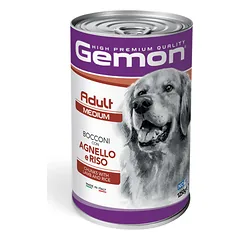
Gemon
1,94 €/kg
2,42 € / 1,3 kg
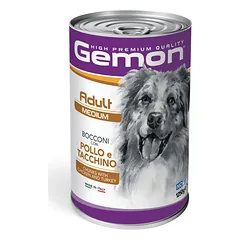
Gemon
1,94 €/kg
2,42 € / 1,3 kg
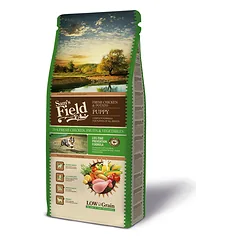
Sam's Field
2,11 €/kg
27,45 € / 13 kg
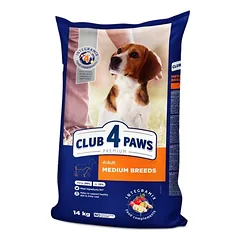
2,14 €/kg
30,00 € / 14 kg
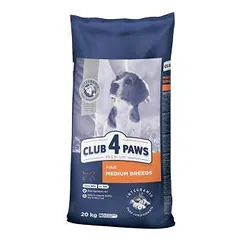
Club 4 Paws
2,15 €/kg
42,99 € / 20 kg