

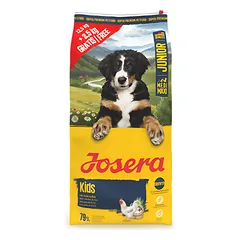
Josera
Josera Kids 12,5kg + 2,5kg = 15 kg
1,38 €/kg
37,89 € / 27,5 kg

Also known as: Setter
The Irish Setter was developed in 18th-century Ireland as a setting dog, working first with a net and later with a gun, hunting grouse across open moorland. The long, silky, mahogany-red coat with feathering on the ears, legs, and tail gives the breed one of the most striking silhouettes among gundogs. Males weigh around 32 kilograms, with a lean, fast build made for covering long distances across open country. Energy levels stay high well into adulthood, and the breed tends to keep a playful, puppyish streak for years. The coat needs frequent brushing to avoid matting, especially behind the ears. Temperament is friendly to a fault, often making it a poor guard dog. Life expectancy runs 11 to 13 years.
Browse dog food sized right for this breed
Irish Setter: how old in human years?
Energy level
Trainability
Family friendly
Grooming need
Males 58–67 cm
Females 55–62 cm
Males 27–32 kg
Females 24–29 kg
Irish Setter's average temperament and family-life score for this breed is moderate.
Irish Setter's energy and exercise needs are high.
Irish Setter's guarding and alertness traits are low.
Irish Setter's grooming needs are moderate.
Mornings with an Irish Setter start with a tail thumping against the wardrobe, the wall and your legs, because a new day is the best news in the world. This dog needs a lot of exercise, every day: long off-lead runs somewhere safe, hikes, swimming, games where he can pour out that bottomless energy. A flat with no garden and no time for long outings will be too small for him, and an under-exercised setter turns into a red tornado indoors.
He can learn and wants to, but his attention flies off easily after a bird or a scent in the grass, as his hunting instinct runs strong. He matures slowly and stays a puppy at heart for a long time, so patience, short cheerful lessons and plenty of praise get further than strictness. Work on a reliable recall from day one, and don't be in a hurry to let him off near a road or in woods full of wildlife.
With people the Irish Setter is friendly with almost everyone: devoted to his family, a patient and cheerful playmate for children, and generally great with other dogs. He is more likely to bowl a stranger over with joy than bark at him, so he is no guard dog. What he needs most is company: a setter left alone for long stretches gets bored and finds his own projects, so he suits a family that spends plenty of time at home and outdoors.
An Irish Setter's coat is his calling card: short and flat on the back, with long, silky feathering on the ears, chest, backs of the legs and tail. That silk streams beautifully when he runs, and collects burrs, pine needles and half a meadow just as beautifully. Brush a few times a week, especially the feathering behind the ears, in the armpits and on the legs, where it tangles first, and after a walk in the woods pick out whatever has hitched a ride. He sheds moderately, so there will be hair but not drifts of it; trim the hair between the toes and around the feet so it doesn't collect mud and balls of snow.
As you brush, part the coat and look at the skin for redness, flakes or scratches from the undergrowth. Long, hanging, feathered ears don't get much air, so once a week lift them and look inside: the ear should be clean, pink and free of any bad smell, and after a bath or a swim it is worth drying it gently. Keep the nails trimmed too, because even a dog who runs a lot doesn't always wear them down evenly.
A mahogany coat streaming out behind him across an autumn field, and a mood stuck permanently on sunny: the Irish Setter looks like energy given legs. Behind the shine are a few areas worth watching: the stomach, bones and joints, the thyroid, the nervous system and the eyes. Their signs can be learned, so if you know what to look for you can get to your vet in good time.
This is general information, not veterinary advice. For your own dog's health, tests and treatment, see a vet.
The stomach fills with gas and can twist on itself, cutting off its blood supply, and that is life-threatening. The dog turns restless, wanders from corner to corner, tries to vomit with nothing coming up, drools, and the belly swells and goes hard. Tall, deep-chested Irish Setters are known to be at risk, so if you see these signs, get him to a vet immediately.
An umbrella term for bone and joint troubles, including developmental joint problems that can show up while the dog is growing or later in life. You might notice your setter getting up stiffly in the morning, limping after a long run, or no longer wanting to jump into the car. For a dog this active, sound joints are everything, so ask the breeder about the parents' health testing and talk to your vet about how much exercise a growing puppy should get.
When the thyroid gland makes too little hormone, the body slows down. A setter who never used to sit still starts sleeping longer, puts on weight while eating the same, seeks out warmth, and that famous red coat turns dry, dull or thin. If your clown has lost his shine, literally and otherwise, it is worth a visit to your vet, who can check with a blood test.
Epilepsy is a brain disorder that causes repeated seizures. During a seizure a dog may fall onto his side, paddle his legs, drool or not respond to you, and beforehand he sometimes acts restless or strange. If your setter has a seizure, especially a first one, a long one or several in a row, contact a vet immediately.
An inherited disease in which the retina slowly wastes away and sight fades, first in dim light. You might notice your setter sticking closer to you on evening walks, reluctant to go into a dark room, or bumping into things he used to avoid. Dogs adapt to it surprisingly well, but ask the breeder about the parents' health testing and talk to your vet about any changes.
A growth disorder in which the cartilage of a joint develops unevenly, cracks and can lift away as a flap, in the shoulder, elbow or knee. It is the owner of a young, fast-growing dog who notices it: the setter limps, especially after rest or hard play, and the limp comes and goes. Don't wait it out; take a limping youngster to your vet, who can find the cause.
This list is chosen by the breed's weight (32 kg) rather than the breed itself: shops label food by dog size, so every breed of the same size gets the same list. Prices are updated daily.
≈ 360 g of dry food a day, from €19,68 a month For a neutered, normally active 28 kg dog. Calculate for your dog
Josera
1,38 €/kg
37,89 € / 27,5 kg

Sam's Field
1,80 €/kg
26,99 € / 15 kg

Country Dog
1,89 €/kg
28,29 € / 15 kg

Club 4 Paws
1,92 €/kg
26,94 € / 14 kg

Diamant
1,93 €/kg
28,99 € / 15 kg
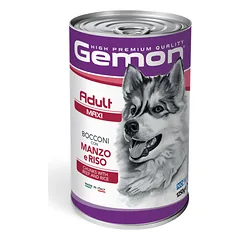
Gemon
1,94 €/kg
2,42 € / 1,3 kg

BIO FORM
2,00 €/kg
40,00 € / 20 kg

BIO FORM
2,00 €/kg
40,00 € / 20 kg