

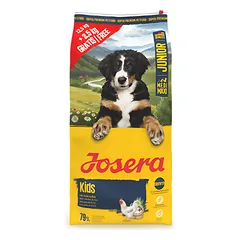
Josera
Josera Kids 12,5kg + 2,5kg = 15 kg
1,38 €/kg
37,89 € / 27,5 kg

Also known as: Kurtzharas, Vokiečių trumpaplaukis pointeris, Vorsteh
The German Shorthaired Pointer was developed in the 19th century by crossing old Spanish Pointers with German scent hounds, aiming for an all-around gundog that could work both before and after the shot. The short, dense, weatherproof coat handles any conditions, and males can weigh up to 32 kilograms, with a muscular, highly durable build. It's one of the most popular hunting breeds in the world, combining nose, speed, and trainability in a rare package. Energy levels run very high, and without enough exercise the dog tends to grow destructive indoors. Temperament runs driven and sharp, quick to pick up new commands. It's affectionate with family but needs constant occupation. Life expectancy runs 12 to 14 years.
Browse dog food sized right for this breed
German Shorthaired Pointer: how old in human years?
Energy level
Trainability
Family friendly
Grooming need
Males 62–66 cm
Females 58–63 cm
Males 25–32 kg
Females 20–27 kg
German Shorthaired Pointer's average temperament and family-life score for this breed is moderate.
German Shorthaired Pointer's energy and exercise needs are high.
German Shorthaired Pointer's guarding and alertness traits are moderate.
German Shorthaired Pointer's grooming needs are low.
You see a meadow; your German Shorthaired Pointer sees a hundred scents, three partridges and a chance to run until the horizon runs out. The breed was developed in Germany as an all-round gundog that searches, points, and retrieves on land and from water, and that engine hasn't gone anywhere. It needs real exercise rather than a walk: long off-lead runs somewhere safe, swimming, canicross or hunting, and every day.
It learns willingly and fast, especially when lessons feel like work: retrieving, searching, tracking. The recall is where you'll need patience, because the nose can be louder than your voice, and a strong prey drive means a cat in the garden or a hare by the roadside can push every command aside in an instant. A dog that hasn't burned off its energy will find its own entertainment, and you are unlikely to enjoy it.
At home it is warm, affectionate and likes to be close, good with children and, properly introduced, with other dogs. It is friendly with strangers and will let you know someone has arrived, but it is no guard. A flat and short walks are too small a life for it; it's happiest with an active family that spends weekends outdoors and gladly takes the dog along.
The German Shorthaired Pointer's short, dense, weatherproof coat practically looks after itself: once a week, run a rubber brush or grooming mitt over it and the dead hair ends up there rather than on the sofa. It sheds moderately all year, a little more in spring and autumn. Mud simply dries and drops off a coat like this, so a bath is only needed when the dog has rolled in something truly fragrant.
The skin and ears need more of your attention. After every outing in woods or fields, run your hand over the whole body: on a short coat you can easily see ticks, scratches from the undergrowth and burrs between the toes. Hanging ears air less well than upright ones, so lift them and look inside every week; a bad smell, redness or a dog that keeps shaking its head are reasons to visit the vet. Check the eyes after a run through tall grass, where seeds and dust collect easily.
A dog that can quarter fields for birds all day is, by its nature, a sturdy one, and the German Shorthaired Pointer lives twelve to fourteen years. A few inherited joint, eye and heart conditions are known in the breed, and its deep chest means it's worth knowing the signs of a twisted stomach. Ask the breeder about the parents' health testing before you take a puppy home, and leave everything else for a vet to judge.
This is general information, not veterinary advice. For your own dog's health, tests and treatment, see a vet.
The hip or elbow joint develops imperfectly, the bones in it don't move as smoothly as they should, and the joint wears over time. You may notice your dog stiff after a day in the field or a long run, limping, or no longer clearing a ditch so easily. A German Shorthaired Pointer's enthusiasm can mask pain until the last minute, so show a change in gait to a vet sooner rather than later.
In this inherited disease the retina slowly wastes away and sight fades, first in dim light. A dog that races freely across a field by day may start hesitating at the stairs or bumping into things in the evening. Because it is inherited, ask the breeder about the parents' health testing before you take a German Shorthaired Pointer puppy home.
This is a narrowing, present from birth, just below where blood leaves the heart for the aorta, so the heart has to work harder to push blood through. In a mild case you may notice nothing at all, and a vet may hear a heart murmur during a routine check; in a more marked case the dog tires more quickly. In such an energetic breed it matters: if your dog suddenly collapses or faints while running, it needs a vet immediately.
The stomach fills with gas, swells and can twist on itself, pinching off its blood supply. The dog becomes restless, tries to vomit but brings nothing up, drools, and its belly looks swollen and tight. The deep-chested German Shorthaired Pointer is one of the dogs at risk, and this is an emergency: if you see these signs, get to a vet immediately.
This list is chosen by the breed's weight (32 kg) rather than the breed itself: shops label food by dog size, so every breed of the same size gets the same list. Prices are updated daily.
≈ 340 g of dry food a day, from €18,63 a month For a neutered, normally active 26 kg dog. Calculate for your dog
Josera
1,38 €/kg
37,89 € / 27,5 kg
Sam's Field
1,80 €/kg
26,99 € / 15 kg

Country Dog
1,89 €/kg
28,29 € / 15 kg

Club 4 Paws
1,92 €/kg
26,94 € / 14 kg
Diamant
1,93 €/kg
28,99 € / 15 kg
Gemon
1,94 €/kg
2,42 € / 1,3 kg

BIO FORM
2,00 €/kg
40,00 € / 20 kg

BIO FORM
2,00 €/kg
40,00 € / 20 kg