

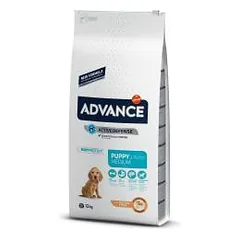
Advance
Advance Puppy Medium sausas maistas vidutinių veislių šuniukams, 12 kg
1,48 €/kg
17,76 € / 12 kg

Also known as: Breton, Spaniel bretón, French Brittany, Bretagnenspanieli, Breton spaniel
The Brittany comes from France's Brittany region, where farmers wanted a compact, economical pointing dog that could both point and retrieve. It's among the smallest of the continental gundogs, males weigh only around 20 kilograms, small enough to travel comfortably even in a small car. Some puppies are born tailless or with a naturally very short tail, a genuine breed trait rather than the result of docking. The coat is dense and slightly wavy, needing only moderate grooming. Energy levels run high, and the breed needs daily exercise or it tends to grow anxious indoors. It's affectionate with its family and forms strong attachments to people. Life expectancy runs 12 to 14 years.
Browse dog food sized right for this breed
Brittany: how old in human years?
Energy level
Trainability
Family friendly
Grooming need
Males 47–50 cm
Females 46–49 cm
Males 14–20 kg
Females 13–18 kg
Brittany's average temperament and family-life score for this breed is high.
Brittany's energy and exercise needs are high.
Brittany's guarding and alertness traits are low.
Brittany's grooming needs are low.
An autumn morning, a dewy meadow, and suddenly your dog freezes like a statue: one front paw raised, nose stretched out, every muscle locked. The Brittany was bred in France as a bird-pointing gundog, and that instinct stays put whether or not you ever plan to hunt. It needs a lot of exercise every day: long walks, free running somewhere safe, trotting beside a bicycle, games of search and find. The hunting drive is strong, so start working on recall from day one.
It loves to learn and learns quickly, but it is a sensitive soul: a harsh tone unsettles it more than it teaches, while praise and a treat work wonders. A clever, energetic dog with nothing to do will soon invent its own entertainment, so short training sessions, scent games or a dog sport suit it down to the ground.
At home it is gentle, affectionate and gets on beautifully with children and other dogs, and it greets visitors in a friendly way, if not straight away. It won't make a guard dog, and it isn't one to bother the neighbours with barking. It can live in a flat as long as it gets its daily dose of the outdoors, but a house with a garden and an owner who enjoys long walks suit it better.
The Brittany's coat is dense, flat or slightly wavy and of medium length, with light feathering on the legs and ears. It sheds moderately and is easy to keep tidy: a brush once or twice a week does it, with extra attention behind the ears and on the leg feathering, where tangles like to start. After a day in fields or woods, run your hand over the whole dog, because burrs, ticks and small scratches on the skin hide easily in a coat like this.
The ears are short and hanging, so after a swim or a wet walk they're worth a look and a gentle dry; a bad smell, redness or a head that keeps shaking is your cue to see a vet. Check the eyes after every long run through grass, since seeds and dust lodge there all too easily. Baths can be rare: once the coat dries, it sheds most of the mud on its own.
With good care, a Brittany can be at your side for twelve to fourteen years, and spend a good share of them on the run: this is a lean, sturdy, tireless gundog. A few inherited conditions are known in the breed, but none of them is a foregone conclusion: before you take a puppy home, it's worth asking the breeder about the parents' health testing. And if something about your dog starts to seem different, a vet is the one to decide what it is.
This is general information, not veterinary advice. For your own dog's health, tests and treatment, see a vet.
The hip joint forms imperfectly, the ball of the thigh bone sits too loosely in its socket, and the joint wears over time. You might notice a dog that gets up stiffly after a long day in the fields, hesitates before jumping into the car, or runs with both back legs pushing off together like a rabbit. A Brittany works with its whole heart and isn't one to complain, so any change in the way it moves is worth showing to a vet.
Epilepsy means repeated seizures, a kind of electrical storm in the brain. A dog may suddenly topple onto its side, jerk or paddle its legs, drool and not respond to its name, then be confused and wobbly for a while afterwards. If your Brittany has a seizure, see a vet; if a seizure goes on for long or one follows another, it needs a vet immediately.
The thyroid gland makes too little hormone, and the whole body shifts into a lower gear. A dog that used to be first at the door suddenly can't be bothered with walks, gains weight without eating more, seeks out warm spots, and grows a thinner or coarser coat. It is easy to put down to age, but in a dog as lively as the Brittany it tends to stand out, and it's worth raising with a vet.
The lens of the eye, which should be clear, gradually turns cloudy, and the dog starts to see as if through a steamed-up window. You might notice a greyish or bluish-white sheen in the pupil, or a dog that takes the stairs more carefully at dusk and can no longer find a thrown toy. For a dog whose job is reading a field with eyes and nose, sight matters a great deal, so any clouding of the eye is for a vet to assess.
This list is chosen by the breed's weight (20 kg) rather than the breed itself: shops label food by dog size, so every breed of the same size gets the same list. Prices are updated daily.
≈ 240 g of dry food a day, from €13,12 a month For a neutered, normally active 16,3 kg dog. Calculate for your dog
Advance
1,48 €/kg
17,76 € / 12 kg

Sam's Field
1,80 €/kg
26,99 € / 15 kg

Country Dog
1,89 €/kg
28,29 € / 15 kg

Gemon
1,94 €/kg
2,42 € / 1,3 kg
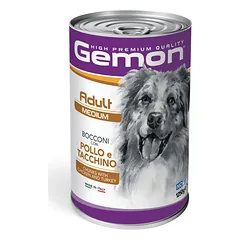
Gemon
1,94 €/kg
2,42 € / 1,3 kg

Sam's Field
2,11 €/kg
27,45 € / 13 kg

2,14 €/kg
30,00 € / 14 kg

Club 4 Paws
2,15 €/kg
42,99 € / 20 kg