

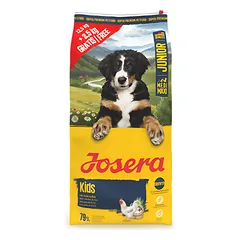
Josera
Josera Kids 12,5kg + 2,5kg = 15 kg
1,38 €/kg
37,89 € / 27,5 kg

The Curly-Coated Retriever is considered the oldest of the retriever breeds, tracing back to late 18th-century England, well before the Labrador or Golden Retriever existed. Tight, crisp curls cover the entire body, a coat closer to sheep's wool than fur, and it holds up well in cold water and thick brush. Males can weigh up to 36 kilograms, with a muscular build made for long swims in cold water. Unlike most retrievers, this coat isn't meant to be brushed, over-brushing can actually ruin the curl pattern, so care is mostly limited to occasional rinsing. The breed is rarer today than its retriever cousins. Temperament runs more independent, generally less clingy than a Labrador or Golden. Life expectancy runs 10 to 12 years.
Browse dog food sized right for this breed
Curly-Coated Retriever: how old in human years?
Energy level
Trainability
Family friendly
Grooming need
Males 64–69 cm
Females 59–64 cm
Males 29–36 kg
Females 29–36 kg
Curly-Coated Retriever's average temperament and family-life score for this breed is moderate.
Curly-Coated Retriever's energy and exercise needs are moderate.
Curly-Coated Retriever's guarding and alertness traits are low.
Curly-Coated Retriever's grooming needs are moderate.
An October lake, mist over the water, and your dog already swimming out to the dummy without noticing the cold. The Curly-Coated Retriever is one of the oldest retriever breeds, developed in England to bring back game from water and marsh, and water is still its idea of happiness. It needs more than an hour of exercise a day: swimming, retrieving, long hikes, not just a walk on the lead.
It is clever and learns quickly, but it has opinions of its own and matures slowly; a young Curly can stay a large puppy for a long time. Repetition bores it fast, so keep sessions short, varied and fun. It is more reserved with strangers than other retrievers, polite rather than gushing, and at home calm and affectionate, especially once it has had enough to do.
It gets on with children and other dogs, but its size and bounce mean small children are best supervised around it. A flat is a tight fit; the ideal life is a house within reach of water. A typical day: a morning swim, an afternoon nap on a cool floor, an evening walk, and wet curls on your sofa if you are not quick enough.
The Curly-Coated Retriever's coat is hundreds of small, crisp, tight curls covering the whole body except the face, built to keep out the chill of cold water. Oddly, a brush does more harm than good here: brushed-out curls straighten and turn into a fuzzy cloud. Instead, wet the coat down and let it dry naturally, and the curls will set again. Shedding is moderate, and during a seasonal moult the loose hair can be worked out by hand or with a wide-toothed comb.
Because the coat is so dense, check the skin with your hands: run your fingers through the curls feeling for ticks, burrs, red patches or lumps. The hanging ears stay damp after a swim, so dry them every time and give them a sniff; a healthy ear smells of very little. The eyes should be clear, with no discharge, and after a walk through reeds or long grass check for seeds. Now and then tidy the hair on the ear edges and the feet with scissors to keep the outline neat.
The Curly-Coated Retriever is a big, powerful working dog that lives ten to twelve years. Its health list includes both inherited conditions and true emergencies, so it pays to know in advance which signs need a vet straight away. What you can do comes down to watching closely and getting help in good time.
This is general information, not veterinary advice. For your own dog's health, tests and treatment, see a vet.
Eye problems cover a range of trouble, from eyelid and eyelash faults to inherited diseases of the retina or lens that can affect sight. You might notice watering, redness, squinting, cloudiness, or a dog that seems unsure of itself at dusk. A Curly spends a lot of time in water and reed beds, so show any change in the eyes to your vet, and if you are getting a puppy, ask the breeder about the parents' health testing.
Hip dysplasia is a developmental fault in the hip joint: the ball of the thigh bone does not sit snugly in its socket, and the joint wears over time. You might notice your dog getting up stiffly after a swim or a long hike, swaying through the hindquarters or reluctant on the stairs. For a dog this big and heavy, sound hips matter a great deal, so ask the breeder about the parents' health testing.
This is an inherited condition in which, after intense and exciting exercise, a dog's hind legs suddenly weaken and it may collapse, even though it seemed perfectly fit a moment earlier. The first sign may be a wobbly, uncoordinated gait during retrieving or hard running. Any sudden collapse means a vet is needed immediately; a genetic test exists for this breed, so ask the breeder about the parents' results.
Glycogen storage disease type IIIa is an inherited condition in which the body cannot properly break down stored glycogen, so it builds up in the liver and muscles. An owner might notice a dog that tires quickly, recovers slowly after exercise or develops a swollen belly. A genetic test for it exists in Curly-Coated Retrievers, so ask the breeder about the parents' results before you take a puppy home.
Bloat is when the stomach fills with gas and can twist on itself, cutting off its blood supply. The dog becomes restless, tries to vomit but brings nothing up, drools, and its belly swells and turns hard. The Curly is a large, deep-chested dog, so know these signs in advance: if you see them, a vet is needed immediately.
Cancer is a name for many different diseases in which cells start to multiply out of control and form tumours. You might notice a new lump under the coat, unexplained weight loss, lethargy or a poorer appetite. A lump is easy to miss in those dense curls, so run your hands over the whole body regularly and show anything you find to your vet.
This list is chosen by the breed's weight (36 kg) rather than the breed itself: shops label food by dog size, so every breed of the same size gets the same list. Prices are updated daily.
≈ 400 g of dry food a day, from €22,02 a month For a neutered, normally active 32,5 kg dog. Calculate for your dog
Josera
1,38 €/kg
37,89 € / 27,5 kg

Sam's Field
1,80 €/kg
26,99 € / 15 kg

Country Dog
1,89 €/kg
28,29 € / 15 kg

Club 4 Paws
1,92 €/kg
26,94 € / 14 kg
Diamant
1,93 €/kg
28,99 € / 15 kg
Gemon
1,94 €/kg
2,42 € / 1,3 kg

BIO FORM
2,00 €/kg
40,00 € / 20 kg

BIO FORM
2,00 €/kg
40,00 € / 20 kg