

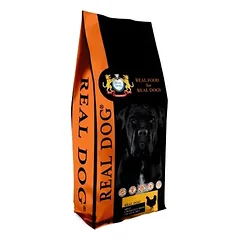
Real Dog
Real Dog sausas maistas suaugusiems, didelių-milžiniškų veislių, šunims su vištiena ir ryžiais 20kg
2,11 €/kg
42,15 € / 20 kg

Also known as: CAO, Alabai, Central Asia Ovcharka, Tobet, Volkodav
The Central Asian Shepherd is one of the oldest and least crossbred herding livestock guardian types, shaped over thousands of years across the vast territory from the Caspian Sea to China, protecting flocks from wolves. A male can weigh up to 79 kilograms on a heavy-boned, massive frame, and the coat runs either short or long depending on the region a particular dog comes from. This is a dog that makes its own calls, often without so much as a glance back at its handler, exactly what you'd expect from a guardian that historically worked without constant supervision. In Central Asian countries it's still used for real flock protection rather than as a show dog. Early socialization and clear household rules matter from the first weeks. It stays protective of its own family but will never be friendly toward strangers. Life expectancy runs 10 to 12 years.
Browse dog food sized right for this breed
Central Asian Shepherd Dog: how old in human years?
Energy level
Trainability
Family friendly
Grooming need
Males 65–78 cm
Females 60–69 cm
Males 40–79 kg
Females 40–65 kg
Central Asian Shepherd Dog's average temperament and family-life score for this breed is low.
Central Asian Shepherd Dog's energy and exercise needs are low.
Central Asian Shepherd Dog's guarding and alertness traits are high.
Central Asian Shepherd Dog's grooming needs are low.
For most of the day a Central Asian Shepherd looks like a hill quietly lying in the yard, right up until a stranger approaches the gate. For centuries it guarded flocks and camps against predators and outsiders, and that job is still in its blood: watchful, independent, confident in its own judgement and serious about its territory.
This is not a flat dog, and not a dog for a first-time owner. It needs a large, securely fenced yard, calm daily walks and an owner who is steady, consistent and experienced. Socialisation from the first weeks is not optional: the more people, sounds and places it meets while young, the more calmly it will take life later. It finds other dogs hard going, particularly ones of the same sex, and with children it calls for supervision and common sense, if only because of its size.
It can learn, but it is not inclined to blind obedience; it judges commands by whether they make sense. Shouting gets you nowhere, while respect and clear rules do. It barks little, but hear something beyond the fence at night and it will say so in a deep, persuasive voice. With its own family it is devoted and gentle, and visitors are accepted only once you make it clear they are welcome.
The Central Asian Shepherd's coat comes short or somewhat longer, but either way it is dense and double: a coarse outer coat over a thick undercoat that guards against both steppe heat and cold. For most of the year a good brush-out once a week is enough. Once or twice a year, though, the undercoat changes and comes out in clumps, and in those weeks you will be brushing almost daily, preferably outdoors. It rarely needs a bath, because a double coat sheds dirt by itself once dry.
Brushing is the best time to look over the whole of this large body: the skin under the collar, the elbows it lies on when resting on hard ground, and the paw pads. Show any blisters, scrapes or sores that won't heal to the vet. Check the ears every week and after every day spent out in the fields; they should be clean, odour-free and without trapped grass seeds. Wipe the corners of the eyes with a damp cloth if discharge collects there, and since this dog drools a little, a towel for the lips after drinking comes in handy.
The Central Asian Shepherd Dog took shape on the steppes, where there was no place for a weak dog, so it is tough, hardy and unfussy. Still, a body this big has its soft spots, namely the joints, the skin and the ears, and ten or twelve years is a giant's whole life, one you want it to live without pain. Watch how it moves and how its skin and ears look, and talk over anything you notice with the vet.
This is general information, not veterinary advice. For your own dog's health, tests and treatment, see a vet.
Hip dysplasia is a fault in how the hip joint forms: the ball of the thigh bone sits loosely in its socket, so the joint wears faster than it should. You might see your dog struggle to stand after a rest, avoid stairs, sway its hindquarters at a trot or shorten its stride. A Central Asian Shepherd grows slowly into a great deal of weight, which is no small load on the joints, so show changes in gait to the vet, and if you are getting a puppy, ask the breeder about the parents' health testing.
This is an inherited disease in which the layers of the skin are poorly anchored to each other, so even slight friction raises blisters and sores. It shows up in puppies: blisters and small ulcers appear on the paw pads, around the muzzle, in the mouth or wherever skin rubs, such as under a collar. If you are getting a Central Asian Shepherd puppy, ask the breeder about the parents' health testing, and show any blisters or sores that won't heal to the vet.
An ear infection is inflammation of the ear canal that itches and hurts, and a warm, damp ear suits bacteria and yeast very well. Your dog shakes its head, rubs its ear along the ground, holds its head tilted, and the ear may smell bad or show dark discharge. A Central Asian Shepherd spends a lot of time outdoors in dust and grass, so check its ears regularly and let the vet assess signs like these.
This list is chosen by the breed's weight (79 kg) rather than the breed itself: shops label food by dog size, so every breed of the same size gets the same list. Prices are updated daily.
≈ 605 g of dry food a day, from €33,21 a month For a neutered, normally active 56 kg dog. Calculate for your dog
Real Dog
2,11 €/kg
42,15 € / 20 kg

Sam's Field
2,56 €/kg
33,26 € / 13 kg
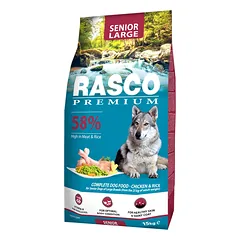
Rasco
2,67 €/kg
39,99 € / 15 kg
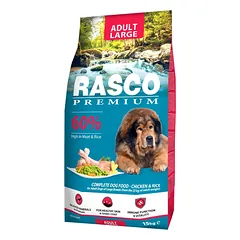
Rasco
2,67 €/kg
39,99 € / 15 kg
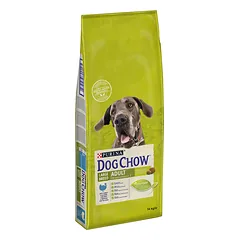
Purina
2,71 €/kg
37,96 € / 14 kg
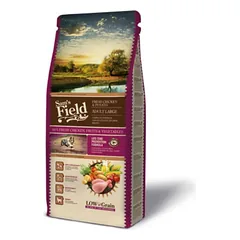
Sam's Field
2,77 €/kg
35,99 € / 13 kg
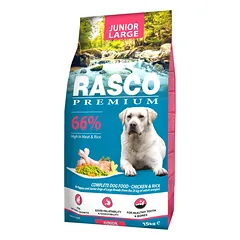
Rasco
2,80 €/kg
41,99 € / 15 kg
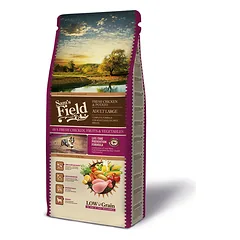
Sam's Field
2,85 €/kg
37,04 € / 13 kg