


VetExpert
Raw Paleo Dog Ultra Mini Puppy Beef 750 kg
0,02 €/kg
13,09 € / 750 kg

Also known as: Terrier Brasileiro
The Brazilian Terrier traces back to the late 19th century, when European settlers brought small terriers to Brazil that mixed locally with other breeds into a type kept on rural properties to hunt rodents. An adult weighs around 9 kilograms, and the short, smooth coat needs little grooming. The breed remains more common in the Brazilian countryside than in cities, though it's gained recognition as a family dog in recent decades. It kept the typical terrier stubbornness and prey drive, so small pets at home can draw unwanted attention. It tends to be alert and quick to bark at anything out of the ordinary. It's playful and attached to its family. Life expectancy runs 12 to 14 years.
Browse dog food sized right for this breed
Brazilian Terrier: how old in human years?
Energy level
Trainability
Family friendly
Grooming need
Males 35–40 cm
Females 35–40 cm
Males 6.5–9 kg
Females 6.5–9 kg
Brazilian Terrier's average temperament and family-life score for this breed is moderate.
Brazilian Terrier's energy and exercise needs are high.
Brazilian Terrier's guarding and alertness traits are moderate.
Brazilian Terrier's grooming needs are low.
A leaf rustles in the corner and a small tricoloured dog is already there, ears up, body taut, expression saying "I have this under control". The Brazilian Terrier grew up on farms and country estates catching rodents, and that alertness is still very much alive. It has enough energy for a dog twice its size, so it needs more than walks: running, games, trick training and food puzzles all earn their place.
It is clever and learns fast, but it has opinions: this is a terrier, not an obedience champion. Short, playful sessions with treats work far better than drilling to boredom. The prey drive is strong, so cats and small pets interest it as quarry rather than friends, and a lead in open spaces is the sensible choice. It likes to announce everything happening beyond the front door, so teach it some volume control early, especially in a flat.
With its own people it is affectionate and devoted, keen to join every family activity, and with older children who respect its limits it can become an inseparable playmate. A flat works if it gets a proper outlet every day: a tired Brazilian Terrier curls up on the sofa in the evening looking like the calmest creature alive. An under-exercised one will find its own entertainment, and you are unlikely to enjoy it.
If you want a dog whose coat asks almost nothing of you, the Brazilian Terrier is a strong candidate. The hair is short, smooth and lies close to the body, and it sheds very little. A weekly once-over with a rubber brush or a damp grooming mitt lifts the dead hair and leaves the coat shining. Baths are rare, needed only when the dog has rolled in something it shouldn't.
That short coat has a flip side: it gives little protection against cold. In a Lithuanian winter, especially when standing around or on a long walk through sleet, this small dog will appreciate a coat of its own. Because nothing hides the skin, check it weekly for scratches from bramble raids, ticks or red patches. Trim the nails when you hear them clicking on the floor.
We don't have reliable health information specific to this breed, so we don't list conditions here. Keep up regular vet check-ups, and if you are getting a puppy, ask the breeder about the parents' health testing.
This is general information, not veterinary advice. For your own dog's health, tests and treatment, see a vet.
This list is chosen by the breed's weight (9 kg) rather than the breed itself: shops label food by dog size, so every breed of the same size gets the same list. Prices are updated daily.
≈ 140 g of dry food a day, from €7,55 a month For a neutered, normally active 7,8 kg dog. Calculate for your dog
VetExpert
0,02 €/kg
13,09 € / 750 kg

1,70 €/kg
17,02 € / 10 kg

Real Dog
1,78 €/kg
17,79 € / 10 kg
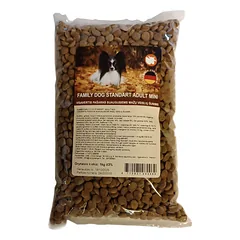
Family Dog
1,89 €/kg
1,89 € / 1 kg

Club 4 Paws
1,93 €/kg
26,99 € / 14 kg

Club 4 Paws
1,93 €/kg
26,99 € / 14 kg

Real Dog
1,94 €/kg
19,42 € / 10 kg

Real Dog
1,95 €/kg
19,49 € / 10 kg