


VetExpert
Raw Paleo Dog Ultra Mini Puppy Beef 750 kg
0,02 €/kg
13,09 € / 750 kg

Also known as: Reedwater terrier
Bred along the England Scotland border to hunt foxes alongside mounted riders and hounds, this terrier needed to be small enough to go to ground yet leggy enough to keep pace with a horse at a run. An adult weighs only around 7 kilograms, and its head is often described as otter shaped, broad and flat, a specific point in the breed standard. The harsh, weatherproof coat needs periodic hand stripping. The Border Terrier is considered one of the more instinct driven terriers, and modern dogs still dig and chase small animals readily. Despite that, its temperament at home tends to be calmer and less quarrelsome with other dogs than many of its relatives. Life expectancy runs 12 to 15 years.
Browse dog food sized right for this breed
Border Terrier: how old in human years?
Energy level
Trainability
Family friendly
Grooming need
Males 33–40 cm
Females 33–40 cm
Males 5.9–7.1 kg
Females 5.1–6.4 kg
Border Terrier's average temperament and family-life score for this breed is high.
Border Terrier's energy and exercise needs are high.
Border Terrier's guarding and alertness traits are moderate.
Border Terrier's grooming needs are low.
Rain, sleet or scorching sun, a Border Terrier heads out for its walk with the same enthusiasm. It was bred on the border between England and Scotland to work outdoors in any weather, and that stamina hasn't gone anywhere: it needs long walks, running, search games and chances to use its nose for what it was made for.
It is clever and keen to learn, though the hunter's nose sometimes overrules the ears: let off in open country, it can follow a scent so far that your call no longer reaches it. A fenced area and a sound fence are no luxury here, because these terriers dig and can find every gap. A flat works if it gets a proper outlet every day; otherwise its energy turns to your shoes and flowerbeds.
At home it is a far easier companion than the word "terrier" might suggest: devoted to its family, patient with children and friendly with other dogs. Cats and small pets are another story; to a Border they look like prey, so a shared life with them has to be built carefully and from puppyhood. And that otter-shaped head, tilted to one side while you talk, will teach you never to refuse one more treat.
A Border Terrier's coat is as wiry as a scouring pad, dense and made to keep out rain, wind and thorny scrub. It never needs cutting: a couple of times a year the dead hair is best hand-stripped, by a groomer or, once you've learned, by you, and between strips a weekly brush is plenty. Shedding is light, especially if the coat is stripped on time, whereas clippers soften a wiry coat and cost it some of its weatherproofing.
After a walk through fields, run your hand through the coat right down to the skin: that thick jacket hides a tick or a thorn perfectly. Check the small, forward-folding ears once a week, and the eyes whenever your dog comes out of the bushes; wipe sleep from the corner with a damp cloth, and take an eye that is red or cloudy to the vet.
Muddy to the ears, pleased with itself and ready for one more lap: that is a healthy Border Terrier, a dog that can live twelve to fifteen years. A few conditions are linked to the breed, including some whose early signs are faint, so it pays to know your dog well and notice when it behaves differently from usual. When in doubt, talk to a vet, and if you are getting a puppy, ask the breeder about the parents' health testing.
This is general information, not veterinary advice. For your own dog's health, tests and treatment, see a vet.
Thick, jelly-like mucus builds up in the gallbladder and can block the bile ducts; in the worst case the gallbladder can burst. The signs are vague: a poorer appetite, vomiting, listlessness or a sore belly, sometimes yellowing of the whites of the eyes or the gums. The condition is linked to Border Terriers, so show signs like these to a vet without delay.
In this condition the body produces too much of the stress hormone cortisol over a long period, and that slowly changes the whole body. You might notice your dog drinking and peeing far more, always hungry, its belly looking swollen and its coat thinning. The changes creep in slowly and are easy to put down to old age, so if an older Border Terrier starts changing like this, show it to a vet.
This is an episodic disorder in which a dog's muscles suddenly cramp: it starts to stagger, goes stiff or cannot walk, though it seems aware of what is going on. The condition is linked to Border Terriers, and from the outside it is easy to mistake for a seizure. So during such an episode, or right after it, your dog needs a vet immediately; if you can, film it, because the footage will help the vet a great deal.
A cataract is a clouding of the lens of the eye: the clear lens gradually turns milky, and the dog sees less and less well through it. You might notice a bluish-white tinge in the pupil, or a terrier that starts to stumble at dusk and no longer catches a thrown toy as neatly. A Border Terrier checks the world with its eyes as well as its nose, so show any change in its sight to a vet as soon as you notice it.
This list is chosen by the breed's weight (7 kg) rather than the breed itself: shops label food by dog size, so every breed of the same size gets the same list. Prices are updated daily.
≈ 115 g of dry food a day, from €6,28 a month For a neutered, normally active 6,1 kg dog. Calculate for your dog
VetExpert
0,02 €/kg
13,09 € / 750 kg

1,70 €/kg
17,02 € / 10 kg

Real Dog
1,78 €/kg
17,79 € / 10 kg
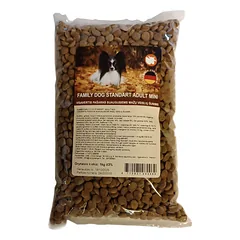
Family Dog
1,89 €/kg
1,89 € / 1 kg

Club 4 Paws
1,93 €/kg
26,99 € / 14 kg

Club 4 Paws
1,93 €/kg
26,99 € / 14 kg

Real Dog
1,94 €/kg
19,42 € / 10 kg

Real Dog
1,95 €/kg
19,49 € / 10 kg