

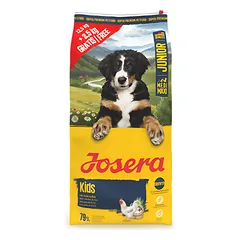
Josera
Josera Kids 12,5kg + 2,5kg = 15 kg
1,38 €/kg
37,89 € / 27,5 kg

Also known as: Basid hound
The Basset Hound originated in France, developed in the nineteenth century to hunt hare at a walking pace so hunters on foot could keep up, though it was later refined and popularised further in Britain. The short, bowed legs come from chondrodysplasia, the same genetic trait behind the wrinkled skin, and it's a feature rather than a flaw: it keeps the dog moving slowly but tirelessly over hours on a trail. Its sense of smell ranks second only to the Beagle's among all breeds. An adult male can weigh up to 29 kilograms despite the low stance, with a long, heavy body. The long, drooping ears help funnel scent particles toward the nose but need regular cleaning to avoid infection. Temperament is calm and stubborn, hard to motivate without food as an incentive. Back problems are a real health concern given the ratio of long body to short legs. Life expectancy runs 10 to 12 years.
Browse dog food sized right for this breed
Basset Hound: how old in human years?
Energy level
Trainability
Family friendly
Grooming need
Males 33–38 cm
Females 33–38 cm
Males 23–29 kg
Females 20–27 kg
Basset Hound's average temperament and family-life score for this breed is high.
Basset Hound's energy and exercise needs are moderate.
Basset Hound's guarding and alertness traits are low.
Basset Hound's grooming needs are moderate.
A walk with a Basset is less a route than an investigation: twenty metres can take ten minutes if someone has left a message on a lamppost. The breed was created in France and finished in Britain as a scent hound that followed hares at the pace of hunters on foot, and to this day its nose outranks any command you care to give.
Training takes humour and patience. A Basset is no fool, just independent: it understands perfectly well what you are asking and then considers whether it's worth it. Treats and short sessions work; a stern tone doesn't. It has little energy to spare but still needs to move, and daily unhurried walks keep it in shape and its joints working, while freedom without a fence ends with the nose leading it far away and deaf to your calls. Keep stairs and sofa jumps to a minimum; that long back will thank you.
With people, a Basset is the kindest of souls: patient with children, happy among other dogs and greeting visitors like old friends, so don't expect a guard. A flat suits it fine, provided the neighbours can live with its deep, melodious voice, which comes out when it is bored or sad to be left alone. In the evening it will happily stretch out on the sofa and take up far more room than its height would suggest.
A Basset's short, smooth coat asks very little: a weekly once-over with a rubber brush or grooming mitt and it shines again. It sheds a little all year round, so you'll find short hairs on the floor and the sofa, though never in drifts. The skin deserves more attention than the coat: wipe the folds on the neck and face, where drool and moisture collect, with a damp cloth a few times a week and dry them well, and show any redness or smell to your vet.
The ears are the longest part of a Basset and your biggest job. On walks they sweep through grass and puddles, at mealtimes they dip in the bowl, so check them weekly on both sides: the inside should be clean, pale and free of any smell. The eyes, with their slightly drooping lower lids, can be wiped gently with a soft damp cloth when needed; show any watering or redness to your vet. And keep a drool towel within reach at all times.
Basset Hounds live ten to twelve years, and you can guess their health questions from the silhouette: a long, heavy body on short legs, long ears and loose, folded skin. Plenty can be spotted at home, such as a limp, scratching or a smell from the ears, and your vet can take it from there. If you are getting a puppy, ask the breeder about the parents' health testing.
This is general information, not veterinary advice. For your own dog's health, tests and treatment, see a vet.
This covers a range of skin troubles, from itchy inflammation to infections in skin folds where moisture and warmth collect; the long, hanging ears can become inflamed in much the same way. You might notice scratching and licking, reddened folds, or a sour, unpleasant smell coming from the folds or the ears. A Basset's ears sweep the ground and the folds on its neck and face stay damp with drool, so check them weekly and show any changes to your vet.
These are faults in how the hip or elbow joints develop, where the bone surfaces don't fit together as they should and the joint wears over time. You may see your dog struggle to get up after a nap, limp after a walk or avoid the stairs. A Basset weighs as much as a medium-sized dog but carries it all on short legs, so its joints work hard; ask the breeder about the parents' health testing.
Arthritis is inflammation of the joints, where the cartilage wears away and movement starts to hurt. You might notice your Basset getting up more slowly in the morning, no longer keen to jump into the car or onto the sofa, and falling further behind on walks. Since this dog never hurries anyway, the change is easy to miss, so watch closely and tell your vet about any stiffness.
The kneecap is a small bone at the front of the knee that should glide in its groove; when it luxates, it pops out to the side. It shows as a few hops on three legs or a hind leg suddenly held up, after which the dog walks on as if nothing happened. A low-slung Basset already has a gait all its own, so make a note of these moments and mention them to your vet.
This is when the cushioning discs between the vertebrae break down or bulge and press on the spinal cord. You may notice your dog unwilling to tackle stairs, flinching when touched, walking hunched, or starting to drag its hind legs. A Basset's long back doesn't love jumps off sofas or stairs, and sudden weakness or paralysis of the legs means your dog needs a vet immediately.
Bloat is when the stomach fills with gas and can twist, cutting off its blood supply. The dog turns restless, its belly swells and tightens, it retches without bringing anything up and drools even more than usual for a Basset. Short as it is, a Basset has a deep chest, so if you see these signs don't wait: your dog needs a vet immediately.
This list is chosen by the breed's weight (29 kg) rather than the breed itself: shops label food by dog size, so every breed of the same size gets the same list. Prices are updated daily.
≈ 330 g of dry food a day, from €17,98 a month For a neutered, normally active 24,8 kg dog. Calculate for your dog
Josera
1,38 €/kg
37,89 € / 27,5 kg

Sam's Field
1,80 €/kg
26,99 € / 15 kg

Country Dog
1,89 €/kg
28,29 € / 15 kg

Club 4 Paws
1,92 €/kg
26,94 € / 14 kg
Diamant
1,93 €/kg
28,99 € / 15 kg
Gemon
1,94 €/kg
2,42 € / 1,3 kg

BIO FORM
2,00 €/kg
40,00 € / 20 kg

BIO FORM
2,00 €/kg
40,00 € / 20 kg