

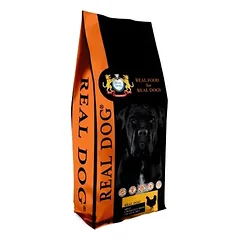
Real Dog
Real Dog sausas maistas suaugusiems, didelių-milžiniškų veislių, šunims su vištiena ir ryžiais 20kg
2,11 €/kg
42,15 € / 20 kg

Also known as: Akita Inu, Japanese Akita, Kuma Inu, Akita Shepherd, Great Japanese Dog
The Akita originates from Japan's Akita Prefecture, where it hunted large game, bear included, for centuries before becoming a national symbol of loyalty, embodied by Hachiko, the dog who kept waiting at a train station for his owner years after the man had died. The dense double coat, with a short, harsh outer layer, blows out heavily twice a year. A build up to 45 kilograms stays solid and muscular, and the breed is considered one of the most independent and dominant among spitz-type dogs. It can be confrontational with other dogs, especially of the same sex, so early socialization matters. With its owner it tends to be deeply loyal, though reserved with strangers. Life expectancy runs 10 to 13 years.
Browse dog food sized right for this breed
Akita: how old in human years?
Energy level
Trainability
Family friendly
Grooming need
Males 64–70 cm
Females 58–64 cm
Males 32–45 kg
Females 25–35 kg
Akita's average temperament and family-life score for this breed is moderate.
Akita's energy and exercise needs are moderate.
Akita's guarding and alertness traits are moderate.
Akita's grooming needs are moderate.
Japan still tells the story of Hachikō, the Akita who waited at a railway station every day for nearly ten years for an owner who had died. It sums up the breed well: an Akita attaches itself to its people deeply and for good, but it doesn't squander its feelings. It is calm and dignified at home, doesn't throw itself into every lap and doesn't bark without a reason, so when it does bark, go and see what's there.
This dog is clever but independent: it understands what you want and then decides for itself whether it makes sense. Training goes best in short, interesting sessions, with patience and respect, rather than repeating the same exercise for the tenth time. An Akita may well not get on with other dogs, especially of the same sex, so early socialisation and a reliable lead are essential, as is caution around small animals.
It needs moderate exercise: a couple of good walks a day and time in the garden or out in nature mean more to it than endless running. With strangers an Akita is reserved and alert, and it guards its territory and family by instinct. It is a dog for someone who values calm, loyal company and is ready to lead firmly but without harshness, not for those looking for a dog that loves the whole world.
For much of the year an Akita's coat looks like an advert and needs nothing more than a brush once or twice a week: the harsh outer hairs shed dirt, and underneath lies a dense, soft undercoat. Twice a year, though, that undercoat starts coming out in clumps, and for a few weeks tufts of fur roll across your floor like tumbleweed. Brush every day during those weeks, ideally with an undercoat rake, and outdoors if you can.
While you brush, look at the skin as well as the hair: dry flakes, thinning patches or a coat that has suddenly gone dull are signals in an Akita that shouldn't be ignored. Check the small upright ears weekly for dirt and smell, and the eyes for weeping, redness or squinting. Akitas are fairly clean dogs that groom themselves rather like cats, so they need bathing only now and then.
A big frame, a deep chest and a thick double coat: the things that make the Akita so striking also point to what's worth watching, namely the joints, the stomach, the skin and the coat. The Japanese Akita lives ten to thirteen years, and some of the conditions known in the breed are inherited, so ask the breeder about the parents' health testing before you take a puppy home. Akitas are stoical about pain and feeling unwell, so even small changes in behaviour or coat are worth showing to a vet.
This is general information, not veterinary advice. For your own dog's health, tests and treatment, see a vet.
The hip joint forms imperfectly, the ball of the thigh bone sits loosely in its socket, and the joint wears over time. You may notice your dog getting up slowly after a rest, reluctant on the stairs, or pushing off with both hind legs together when it runs, bunny-hopping. An Akita is a big, heavy dog that bears discomfort quietly, so show any change in gait to a vet.
The thyroid gland makes too little hormone and the whole body slows down. The dog may become sluggish, put on weight without eating more, seek out warm spots, and its coat may thin or lose its shine. An Akita's coat is so lush that you'll notice changes quickly, and working out what caused them is a job for a vet.
This is an umbrella term for a range of eye troubles, from the eyelids to the retina, and some of them can be inherited. You might notice your Akita squinting, a weeping or red eye, pawing at its face, cloudiness in the eye, or uncertain movement at dusk. An Akita's gaze is a hallmark of the breed, so show any change to a vet promptly, and when buying a puppy ask the breeder about the parents' health testing.
In this disease, inflammation damages the skin's oil glands, which should keep skin and hair supple, so the skin starts to scale and the coat loses its quality. You may notice a dull, dry coat, dandruff-like flakes, scale clinging to the hairs and thinning patches, sometimes with an unpleasant smell. The Akita is one of the breeds this disease is linked to, so a coat that fades unusually or skin that keeps flaking is worth showing to a vet.
The stomach fills with gas, swells and can twist, cutting off its own blood supply. The dog becomes restless, tries to vomit but brings nothing up, drools heavily, and its belly looks swollen and tight. A large, deep-chested Akita is one of the dogs at risk, and this is an emergency: if you see these signs, get to a vet immediately.
This list is chosen by the breed's weight (45 kg) rather than the breed itself: shops label food by dog size, so every breed of the same size gets the same list. Prices are updated daily.
≈ 420 g of dry food a day, from €22,91 a month For a neutered, normally active 34,3 kg dog. Calculate for your dog
Real Dog
2,11 €/kg
42,15 € / 20 kg

Sam's Field
2,56 €/kg
33,26 € / 13 kg
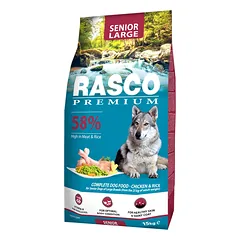
Rasco
2,67 €/kg
39,99 € / 15 kg
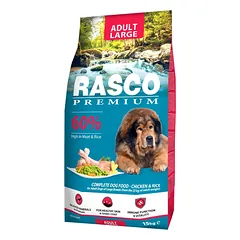
Rasco
2,67 €/kg
39,99 € / 15 kg
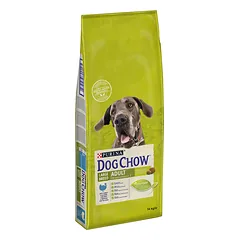
Purina
2,71 €/kg
37,96 € / 14 kg

Sam's Field
2,77 €/kg
35,99 € / 13 kg
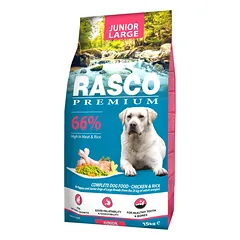
Rasco
2,80 €/kg
41,99 € / 15 kg
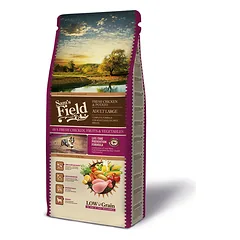
Sam's Field
2,85 €/kg
37,04 € / 13 kg