

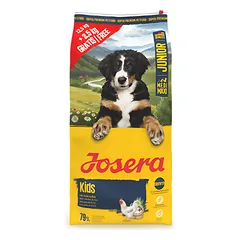
Josera
Josera Kids 12,5kg + 2,5kg = 15 kg
1,38 €/kg
37,89 € / 27,5 kg

Also known as: Oorang airedale
Known as the King of Terriers for being the largest of all terrier breeds, the Airedale was developed in Yorkshire's Aire Valley in the 19th century to hunt otters and other water game. A male can weigh up to 29 kilograms, and its wiry, dense coat needs periodic hand stripping to keep its proper texture rather than just clipping. During the First World War the British Army used Airedales as messenger and casualty dogs in the trenches, valued for their courage and stamina. That size and strength mean the breed needs firm, consistent training from an early age, particularly around other dogs. Despite its working background, at home the Airedale is often playful and deeply attached to its family. Life expectancy runs 10 to 13 years.
Browse dog food sized right for this breed
Airedale Terrier: how old in human years?
Energy level
Trainability
Family friendly
Grooming need
Males 58–61 cm
Females 56–59 cm
Males 23–29 kg
Females 18–23 kg
Airedale Terrier's average temperament and family-life score for this breed is moderate.
Airedale Terrier's energy and exercise needs are high.
Airedale Terrier's guarding and alertness traits are moderate.
Airedale Terrier's grooming needs are low.
An Airedale wakes up with a plan, and it rarely matches yours. He needs a lot of movement: long walks, runs, tug and ball games, and his idea of a perfect day is one spent with you in a forest, along a beach or on a long hike. Without enough exercise and things to do he will find his own entertainment, and after such a day the flower bed can look like an archaeological dig. A small flat with no long outings will feel cramped to him.
He is clever and quick to learn, yet always a terrier: he understands perfectly well, he just doesn't always see why he should comply right now. Short, varied lessons, a sense of humour and treats work best, while repeating the same command for the tenth time bores him fast. His hunting instinct is strong, so a neighbour's cat or a hare in a meadow can push your commands into second place in a heartbeat; start recall training early and be patient with it.
With his family the Airedale is cheerful, mischievous and deeply attached, keen to be wherever something interesting is going on. He gets on with children, though his energy can be a bit much for little ones, so keep an eye on play. He meets strangers with reserve and will make sure you know about everyone who stops at the gate, and he gets along better with other dogs if he spends plenty of time with them from puppyhood.
The Airedale wears a wire coat: hard, dense, crinkly hair on top and a soft undercoat beneath. It shrugs off rain and brambles and leaves little hair on the floor, but because it doesn't shed out the way many coats do, dead hair stays put and the dog slowly starts to look like a scruffy doormat. Traditionally the coat is hand-stripped a few times a year, which keeps its colour and harsh texture; for a dog that isn't being shown, plenty of owners go for clipping instead, accepting a softer and slightly paler coat. Between trims, brush once or twice a week, paying special attention to the legs and beard, where hair tangles first.
The beard is a story of its own. After every drink it drips across the kitchen, and after a walk it brings home half the forest, so give it a wipe and a comb. While brushing, part the coat and look at the skin for redness, flakes or scratched patches. Check inside the folded ears weekly to see they are clean and don't smell; a groomer can tidy the hair at the ear opening. The eyes should be clear, and if the eyebrow hair starts poking into them, trim it back.
The Airedale is the largest of the terriers and tends to look as if illness had never heard of him: solid, muscular and ready for the next adventure. Still, there are a few areas his owners should keep an eye on, namely the joints, the stomach and the thyroid. None of them means your dog will get ill, but knowing the signs helps you notice early when something is off.
This is general information, not veterinary advice. For your own dog's health, tests and treatment, see a vet.
A developmental problem of the hip joint: the head of the thigh bone and the socket in the pelvis don't form quite properly, so the joint moves unevenly and wears over time. You might notice your Airedale getting up stiffly in the morning, hesitating before jumping into the car, or swaying slightly at the hips as he runs. For such an active, bouncy dog sound hips matter a lot, so ask the breeder about the parents' health testing and talk to your vet about how much exercise a growing puppy should get.
The stomach fills with gas and can twist, pinching off its blood vessels, and this is life-threatening. The dog becomes restless, looks round at his flank, tries to vomit without success, drools, and the belly swells and turns hard. For a big, deep-chested dog like the Airedale the risk is real, so if you see these signs he needs a vet immediately.
When the thyroid gland makes too little hormone, the whole body seems to slow down. Your normally tireless Airedale stops racing to the door, puts on weight while eating the same, seeks out warm spots, and his coat thins or turns dry and dull. Changes like these are easy to put down to age or laziness, but if your terrier has lost his spark, it is worth a visit to your vet, who can check with a blood test.
This list is chosen by the breed's weight (29 kg) rather than the breed itself: shops label food by dog size, so every breed of the same size gets the same list. Prices are updated daily.
≈ 315 g of dry food a day, from €17,15 a month For a neutered, normally active 23,3 kg dog. Calculate for your dog
Josera
1,38 €/kg
37,89 € / 27,5 kg

Sam's Field
1,80 €/kg
26,99 € / 15 kg

Country Dog
1,89 €/kg
28,29 € / 15 kg

Club 4 Paws
1,92 €/kg
26,94 € / 14 kg
Diamant
1,93 €/kg
28,99 € / 15 kg
Gemon
1,94 €/kg
2,42 € / 1,3 kg

BIO FORM
2,00 €/kg
40,00 € / 20 kg

BIO FORM
2,00 €/kg
40,00 € / 20 kg