

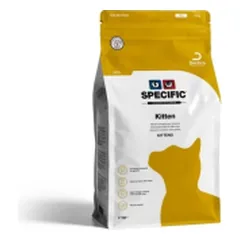
Specific
Specific FPD Kitten sausas maistas augantiems kačiukams, 400 kg
0,01 €/kg
5,59 € / 400 kg

The Burmilla breed arose in the United Kingdom in the 1980s, when a Burmese and a chinchilla Persian mated by accident. The short, smooth coat has a silvery or golden shimmer, because each hair is tipped with a darker shade, and the eyes are outlined in a dark line. Adults typically weigh around 3 to 6 kilograms and are medium-sized and muscular. The coat is easy to look after, and an occasional brushing is enough. Burmillas are typically playful and curious, and they like to be at the centre of family life. The name combines those of the two parent breeds, Burmese and Chinchilla. Life expectancy is typically around 12 to 16 years.
Burmilla: how old in human years?
Energy level
Playfulness
Family friendly
Grooming need
Males 4–6 kg
Females 3–4.5 kg
Burmilla: average score for sociability and trainability is moderate.
Burmilla: average score for activity and living space is high.
Burmilla: average score for personality and communication is moderate.
Burmilla: grooming and shedding demands are low.
The 1–5 trait scores are editorial estimates, not measurements. Every cat is an individual, so treat them as a general guide.
A Burmilla plays like a kitten well into adulthood: chasing a spot of light, hiding behind the curtain and waiting for you to pass so it can ambush an ankle. It has plenty of energy, so a daily game with a wand or a ball matters to it as much as dinner, and a sturdy cat tree takes care of whatever is left.
It is affectionate but not clingy: it likes to be wherever you are, sits on the edge of the desk while you work and finds your lap in the evening. It gets on with children who know how to play gently, and a friendly dog tends to become just another playmate.
It talks in moderation, in a soft voice, and mainly when it has something to say. It lives comfortably in a flat and copes with a long day alone, though it would rather spend it with another cat, and a window with a bird feeder beyond the glass is its idea of television.
A Burmilla's eyes look as though they have been outlined in pencil, and its short, smooth coat is pale at the roots and darker only at the tips, so it shimmers as the cat moves. A coat like this sheds little and barely tangles: once a week, run a soft brush or a rubber grooming glove over it, and the loose hair ends up in your hand rather than on your black jumper.
No more work than that, unless the cat gets properly dirty; a short coat almost never needs a bath. The weekly brush has another use, too: you see whether the coat still shines and feel any rough patch of skin or new lump. Show anything that looks unusual to a vet.
We don't have reliable health information specific to this breed, so we don't list conditions here. Keep up regular vet check-ups, and if you are getting a kitten, ask the breeder about the parents' health testing.
This is general information, not veterinary advice. For your own cat's health, tests and treatment, see a vet.
This list is the same on every cat breed page. Shops do not label cat food by breed, so it simply shows the cheapest cat food we track per kilogram. Check the label for your cat's age and health needs. Prices are updated daily.
≈ 66 g of dry food a day, from €3,80 a month For a neutered, normally active 4,4 kg cat. Calculate for your cat
Specific
0,01 €/kg
5,59 € / 400 kg
Brit Premium
0,33 €/kg
0,80 € / 2,4 kg
0,55 €/kg
1,05 € / 1,9 kg
0,55 €/kg
1,05 € / 1,9 kg

Tigerino
0,87 €/kg
20,89 € / 24 kg
Gourmet
0,94 €/kg
0,96 € / 1,0 kg
Fitmin for Life
1,00 €/kg
0,80 € / 0,8 kg
Josera
1,10 €/kg
1,49 € / 1,4 kg