

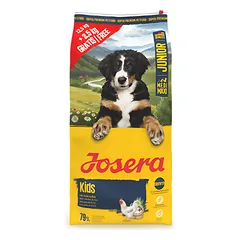
Josera
Josera Kids 12,5kg + 2,5kg = 15 kg
1,38 €/kg
37,89 € / 27,5 kg

Also known as: Portie
Portuguese fishermen used this dog to help with work at sea: carrying messages between boats, herding fish into nets, and retrieving anything that fell overboard. The curly or wavy single coat, with no undercoat, functions much like a poodle's, repels water and sheds very little, which is why the breed is often cited among the more allergy friendly options. A male can weigh up to 25 kilograms of muscular, swimming built frame with webbed feet. The breed came close to extinction as motorized boats replaced sailing vessels and fishermen no longer needed its help, but it was revived in the mid 20th century by dedicated breeders, including a Portuguese businessman. High energy and intelligence mean it needs consistent engagement. Life expectancy runs 11 to 13 years.
Browse dog food sized right for this breed
Portuguese Water Dog: how old in human years?
Energy level
Trainability
Family friendly
Grooming need
Males 50–57 cm
Females 43–52 cm
Males 19–25 kg
Females 16–22 kg
Portuguese Water Dog's average temperament and family-life score for this breed is high.
Portuguese Water Dog's energy and exercise needs are high.
Portuguese Water Dog's guarding and alertness traits are moderate.
Portuguese Water Dog's grooming needs are low.
On the Algarve coast, fishermen once worked alongside dogs like this one: they swam out to herd fish into the nets, fetched gear that went overboard and carried messages between boats. The modern Portuguese Water Dog still wants a job and still treats water as his natural element. He has energy and brains in equal, generous measure, and a day of only short walks will be spent inventing work, from rearranging the shoes to finding out how the bin opens.
Training him is one of the real pleasures of owning a dog: he is quick, keen and happy to work for praise and a game, so give him something to learn, whether that is obedience, retrieving, scent games, water work or agility. Mental work tires him as much as running does. He is affectionate and loyal with his family, great with children who like to play, gets along with other dogs, is polite with visitors, and will announce arrivals with a bark or two.
A flat works only if you are truly committed to long daily exercise; a house with a garden and a lake within reach is much closer to his dream. He wants to be with you, and long days alone don't suit him. A typical good day: a long walk or a swim in the morning, a training game at lunchtime, another proper outing in the evening, and then a heap of sleeping curls at your feet.
With no undercoat, this coat hardly sheds, but every hair that comes loose stays caught in the curls, and that is exactly how mats begin. Brush right down to the skin two or three times a week with a slicker brush and a metal comb, paying attention to the armpits, behind the ears and the legs, and plan on a clip every couple of months: the short retriever clip, or the traditional lion clip with the hindquarters shaved. A groomer can do it, or you can learn; either way, the comb is also how you find dry, flaky or reddened skin under all that hair.
This dog was made for water, and he will prove it in every lake you pass. After a swim, rinse off the salt or lake water if you can and dry the coat well, right down to the skin. The ears are covered in hair and hang close to the head, so they hold moisture: dry them after swimming and look inside once a week, where they should be clean, pale and odourless. Trim the hair around the eyes so it doesn't poke into them, and wipe the corners gently with a damp cloth.
The trickiest thing about the conditions below is that their first signs look like nothing much: a little tiredness, a stiff morning, a dog off his food. A Portuguese Water Dog can expect eleven to thirteen years, and a fit, busy dog of this size can spend a good share of them in excellent shape. With regular check-ups and an eye on those small changes, you and your vet can act early.
This is general information, not veterinary advice. For your own dog's health, tests and treatment, see a vet.
Hypothyroidism means the thyroid makes too little hormone, and everything in the body slows down. In a dog as lively as a Portuguese Water Dog the change can be striking: less enthusiasm for the water, weight that creeps on, a dog who seeks out warmth, and a coat that thins or changes texture. If your bright, busy dog starts to seem dull, let your vet find out why.
Hip dysplasia is a loose, poorly fitting hip joint that wears unevenly over time. Signs include stiffness after rest, reluctance to jump into the car or climb stairs, a swaying hind end or a shortened stride. For an athletic dog who swims, runs and jumps, any change in how he moves is worth showing your vet, and before getting a puppy, ask the breeder about the parents' health testing.
In Addison's disease the adrenal glands make too little of the hormones the body needs to cope with stress and keep its salts in balance. The early signs are vague and come and go: tiredness, poor appetite, vomiting or diarrhoea, a dog who seems off and then better again. It can also cause a sudden collapse, which needs a vet immediately; for the quieter signs, talk to your vet if your normally tireless water dog keeps having off days.
Congenital eye problems are faults a puppy is born with, affecting for example the lens, the retina or the structure of the eye itself. Some are obvious, like cloudiness or one eye looking different from the other, while others only show as a puppy who seems clumsy or hesitant in dim light. The curly fringe over a Portuguese Water Dog's eyes can hide a lot, so lift it and look, have the vet check a new puppy's eyes, and ask the breeder about the parents' health testing.
This list is chosen by the breed's weight (25 kg) rather than the breed itself: shops label food by dog size, so every breed of the same size gets the same list. Prices are updated daily.
≈ 285 g of dry food a day, from €15,58 a month For a neutered, normally active 20,5 kg dog. Calculate for your dog
Josera
1,38 €/kg
37,89 € / 27,5 kg

Sam's Field
1,80 €/kg
26,99 € / 15 kg

Country Dog
1,89 €/kg
28,29 € / 15 kg

Club 4 Paws
1,92 €/kg
26,94 € / 14 kg
Diamant
1,93 €/kg
28,99 € / 15 kg
Gemon
1,94 €/kg
2,42 € / 1,3 kg

BIO FORM
2,00 €/kg
40,00 € / 20 kg

BIO FORM
2,00 €/kg
40,00 € / 20 kg