

Josera
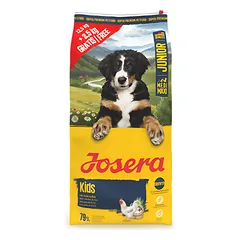
Josera Kids 12,5kg + 2,5kg = 15 kg
1,38 €/kg
37,89 € / 27,5 kg

Also known as: English Pointer
Bred in England through the 18th century for one specific task, freezing into a rigid stance the instant it scents game and holding that pose to mark the exact spot for the hunter, which is exactly where the name Pointer comes from. The short, glossy coat needs almost no grooming, but underneath it is a long-legged, aerodynamic frame built to cover open ground for hours at a stretch. An adult male can weigh up to 34 kilograms without carrying an ounce of excess. This is not a dog that settles quietly on a rug all day; without enough exercise it grows restless and vocal about it. Britain's tradition of pointing breeds goes back centuries, and this one's build has changed remarkably little in that time. In the home it tends to be affectionate and even-tempered, provided its outdoor needs are met first. Life expectancy runs 12 to 14 years.
Browse dog food sized right for this breed
Pointer: how old in human years?
Energy level
Trainability
Family friendly
Grooming need
Males 63–69 cm
Females 61–66 cm
Males 25–34 kg
Females 20–30 kg
Pointer's average temperament and family-life score for this breed is moderate.
Pointer's energy and exercise needs are high.
Pointer's guarding and alertness traits are low.
Pointer's grooming needs are low.
A walk in the park, a pigeon on the path, and your dog turns to stone: body stretched, tail level, one front paw lifted, nose aimed at the bird. That is a Pointer doing exactly what it was bred for in Great Britain, finding game and showing you where it is. Until that moment it runs, wide and fast, and it needs to run every single day, not half an hour around the block but long and free somewhere safe. A flat and a quiet routine are far too small a life for it.
It learns willingly and understands quickly, but the nose and the hunting instinct are very strong. Work on the recall patiently and early, and until it is reliable a long line is your best friend. A cat in the garden or a hare at the edge of a field can push every command out of its head in an instant. Harshness gets you nowhere with this sensitive dog; play, praise and tasks that feel like work get you everything.
Indoors, once it has had a proper run, it is surprisingly calm and happy to doze at your feet. It gets on well with children, rubs along with other dogs when properly introduced, and greets visitors without suspicion. As a guard it is useless and it barks very little. It is happiest with an active family that runs, hikes or hunts and gladly brings the dog along.
A Pointer's coat is short, dense and glossy, as if someone had polished it, and it asks very little of you. Once a week, run a rubber brush or grooming mitt over it: the dead hair comes away on the mitt and the shine only gets better. It sheds moderately all year round, so you will still find short hairs on dark trousers. Baths can be rare; mud dries on a coat like this and simply falls off.
The skin is where your attention belongs. That thin coat is poor armour against thorns, sticks and stubble, so after every run in the fields go over the whole body with your hand and check the feet, chest and belly, where scratches, ticks and grass seeds are easy to spot. In winter the same coat means a Pointer standing still in the cold gets chilly fast, even though it keeps itself warm while running. Lift the hanging ears and look inside every week, and check the eyes after a dash through long grass; redness, a bad smell or weeping are reasons to see the vet.
Lean, long-legged and built to cover open country from dawn to dusk, the Pointer is a sturdy dog at heart and lives twelve to fourteen years. A handful of inherited joint and nerve conditions are known in the breed, along with deafness, and its deep chest means the signs of a twisted stomach are worth knowing. Ask the breeder about the parents' health testing before you bring a puppy home, and leave the rest for a vet to judge.
This is general information, not veterinary advice. For your own dog's health, tests and treatment, see a vet.
The hip or elbow joint forms imperfectly, so the bones grind instead of gliding and the joint wears over time. You might notice your dog slow to get up after a long run, limping, or suddenly reluctant to jump into the car. A Pointer runs with its whole heart and can hide discomfort for a long time, so show any change in its gait to a vet.
The kneecap, a small bone at the front of the knee, can slip out of its groove, and the leg briefly seems to lock. You might see your dog hold up a hind leg for a few strides mid-run and then carry on as if nothing happened. For a runner like the Pointer sound knees matter a great deal, so that little skip is worth showing to a vet.
This inherited nerve disease means a young dog gradually feels less and less pain in its paws and toes. You may notice a puppy constantly licking or chewing its feet, with sores appearing that don't seem to bother it at all. A dog that tears through stubble and brambles needs feeling in its feet, so show such changes to a vet promptly, and ask the breeder about the parents' health testing before you take a puppy.
In this inherited disease the nerve cells in the spinal cord that tell the muscles to move slowly die off, and the muscles weaken and waste. It appears in young dogs: a puppy may tire quickly, walk unsteadily or with short steps, and seem weak in the hind legs. A Pointer puppy ought to be tireless, so if yours keeps sitting down for a rest, take it to a vet.
The cerebellum is the part of the brain that coordinates movement and balance; in this inherited disease it doesn't do its job properly, and movements lose their precision. You may notice a wobbly gait, legs lifted too high or a wide-legged stance. A Pointer should move lightly and smoothly, so any clumsiness, especially in a young dog, is worth showing to a vet.
A deaf dog hears nothing at all or only on one side, and a deaf puppy is easy to miss because it simply follows its littermates around. You might notice it doesn't wake when you walk in, or ignores your call when it can't see you. A Pointer works far from its handler and relies on hearing, so ask the breeder about the parents' health testing before you choose a puppy.
The stomach fills with gas, swells and can twist on itself, cutting off its own blood supply. The dog turns restless, retches without bringing anything up, drools, and its belly looks swollen and tight. The deep-chested Pointer is one of the dogs at risk, and this is an emergency: if you see these signs, get to a vet immediately.
This list is chosen by the breed's weight (34 kg) rather than the breed itself: shops label food by dog size, so every breed of the same size gets the same list. Prices are updated daily.
≈ 355 g of dry food a day, from €19,32 a month For a neutered, normally active 27,3 kg dog. Calculate for your dog
Josera
1,38 €/kg
37,89 € / 27,5 kg

Sam's Field
1,80 €/kg
26,99 € / 15 kg

Country Dog
1,89 €/kg
28,29 € / 15 kg

Club 4 Paws
1,92 €/kg
26,94 € / 14 kg

Diamant
1,93 €/kg
28,99 € / 15 kg

Gemon
1,94 €/kg
2,42 € / 1,3 kg

BIO FORM
2,00 €/kg
40,00 € / 20 kg

BIO FORM
2,00 €/kg
40,00 € / 20 kg