

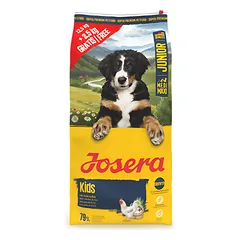
Josera
Josera Kids 12,5kg + 2,5kg = 15 kg
1,38 €/kg
37,89 € / 27,5 kg

The breed was developed in late 18th century Scotland by the fourth Duke of Gordon, who gave it his name, aiming for a setter sturdy and enduring enough for rugged, hilly terrain. It is the heaviest of the three setter breeds: a male can reach 36 kilograms, on a considerably heavier frame than its English or Irish cousins. The medium length, flat or slightly wavy coat is always black with rich tan markings, and that combination is so distinctive that similar coloring is often described simply as gordon coloring. Though bred as a gundog, the Gordon Setter matures more slowly than most breeds and can be quite boisterous and clumsy as a youngster. With family it tends to be loyal and protective, sometimes reserved with strangers. Regular brushing is essential to keep the coat from matting. Life expectancy runs 10 to 12 years.
Browse dog food sized right for this breed
Gordon Setter: how old in human years?
Energy level
Trainability
Family friendly
Grooming need
Males 62–68 cm
Females 58–64 cm
Males 25–36 kg
Females 20–32 kg
Gordon Setter's average temperament and family-life score for this breed is high.
Gordon Setter's energy and exercise needs are moderate.
Gordon Setter's guarding and alertness traits are moderate.
Gordon Setter's grooming needs are moderate.
Anyone who has seen a Gordon Setter tearing across an autumn stubble field understands why a lap of the block will never be enough. This is a strong, tireless bird dog that needs long walks and a chance to really run every day, ideally in fields or woods, somewhere safe and fenced, because its nose pulls harder than your voice. A flat is too cramped for it, and an unfenced garden is an invitation to adventure.
It is clever and keen to learn, but it matures slowly and stays a bit of a puppy for a long time, and sometimes a bit stubborn too. Patient, cheerful sessions and plenty of praise work best; harshness only pushes this sensitive dog away. With its family it is affectionate and loyal, patient with children and usually fine with other dogs. It is a little more reserved with strangers than other setters and will let you know someone has arrived, but it will never make a real guard.
A good day for it means a morning outdoors with work for its nose and an evening close to its people. It does not like being left alone for long and will follow you from room to room, and once tired it will claim the whole sofa and sigh as if it had walked a hundred kilometres.
A Gordon Setter's coat is medium-length, straight or slightly wavy, black with rich tan markings, turning into long feathering on the ears, chest, belly, backs of the legs and tail. That feathering is where burrs, grass seeds and mats collect after a walk through fields, so brush several times a week and give the dog at least a quick check after every outing in long grass. It sheds moderately: there will be hair on a dark rug, but not clouds of it. Trim the hair between the toes and around the feet regularly; less mud, fewer seeds caught there.
The long, heavy ears cover the ear canal, so once a week lift them, look inside and give them a sniff, and dry them gently after a swim. Check the skin as you brush: ticks, scratches and red patches hide easily under thick black hair, so it is better to find them with your fingers. The eyes should be clear, without redness or heavy discharge; wipe dirt from the corners with a damp cloth.
The Gordon Setter is a large, deep-chested gundog built to work for hours in the field, and its health reflects that build. The stomach, hips, eyes and thyroid are worth knowing about, and one of these is better learned in advance, because there is no time to wait when it strikes. Regular vet check-ups and your own attention will catch the rest.
This is general information, not veterinary advice. For your own dog's health, tests and treatment, see a vet.
This is a condition in which the stomach fills with gas and can twist, pinching off its blood vessels. The dog becomes restless, tries to vomit but brings nothing up, drools, and the belly looks swollen and tight. A Gordon Setter is a big, deep-chested dog, so know these signs by heart: if they appear, the dog needs a vet immediately.
Hip dysplasia is a fault in how the hip joint forms: the ball of the thigh bone sits poorly in its socket and the joint wears over time. You might notice that after a long day in the field your Setter gets up stiffly, won't jump into the car boot, or walks with a slight sway at the back. For a dog that lives to run, sound hips are everything, so ask the breeder about the parents' health testing.
This is an inherited disease in which the retina slowly wastes away and sight fades. It shows first at dusk: a Setter that raced around freely by day starts to hesitate at the stairs in the evening or bumps into furniture in a dim room. Because it is inherited, if you are getting a puppy, ask the breeder about the parents' health testing.
When the thyroid gland makes too little hormone, the body slows down. A Gordon Setter becomes sluggish, tires sooner, gains weight, and its glossy black coat loses its gleam, thins or turns coarse. These changes arrive quietly, but whether the thyroid is to blame is something a vet can check with blood tests.
This list is chosen by the breed's weight (36 kg) rather than the breed itself: shops label food by dog size, so every breed of the same size gets the same list. Prices are updated daily.
≈ 360 g of dry food a day, from €19,84 a month For a neutered, normally active 28,3 kg dog. Calculate for your dog
Josera
1,38 €/kg
37,89 € / 27,5 kg

Sam's Field
1,80 €/kg
26,99 € / 15 kg

Country Dog
1,89 €/kg
28,29 € / 15 kg

Club 4 Paws
1,92 €/kg
26,94 € / 14 kg

Diamant
1,93 €/kg
28,99 € / 15 kg

Gemon
1,94 €/kg
2,42 € / 1,3 kg

BIO FORM
2,00 €/kg
40,00 € / 20 kg

BIO FORM
2,00 €/kg
40,00 € / 20 kg