

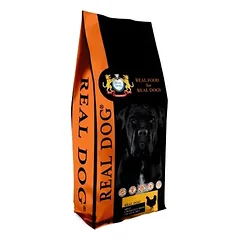
Real Dog
Real Dog sausas maistas suaugusiems, didelių-milžiniškų veislių, šunims su vištiena ir ryžiais 20kg
2,11 €/kg
42,15 € / 20 kg

Also known as: Italian Mastiff
The Neapolitan Mastiff comes from southern Italy and is considered a direct descendant of the old Roman molossers used for both warfare and farm guarding. Its most striking feature is an abundance of loose skin, with deep wrinkles across the muzzle and neck, historically thought to protect the dog from bite wounds while fighting. A male can weigh up to 70 kilograms, with a heavy, slow-moving build unlike many other guardian breeds. The short, dense coat needs little upkeep, but the abundant skin can bring health concerns around eye and skin-fold infections. In temperament it is calm, dignified, and strongly territorial, known for serious rather than noisy guarding. Life expectancy runs 8 to 10 years, on the short end even for a giant breed.
Browse dog food sized right for this breed
Neapolitan Mastiff: how old in human years?
Energy level
Trainability
Family friendly
Grooming need
Males 65–75 cm
Females 60–68 cm
Males 60–70 kg
Females 50–60 kg
Neapolitan Mastiff's average temperament and family-life score for this breed is moderate.
Neapolitan Mastiff's energy and exercise needs are low.
Neapolitan Mastiff's guarding and alertness traits are moderate.
Neapolitan Mastiff's grooming needs are moderate.
There is a moment, just after the Neapolitan Mastiff has had a drink, when everyone in the kitchen takes a step back. This is a dog who lives at his own pace: an unhurried walk morning and evening, a long sleep in between, and next to no interest in fetching anything. Descended from the guard dogs of southern Italy, he was kept to protect home and property, and that instinct sits at the centre of who he is.
He is deeply devoted to his family and gentle with the people he knows, but he warms to strangers very slowly, if at all, and he barks little, so his warning is a heavy presence in the doorway rather than noise. That makes early, thorough socialising and calm, consistent training essential rather than optional; he is not easy to train, and at sixty kilos his manners need to be in place long before he is fully grown. He is not always friendly with other dogs, so make introductions with care, and stay alert around small children: a giant like this can knock a toddler over without meaning to.
A flat is not his place: he needs room, a secure garden with a solid fence and an owner with experience of large guarding breeds. On hot days keep him in the shade and save the walks for the cool hours. In return you get a quiet, imposing housemate who wants nothing more than to lie near you, preferably on your feet.
The coat itself is easy: short, dense and smooth, it needs a rubber mitt once a week and a bit more attention when he sheds. The real grooming is the skin. The folds on the face, the neck and the dewlap trap moisture, food and drool, so a few times a week wipe them with a soft damp cloth and dry them properly, looking for redness or a sour smell; the folds above the eyes deserve the same care.
And then there is the drool. A Neapolitan Mastiff produces it in ropes, after a drink, after dinner and every time he shakes his head, so keep towels in every room you share and wipe his jowls after he eats. Check the eyes daily, since dust and grit can sit under those heavy lids, and look into the ears once a week: they should be clean, pale and odourless.
Everything about the Neapolitan Mastiff is generous: the head, the folds, the dewlap, the sixty-odd kilos. His health follows from that build: the joints carry a heavy load, the deep chest has its own risk, and all those folds of skin and heavy lids need watching. Dogs of this breed live around eight to ten years; know the signs below, keep your vet in the loop, and you give a gentle giant the best chance of growing old in comfort.
This is general information, not veterinary advice. For your own dog's health, tests and treatment, see a vet.
Heart disease covers several problems with the heart muscle or valves that leave the heart pumping less well. Signs to watch for are a cough, hard breathing at rest, tiring sooner on walks, or a swollen belly. In a calm, unhurried giant, tiring early is easy to put down to temperament, so mention any change to your vet; and if he ever collapses or faints, get to a vet immediately.
An allergy is the immune system overreacting to something harmless, such as pollen, dust mites or an ingredient in food, and in dogs it shows up on the skin. You may see paw licking, scratching, reddened skin or ear trouble that keeps coming back. On a Neapolitan Mastiff, look inside the skin folds too, where redness hides easily, and let the vet work out the cause.
Bloat happens when the stomach swells with gas and can rotate, trapping its contents and cutting off its blood supply; it can kill a dog within hours. Pacing, retching without bringing anything up, extra drooling and a hard, swollen belly are the warning signs. In a dog who drools anyway, the retching and the belly are the clues to trust, and as a deep-chested giant he has exactly the build this threatens, so get to a vet immediately.
Elbow and hip dysplasia means these joints develop out of shape, so the bones grind instead of gliding and the joints wear out early. Watch for a young dog limping on a front leg after play, stiffness when getting up, or a hind end that sways or bunny-hops at a run. A puppy heading for sixty kilos grows fast, so keep him lean, spare him stairs and long forced exercise while the joints form, and ask the breeder about the parents' health testing.
Cherry eye is when the tear gland of the third eyelid slips out of place and appears as a red, rounded lump in the inner corner of the eye. It is hard to miss: one morning there is a small red cherry where there was none, sometimes with watering or rubbing. Heavy, loose lids are part of the Neapolitan Mastiff's look, so check his eyes daily, and once the cherry appears, let the vet decide what to do.
This list is chosen by the breed's weight (70 kg) rather than the breed itself: shops label food by dog size, so every breed of the same size gets the same list. Prices are updated daily.
≈ 635 g of dry food a day, from €34,98 a month For a neutered, normally active 60 kg dog. Calculate for your dog
Real Dog
2,11 €/kg
42,15 € / 20 kg

Sam's Field
2,56 €/kg
33,26 € / 13 kg
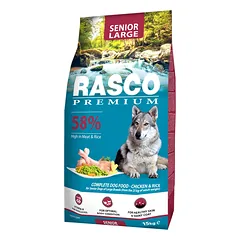
Rasco
2,67 €/kg
39,99 € / 15 kg
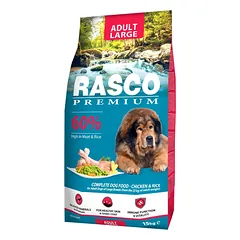
Rasco
2,67 €/kg
39,99 € / 15 kg
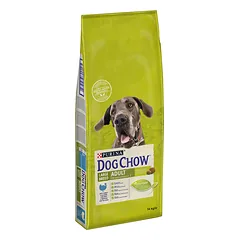
Purina
2,71 €/kg
37,96 € / 14 kg

Sam's Field
2,77 €/kg
35,99 € / 13 kg
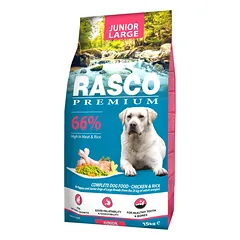
Rasco
2,80 €/kg
41,99 € / 15 kg

Sam's Field
2,85 €/kg
37,04 € / 13 kg