

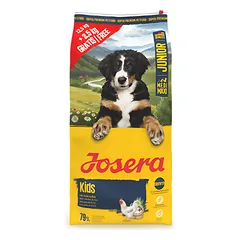
Josera
Josera Kids 12,5kg + 2,5kg = 15 kg
1,38 €/kg
37,89 € / 27,5 kg

The Pyrenean type of the Braque Français is the smaller, lighter cousin of the Gascony type, shaped in the foothills of the Pyrenees where hunters needed a gentler, more agile pointer than the heavier lowland dog. The short, dense coat needs little grooming, and a male rarely tops 25 kilograms, which lets it move nimbly over rocky, uneven ground. The breed was bred almost entirely for pointing and steadiness in the field, so appearance has always been a secondary concern. It has a soft temperament and reads its handler closely, responding well to voice commands during a hunt. In France it is still seen far more often in the field than in the show ring. Life expectancy runs 12 to 14 years.
Browse dog food sized right for this breed
Braque Français, Pyrenean type: how old in human years?
Energy level
Trainability
Family friendly
Grooming need
Males 47–58 cm
Females 44–54 cm
Males 17–25 kg
Females not specified
Braque Français, Pyrenean type's average temperament and family-life score for this breed is moderate.
Braque Français, Pyrenean type's energy and exercise needs are high.
Braque Français, Pyrenean type's guarding and alertness traits are low.
Braque Français, Pyrenean type's grooming needs are low.
You open the boot of the car and he is already in it, nose into the wind, tail making it impossible to stand still. This pointer was bred in south-west France to find birds and hold a point on them, and he needs work about as much as you need breakfast. A lap of the block will not touch him: he wants long walks, off-lead running somewhere safe and jobs for his nose.
He learns willingly and quickly works out what you want, especially when training feels like a game rather than a parade ground. The hunting drive is strong, though: a flushing pheasant or a hare bolting from a hedge can wipe every lesson from his head in a second, so practise the recall from day one. A small city flat is the wrong home for him; he does far better with a garden and owners who like being outdoors themselves.
Indoors he is gentle and affectionate, good with children, and happy to fold himself onto the sofa beside you once the day has been long enough. He usually gets on with other dogs and greets strangers without much enthusiasm but without hostility either. He will not make a guard dog, and he won't wear out the neighbours with barking.
The Braque Français, Pyrenean type wears a short, dense coat that lies flat against the body, so brushes and groomers barely come into it. Once a week, run a rubber mitt or a soft brush over him to lift the loose hairs and bring back the shine. He sheds lightly, though during a seasonal coat change you will still find the odd short hair woven into a dark rug.
The real work starts after a day outdoors. When you come back from fields and woodland, run your hands over his whole body, paying attention to the armpits, groin and the spot behind the ears where ticks like to settle. Check the drop ears once a week, and look at his pads after every long run over stubble or stony ground.
We don't have reliable health information specific to this breed, so we don't list conditions here. Keep up regular vet check-ups, and if you are getting a puppy, ask the breeder about the parents' health testing.
This is general information, not veterinary advice. For your own dog's health, tests and treatment, see a vet.
This list is chosen by the breed's weight (25 kg) rather than the breed itself: shops label food by dog size, so every breed of the same size gets the same list. Prices are updated daily.
≈ 290 g of dry food a day, from €15,87 a month For a neutered, normally active 21 kg dog. Calculate for your dog
Josera
1,38 €/kg
37,89 € / 27,5 kg
Sam's Field
1,80 €/kg
26,99 € / 15 kg

Country Dog
1,89 €/kg
28,29 € / 15 kg

Club 4 Paws
1,92 €/kg
26,94 € / 14 kg
Diamant
1,93 €/kg
28,99 € / 15 kg
Gemon
1,94 €/kg
2,42 € / 1,3 kg

BIO FORM
2,00 €/kg
40,00 € / 20 kg

BIO FORM
2,00 €/kg
40,00 € / 20 kg