

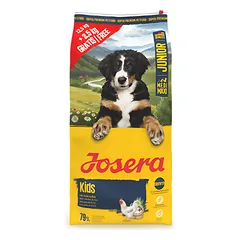
Josera
Josera Kids 12,5kg + 2,5kg = 15 kg
1,38 €/kg
37,89 € / 27,5 kg

The Pudelpointer was developed in Germany in the late 19th century by crossing the Poodle with English Pointers, aiming for an all-around gun dog tough enough for cold water and rough terrain. The idea was to combine the Poodle's intelligence and weatherproof coat with the Pointer's instinct to hold steady before flushed game. The harsh, wiry coat protects against brambles and cold while working outdoors, and a male weighing up to 30 kilograms carries enough stamina for a full day's hunt. This is a working breed that needs a real job, not just a backyard romp. At home it tends to bond closely with its handler and trains readily when given enough physical outlet. Life expectancy runs 13 to 14 years.
Browse dog food sized right for this breed
Pudelpointer: how old in human years?
Energy level
Trainability
Family friendly
Grooming need
Males 60–68 cm
Females 58–63 cm
Males 25–30 kg
Females 20–27 kg
Pudelpointer's average temperament and family-life score for this breed is high.
Pudelpointer's energy and exercise needs are high.
Pudelpointer's guarding and alertness traits are moderate.
Pudelpointer's grooming needs are low.
By eight in the morning he has already brought you a shoe, the lead and, if you let him, most of the meadow. The Pudelpointer was bred in Germany as an all-round hunting dog that points birds in the field, tracks in the forest and goes into water without a second thought. His energy reserves feel close to bottomless, so long daily walks, running, swimming and scent work are not treats for him but necessities.
He is one of those dogs it is a real pleasure to train: quick to understand, keen to work with you and happiest when given a job. But a mind like that, left idle, soon invents its own projects, and the strong hunting drive means cats, hares and birds will always interest him. A flat is not for him; he is happiest with an active family that hunts, runs or at least spends every weekend outdoors.
At home he is affectionate and friendly with children, and once tired he will doze contentedly at your feet. With other dogs and strangers he is usually polite, though he won't throw himself into everyone's arms. He will announce a visitor, but don't expect a guard dog; he is more interested in whether the visitor might throw a ball.
The Pudelpointer's coat is a compromise between poodle and pointer: harsh, wiry and dense, with a beard and eyebrows that give him a faintly professorial look. It shrugs off thorns and cold water and sheds lightly. Go through it with a stiff brush or comb once or twice a week, especially the beard, which collects grass seeds, twigs and bits of dinner; now and then the dead hair is best plucked out by hand to keep the coat harsh and weatherproof. Check the skin while you brush: redness, flakes or scratching are a reason to talk to your vet.
After work in water or wet grass, dry the drop ears and look inside them, since damp and warmth under an ear flap invite trouble. Check the eyes when you come out of the undergrowth: a seed or a speck of grit in the corner can irritate an eye, so show redness or watering to your vet. Trim the nails every few weeks if hard ground doesn't wear them down; when you hear them clicking on the floor, it's time.
The Pudelpointer is a sturdy working dog bred for field, forest and water, with a life expectancy of thirteen to fourteen years, and an active one stays fit well into maturity. Two conditions are linked to the breed, one affecting the nervous system and one the joints. If you are getting a puppy, ask the breeder about the parents' health testing, and regular vet visits help you catch changes early.
This is general information, not veterinary advice. For your own dog's health, tests and treatment, see a vet.
Epilepsy is a disorder of brain activity that causes repeated seizures. You might see your dog suddenly go rigid, fall onto his side, paddle his legs or drool, then seem confused for a while afterwards. A seizure is frightening to watch, especially in a dog as strong and busy as a Pudelpointer, so get him to a vet immediately when one happens.
Hip dysplasia means the hip joint has formed badly, so the ball of the thigh bone does not sit as snugly in its socket as it should. You might notice your dog getting up stiffly after a rest, pushing off with both hind legs together like a rabbit when he runs, or hesitating before jumping into the car. A Pudelpointer spends his day on the move and needs sound hips, so show any lameness to your vet.
This list is chosen by the breed's weight (30 kg) rather than the breed itself: shops label food by dog size, so every breed of the same size gets the same list. Prices are updated daily.
≈ 335 g of dry food a day, from €18,35 a month For a neutered, normally active 25,5 kg dog. Calculate for your dog
Josera
1,38 €/kg
37,89 € / 27,5 kg

Sam's Field
1,80 €/kg
26,99 € / 15 kg

Country Dog
1,89 €/kg
28,29 € / 15 kg

Club 4 Paws
1,92 €/kg
26,94 € / 14 kg
Diamant
1,93 €/kg
28,99 € / 15 kg
Gemon
1,94 €/kg
2,42 € / 1,3 kg

BIO FORM
2,00 €/kg
40,00 € / 20 kg

BIO FORM
2,00 €/kg
40,00 € / 20 kg