

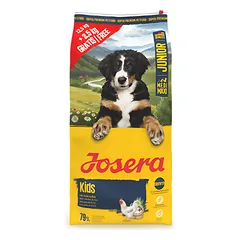
Josera
Josera Kids 12,5kg + 2,5kg = 15 kg
1,38 €/kg
37,89 € / 27,5 kg

Also known as: Flanders Cattle Dog
The Bouvier des Flandres developed on the marshy plains of Flanders, spanning Belgium and France, where monks and farmers used it to drive cattle, pull carts, and guard the farmstead. The rough double coat with its dense undercoat protected the dog from damp weather and thorny brush, and a male carries up to 40 kilograms of solid, muscular frame. During the First World War the breed served as a messenger and ambulance dog in the trenches for the Belgian army, work that nearly wiped it out by the war's end. The breed is known for a calm, independent temperament backed by a strong protective instinct that shows without excess aggression. Regular clipping and brushing of the coat is a genuine requirement, not an option. Life expectancy runs 10 to 12 years.
Browse dog food sized right for this breed
Bouvier des Flandres: how old in human years?
Energy level
Trainability
Family friendly
Grooming need
Males 62–68 cm
Females 59–65 cm
Males 35–40 kg
Females 27–35 kg
Bouvier des Flandres's average temperament and family-life score for this breed is high.
Bouvier des Flandres's energy and exercise needs are moderate.
Bouvier des Flandres's guarding and alertness traits are high.
Bouvier des Flandres's grooming needs are moderate.
The Bouvier des Flandres once drove cattle on Belgian farms, pulled carts and guarded the yard, so he is not a dog content to lie about all day. He needs a couple of hours of activity and work a day: long walks, games, obedience work, tracking or herding. A flat doesn't suit him; he is happiest in a house with a fenced garden and a family that takes him along in its life.
He is very intelligent and learns fast, but he thinks for himself, so he needs a calm, consistent and confident handler. Training with clear rules and tasks that mean something suits him better than endless repetition, and early socialisation with people, dogs and new places is a must.
To his family the Bouvier is devoted, patient and protective, gentle with children, though his size and herding instinct mean he may now and then try to round small children up into a group. He is reserved with strangers and makes a serious, reliable guard and watchdog. He gets along with other dogs if properly introduced, but may voice an opinion to dogs of the same sex.
The Bouvier wears a double coat: harsh, dry, slightly tousled-looking guard hairs over a dense, soft undercoat, and on his face it turns into a moustache, a beard and bushy eyebrows. He sheds little, but that is no gift, rather a reason to brush: loose hair stays trapped in the coat and, if a comb doesn't take it out, twists into felt. Brush and comb him down to the skin several times a week, especially in the armpits, behind the ears and on the legs, and every few months have the coat tidied, by hand-stripping or scissors, by a groomer who knows the breed.
The beard is a chapter of its own: wipe it after every meal and drink, because food gets caught there, it stays damp for a long time and starts to smell, and the skin underneath can turn red. Trim the eyebrows enough to keep his eyes visible, and check that they are clear, without discharge. His drop ears have hair inside and get little air, so look inside once a week. Trim his nails when you hear them clicking on the floor, and trim the hair between his pads.
A Bouvier des Flandres lifts his head from the water bowl, and his beard leaves a trail across half the room. Behind that bearded look is a strong, hardy working dog, but his owner has quite a list to know about: joints, heart, muscles, thyroid, larynx, eyes and a couple of emergencies. That doesn't mean he will be a sickly dog; it means that knowing the signs lets you catch changes in time, and regular vet check-ups help make sense of them.
This is general information, not veterinary advice. For your own dog's health, tests and treatment, see a vet.
An emergency in which the stomach fills with gas and can twist on itself, cutting off its blood supply. With a big, deep-chested Bouvier it pays to know the signs: restlessness, a swollen, tight belly, retching that brings nothing up, and heavy drooling. If you suspect it, don't wait: he needs a vet immediately.
An inherited muscle disease in which the muscle fibres gradually waste away and weaken. You may notice your Bouvier tiring sooner, moving with short, stiff steps and his leg muscles looking thinner, and sometimes he finds it harder to swallow or brings his food back up. Whether weakness comes from this disease is for your vet to determine, and if you are getting a puppy, ask the breeder about the parents' health testing.
An umbrella term for a range of eye troubles, from eyelid faults to inflammation, a clouding lens or damage to the cornea. A Bouvier's eyes sit under bushy eyebrows, so part them regularly and check that the eye isn't watering, red or cloudy and that he isn't squinting. If an eye suddenly turns red, looks painful or has been injured, he needs a vet immediately.
A developmental problem of the joints: as the puppy grows, the parts of the hip or elbow don't form quite right, so the joint wears faster than it should. His shaggy coat hides his gait well, so watch whether he gets up stiffly after a nap, limps after an active day or hesitates to jump into the car. Sound joints matter a great deal to a big working dog, so ask the breeder about the parents' health testing.
When the thyroid makes too little hormone, the body slows down. A lively, hard-working Bouvier may turn sluggish, gain weight without eating more, and his coat may thin or turn dry. Whether the thyroid is behind it is for your vet to determine.
The cartilages of the larynx no longer open properly when the dog breathes in, so less air reaches the lungs and he finds it harder to cool down. You may hear noisy, rasping breathing, especially on a hot day or after exercise, notice his bark changing or turning hoarse, or hear him cough as he drinks. If your Bouvier is struggling to breathe, his gums turn blue or he collapses, he needs a vet immediately.
An inherited disorder in which, after intense, exciting running or play, a dog's hind legs suddenly weaken and he can no longer walk. You may see him start to wobble, his legs crossing or dragging, before he lies down though he still wants to run. If your Bouvier collapses, he needs a vet immediately, and if you are getting a puppy, ask the breeder about the parents' health testing.
A narrowing just below the aortic valve that a dog is born with, which makes the heart work harder to push blood out to the body. A vet may first suspect it on hearing a murmur at a routine check-up, while you might notice him tiring sooner or breathing harder. If your Bouvier suddenly faints or collapses, he needs a vet immediately, and if you are getting a puppy, ask the breeder about the parents' health testing.
This list is chosen by the breed's weight (40 kg) rather than the breed itself: shops label food by dog size, so every breed of the same size gets the same list. Prices are updated daily.
≈ 420 g of dry food a day, from €22,91 a month For a neutered, normally active 34,3 kg dog. Calculate for your dog
Josera
1,38 €/kg
37,89 € / 27,5 kg

Sam's Field
1,80 €/kg
26,99 € / 15 kg

Country Dog
1,89 €/kg
28,29 € / 15 kg

Club 4 Paws
1,92 €/kg
26,94 € / 14 kg
Diamant
1,93 €/kg
28,99 € / 15 kg
Gemon
1,94 €/kg
2,42 € / 1,3 kg

BIO FORM
2,00 €/kg
40,00 € / 20 kg

BIO FORM
2,00 €/kg
40,00 € / 20 kg