

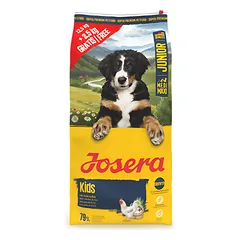
Josera
Josera Kids 12,5kg + 2,5kg = 15 kg
1,38 €/kg
37,89 € / 27,5 kg

Also known as: Belgian Malinois, Belgian Tervuren, Terv, Laekenois, Groenendael
In the late 19th century Belgian breeders unified various regional herding dogs into one breed with four coat varieties, long haired, short haired, rough haired and a fourth distinguished by color and texture. A male can weigh up to 30 kilograms on an athletic, agile frame built for a full day herding and guarding livestock. Belgium's police and military began using the breed as early as the start of the 20th century, and that working legacy still shows in its energy and sharp reactions today. The double coat sheds seasonally but heavily, so it needs regular brushing, particularly in spring and autumn. Without enough mental and physical work this dog can become anxious or destructive. With family it tends to be deeply loyal, though it can be reserved or even wary around strangers. Life expectancy runs 12 to 14 years.
Browse dog food sized right for this breed
Belgian Shepherd Dog: how old in human years?
Energy level
Trainability
Family friendly
Grooming need
Males 60–66 cm
Females 56–62 cm
Males 25–30 kg
Females 20–25 kg
Belgian Shepherd Dog's average temperament and family-life score for this breed is moderate.
Belgian Shepherd Dog's energy and exercise needs are moderate.
Belgian Shepherd Dog's guarding and alertness traits are high.
Belgian Shepherd Dog's grooming needs are low.
At six in the morning your Belgian Shepherd is already sitting by the door, looking at you as if you're both late for work. The breed was developed on Belgian farms to guard and herd flocks, and today you'll find it with the police, in search and rescue and on every sports field. It needs to run, but it also needs a job: tracking, obedience, agility or running beside a bike, and that every single day. A stroll round the block is just its warm-up.
It learns lightning-fast and loves to, but it is sensitive: clear, consistent rules and praise work, while harshness only damages the relationship. For a first-time owner it can be a lot of dog; for an experienced one it becomes a partner that reads your plans from half a glance. Left without anything to do, it will find its own work, such as guarding the garden against every passer-by or chasing the cat, the bicycle and anything else that moves fast.
With its own family it is devoted and gentle, and it gets on best with children old enough to respect a dog's space. With strangers it is reserved and watchful, announces every arrival loudly and will stand up for its people if it thinks it must, so early socialisation is not optional here. A flat works only if it gets a big daily workload outdoors; a house with a garden and an active family is a far better match.
How busy your brush will be depends on which of the four Belgian Shepherd varieties you have. A short-coated Malinois needs a weekly pass with a rubber brush; the long-coated Groenendael and Tervuren want a thorough combing a couple of times a week, especially behind the ears, on the trousers and in the armpits; the wire-coated Laekenois just needs regular tidying so the coat doesn't mat. All four carry a dense undercoat that comes out in earnest once or twice a year, and for those weeks the brush becomes a daily tool. Look at the skin as you go, because a scratch, a tick or a red patch is easy to miss in a thick coat.
Check eyes and ears weekly, ideally after a run through long grass: the upright ears air well, but grass seeds still find their way in, and a red or weeping eye is your cue to see the vet. Trim the nails when you hear them clicking on the floor, and brush the teeth a few times a week with a dog toothpaste; a dog that happily chews everything it can get appreciates a clean mouth more than you might think.
A lean body, straight legs, a muzzle of honest length: the Belgian Shepherd Dog has none of the extremes some breeds pay for with their health, and it lives twelve to fourteen years. Still, a few inherited joint and eye conditions are known in the breed, so before you take a puppy home it's worth asking the breeder about the parents' health testing. And if your dog starts to move or see differently, let a vet decide what is going on.
This is general information, not veterinary advice. For your own dog's health, tests and treatment, see a vet.
The elbow or hip joint forms imperfectly, so the bones don't fit together as they should and the joint wears over time. You might notice your dog getting up more slowly after a long session, favouring a front leg, or hesitating before jumping into the car. A Belgian Shepherd works flat out and wholeheartedly and can hide discomfort for a long time, so show any change in gait to a vet.
A cataract is a clouding of the lens: the clear lens slowly turns milky and the dog sees less and less through it. You may spot a whitish sheen deep in the eye, or notice that your dog no longer catches the ball so confidently at dusk. A Belgian Shepherd follows the whole world with its eyes, so any change in how it looks or sees is worth showing to a vet, who will decide what it is.
In this inherited disease the cells of the retina slowly die off and sight fades, first in dim light and darkness. The first sign may be a dog that is reluctant to go out into the garden in the evening or bumps into things, while running about as usual by day. Because it is inherited, ask the breeder about the parents' health testing before you take a Belgian Shepherd puppy home.
This list is chosen by the breed's weight (30 kg) rather than the breed itself: shops label food by dog size, so every breed of the same size gets the same list. Prices are updated daily.
≈ 330 g of dry food a day, from €18,08 a month For a neutered, normally active 25 kg dog. Calculate for your dog
Josera
1,38 €/kg
37,89 € / 27,5 kg

Sam's Field
1,80 €/kg
26,99 € / 15 kg

Country Dog
1,89 €/kg
28,29 € / 15 kg

Club 4 Paws
1,92 €/kg
26,94 € / 14 kg

Diamant
1,93 €/kg
28,99 € / 15 kg
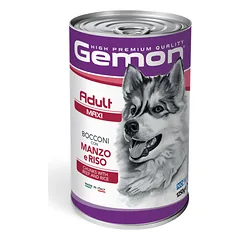
Gemon
1,94 €/kg
2,42 € / 1,3 kg

BIO FORM
2,00 €/kg
40,00 € / 20 kg

BIO FORM
2,00 €/kg
40,00 € / 20 kg