

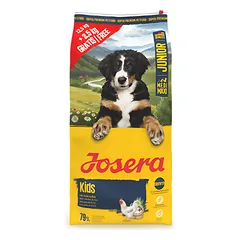
Josera
Josera Kids 12,5kg + 2,5kg = 15 kg
1,38 €/kg
37,89 € / 27,5 kg

Also known as: Portuguese Warren Hound, Podengo, Podengo Portugueso, Portuguese Podengo Pequeno
The Portuguese Podengo has been used to hunt rabbits in Portugal for centuries, often working in packs to flush game through scrub. The breed comes in three sizes, and this large variety can weigh up to 30 kilograms, the strongest and most powerful of the three. The coat comes smooth or wire-haired, both able to shrug off bad weather and thorny brush. The large, triangular ears stay constantly alert, useful for tracking prey movement through dense cover by sound. It tends to stay energetic and curious well into adulthood, and needs a steady outlet for that energy or it will find its own. It's loyal to its family but can be reserved with strangers. Life expectancy runs 12 to 15 years.
Browse dog food sized right for this breed
Portuguese Podengo: how old in human years?
Energy level
Trainability
Family friendly
Grooming need
Males 20–70 cm
Females 20–68 cm
Males 4–30 kg
Females 4–28 kg
Portuguese Podengo's average temperament and family-life score for this breed is moderate.
Portuguese Podengo's energy and exercise needs are high.
Portuguese Podengo's guarding and alertness traits are moderate.
Portuguese Podengo's grooming needs are low.
A rabbit in a bush thirty metres away, and your Portuguese Podengo is already there, ears up like radar dishes, tail taut. This is an old hunting dog that works by nose, eyes and ears alike, and its prey drive is as strong as any breed's. The breed comes in three sizes, from a small dog you can easily pick up to a tall, lean hunter, but the temperament runs through all of them: curious, lively and remarkably independent.
A Podengo learns well, but only when the lesson makes sense to it. Short sessions, treats and play work; harshness and endless repetition do not. Recall is the skill you will spend longest on, and even a well-trained dog is best kept on a lead anywhere unsafe, because when prey appears the ears simply switch off. Your garden needs a reliable fence, and cats or small pets should be introduced carefully and early.
With its own people it is affectionate and fun, it gets along with children who are calm with it, and it watches strangers from a distance and lets you know they are there. It needs real exercise every day: long walks, off-lead running somewhere fenced, or scent games. Once it has had its share it is fairly quiet indoors and will happily curl up wherever is warmest.
Portuguese Podengos come in two coats: smooth, with short hair lying close to the body, and wire, with longer, harsher hair. Either way there is little to do. A smooth coat only needs the occasional going-over with a rubber mitt or soft brush, and a wire coat a weekly comb to clear out dead hair and bits of grass. They shed lightly, and a bath is only needed when the dog has found something fragrant to roll in.
What needs more attention is what lies under the coat. This is a dog that crashes through scrub and long grass, so after every outing like that check the paws for scratches or embedded grass seeds and run your hands over the coat for ticks. The big upright ears collect dust, so look into them regularly; if you see redness or notice a bad smell, see a vet. Trim the nails if they don't wear down on their own.
We don't have reliable health information specific to this breed, so we don't list conditions here. Keep up regular vet check-ups, and if you are getting a puppy, ask the breeder about the parents' health testing.
This is general information, not veterinary advice. For your own dog's health, tests and treatment, see a vet.
This list is chosen by the breed's weight (30 kg) rather than the breed itself: shops label food by dog size, so every breed of the same size gets the same list. Prices are updated daily.
≈ 240 g of dry food a day, from €13,24 a month For a neutered, normally active 16,5 kg dog. Calculate for your dog
Josera
1,38 €/kg
37,89 € / 27,5 kg

Sam's Field
1,80 €/kg
26,99 € / 15 kg

Country Dog
1,89 €/kg
28,29 € / 15 kg

Club 4 Paws
1,92 €/kg
26,94 € / 14 kg
Diamant
1,93 €/kg
28,99 € / 15 kg
Gemon
1,94 €/kg
2,42 € / 1,3 kg

BIO FORM
2,00 €/kg
40,00 € / 20 kg

BIO FORM
2,00 €/kg
40,00 € / 20 kg