

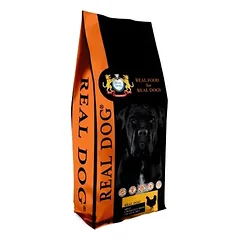
Real Dog
Real Dog sausas maistas suaugusiems, didelių-milžiniškų veislių, šunims su vištiena ir ryžiais 20kg
2,11 €/kg
42,15 € / 20 kg

Also known as: Hungarian sheepdog, Mop dog, Rope Dog
On the Hungarian plains this dog guarded sheep flocks for centuries, working independently and fighting off wolves with no human oversight required. Its signature corded white coat, tangled into thick ropes, isn't decorative: the cords camouflage it among the flock and shield the skin from bites. An adult male can weigh up to 60 kilograms. Maintaining the coat means hand-separating the cords so they don't fuse into a single mat, a process that takes years as the coat matures. The breed is naturally suspicious of strangers and strongly territorial. It suits an experienced owner with real space to offer. Life expectancy runs 10 to 12 years.
Browse dog food sized right for this breed
Komondor: how old in human years?
Energy level
Trainability
Family friendly
Grooming need
Males not specified
Females not specified
Males 50–60 kg
Females 40–50 kg
Komondor's average temperament and family-life score for this breed is low.
Komondor's energy and exercise needs are low.
Komondor's guarding and alertness traits are high.
Komondor's grooming needs are moderate.
The first time you see a Komondor lying in a yard, it is hard to tell which end is which. It, however, has already seen you. In Hungary these dogs guarded flocks for centuries, deciding for themselves what counted as a threat, and a Komondor still likes to make its own calls. With its family it is devoted and calm; with strangers it is reserved and suspicious, and every visitor will be weighed up, loudly announced and kept at the gate until you say otherwise.
It needs little in the way of exercise: a daily walk and a yard to patrol matter more to it than chasing a ball. Training a Komondor is a negotiation rather than a drill: it understands what you want, but first considers whether it makes sense. Early, calm and consistent socialisation with people and other dogs is essential, because a grown guardian without it may take its job far too seriously.
A flat is no place for it at all: a Komondor needs space, a fence and territory it can call its own. It suits people who value a calm, dignified companion that treats its duties with great seriousness, and who don't mind a coat that smells like wet sheep after the rain.
You will never brush a Komondor, and you shouldn't. The puppy fluff gradually clumps together, and you separate those clumps by hand so that they form individual cords rather than one enormous felt mat. It is quiet, almost meditative work that never quite ends, because the cords keep growing for life. The dog barely sheds: loose hair stays in the cords, along with whatever it collected on its walk, from twigs to snowballs.
Bath day is a whole-day project: soaking that coat takes a while, drying it takes far longer, and cords left damp can start to smell. Dry thoroughly, right down to the skin, and feel the skin itself while you're there, since redness or irritation hides easily under so much coat. Part the cords around the face so your dog can see you and you can see its eyes, and check the ear canals every week: they should be dry and free of smell.
Behind the curtain of white cords is a sturdy dog built for work on open pasture, with a life of around ten to twelve years. Its health calls for attention rather than worry: to the joints, the eyes and the ears, all of which that coat is happy to hide from you. If you are choosing a puppy, ask the breeder about the parents' health testing.
This is general information, not veterinary advice. For your own dog's health, tests and treatment, see a vet.
Dysplasia means the elbow or hip joint develops so that its parts don't fit together as they should, and over time the joint wears. You might notice a dog that gets up slowly after a nap, limps, or avoids the stairs. A Komondor's gait is hard to read under all that coat, so watch how it rises and moves, and have your vet look at any limp.
Entropion is when the edge of an eyelid rolls inward, so the lashes rub against the surface of the eye. The dog squints, the eye waters and reddens, and it may paw at its face. A Komondor's eyes live behind a fringe of cords, so part the coat now and then and take a close look; an irritated eye is one for the vet.
An ear infection is an irritated, infected ear canal that leaves a dog itchy and sore. The dog shakes its head, scratches at the ear, and you may notice a bad smell or dark discharge. A Komondor's drop ears sit under heavy cords that trap moisture easily, so check them regularly and take any change to your vet.
This list is chosen by the breed's weight (60 kg) rather than the breed itself: shops label food by dog size, so every breed of the same size gets the same list. Prices are updated daily.
≈ 555 g of dry food a day, from €30,51 a month For a neutered, normally active 50 kg dog. Calculate for your dog
Real Dog
2,11 €/kg
42,15 € / 20 kg

Sam's Field
2,56 €/kg
33,26 € / 13 kg
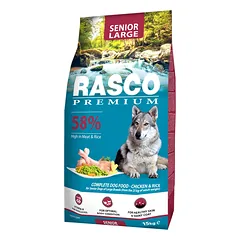
Rasco
2,67 €/kg
39,99 € / 15 kg
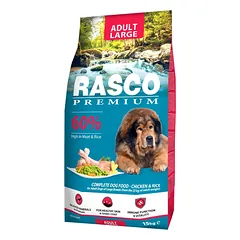
Rasco
2,67 €/kg
39,99 € / 15 kg
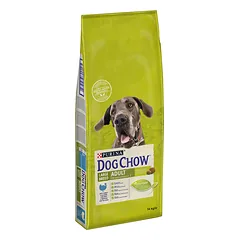
Purina
2,71 €/kg
37,96 € / 14 kg

Sam's Field
2,77 €/kg
35,99 € / 13 kg
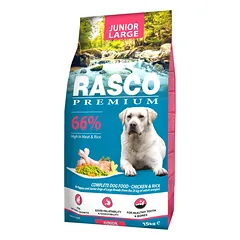
Rasco
2,80 €/kg
41,99 € / 15 kg
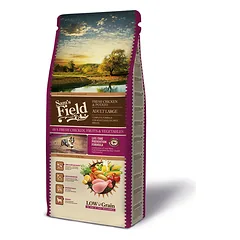
Sam's Field
2,85 €/kg
37,04 € / 13 kg