

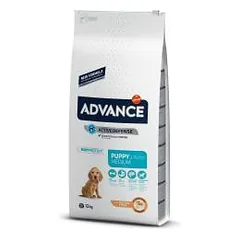
Advance
Advance Puppy Medium sausas maistas vidutinių veislių šuniukams, 12 kg
1,48 €/kg
17,76 € / 12 kg

Also known as: The Kelpie, Australian Sheep Dog
The Australian Kelpie descends from Scottish herding dogs brought to Australia in the 19th century, crossed and adapted locally to manage huge flocks of sheep across open, hot terrain with minimal direct human oversight. One of its most distinctive skills is running across the backs of tightly packed sheep at a fence line to save time and energy. The short, weatherproof double coat needs minimal grooming. A male weighs up to 20 kilograms and has real endurance, capable of covering tens of kilometers in a day. Without work or serious physical outlet at home, the breed quickly turns restless and destructive, making it a poor fit for a sedentary household. Life expectancy runs 10 to 13 years.
Browse dog food sized right for this breed
Australian Kelpie: how old in human years?
Energy level
Trainability
Family friendly
Grooming need
Males 46–51 cm
Females 43–48 cm
Males 14–20 kg
Females 11–18 kg
Australian Kelpie's average temperament and family-life score for this breed is high.
Australian Kelpie's energy and exercise needs are moderate.
Australian Kelpie's guarding and alertness traits are moderate.
Australian Kelpie's grooming needs are low.
At six in the morning it is already sitting by the door, watching you intently as if to ask why the sheep are not in the pen yet. The Australian Kelpie was bred to work flocks across Australia's vast sheep country, covering great distances every day, and that engine is still running. It is clever, learns remarkably fast and works with joy, but a Kelpie with nothing to do will find its own job: taking the fence apart, rounding up the hens or herding passing cyclists.
What it needs each day is not a stroll round the block but real work: long runs, ball games, scent tasks, agility or, best of all, herding. Anything that moves catches its eye, so practise the recall from day one and keep it on the lead near roads. Mental work tires it as much as physical, so even a short training session at home is a gift.
A flat is too small for a dog like this; it needs a garden, open fields and an owner who loves to move. With its family the Kelpie is devoted and affectionate, gets on with children, especially older ones who can run with it, meets strangers with reserve and barks to announce arrivals. Given enough to do, it will happily curl up at your feet in the evening, with one ear still on duty.
A Kelpie's coat is short, double and weatherproof: a dense undercoat guards against heat and rain, and the harsher outer hair sheds mud. It needs little upkeep: once a week go over it with a rubber brush or a short-bristled one, and when the undercoat comes out in tufts during the moult, brush a few times a week. Brushing is also a good moment to check the skin: after a long run through fields it may carry scratches, ticks or tangled seeds.
After every walk through long grass, look in the ears and between the toes, where grass seeds and burrs like to lodge. Upright ears air well but collect dust, so check once a week that they are clean and free of smell. Wipe the corners of the eyes with a damp cloth after a dusty day; red or weepy eyes, like head shaking, are a reason to show the dog to your vet.
The Australian Kelpie was bred to work day after day in heat and dust, so it is a tough, hardy dog, with a life expectancy of around ten to thirteen years. Its health list is short: joints, eyes and coordination. If you are choosing a puppy, ask the breeder about the parents' health testing, and if you notice changes, see your vet.
This is general information, not veterinary advice. For your own dog's health, tests and treatment, see a vet.
In hip dysplasia the hip joint forms badly, the ball moves more loosely in its socket than it should, and the joint wears over time. You might notice a dog who gets up stiffly after resting, is reluctant to jump, or runs with both back legs pushing together. A keen Kelpie may keep working through discomfort, so even a slight limp or a shortened stride is worth showing to your vet.
The kneecap slips out of its groove and the leg briefly locks. The classic picture is a dog running along that suddenly skips on three legs for a few strides, holding a back leg up, then carries on as if nothing happened. A Kelpie jumps a lot and turns sharply, so talk to your vet about any skipping like this.
PRA is an inherited disease in which the retina at the back of the eye slowly wastes away and the dog gradually loses its sight. Vision in dim light goes first: a dog that hesitates on its way into a dark garden, misses its toy at dusk, or whose eyes shine more brightly in the dark than before. A Kelpie works with its eyes, tracking every move of the flock, so before choosing a puppy ask the breeder about the parents' health testing.
The cerebellum, the part of the brain that coordinates movement, gradually stops working properly, and the dog loses precision in how it moves. In a young dog it shows as a wide-legged stance, high-stepping paws, a trembling head or a sway when it tries to walk in a straight line. A Kelpie puppy is naturally remarkably nimble, so clumsiness that doesn't pass is a reason to see your vet, and it is worth asking the breeder about the parents' health testing.
This list is chosen by the breed's weight (20 kg) rather than the breed itself: shops label food by dog size, so every breed of the same size gets the same list. Prices are updated daily.
≈ 235 g of dry food a day, from €12,82 a month For a neutered, normally active 15,8 kg dog. Calculate for your dog
Advance
1,48 €/kg
17,76 € / 12 kg
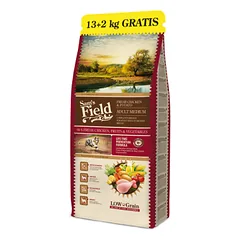
Sam's Field
1,80 €/kg
26,99 € / 15 kg

Country Dog
1,89 €/kg
28,29 € / 15 kg
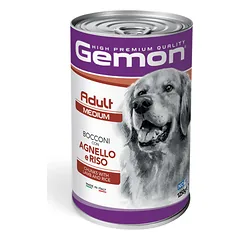
Gemon
1,94 €/kg
2,42 € / 1,3 kg
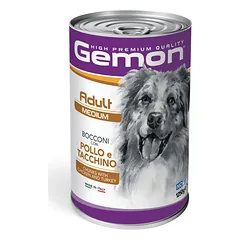
Gemon
1,94 €/kg
2,42 € / 1,3 kg
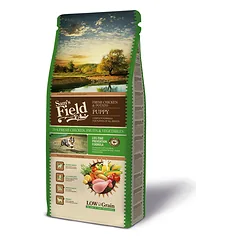
Sam's Field
2,11 €/kg
27,45 € / 13 kg
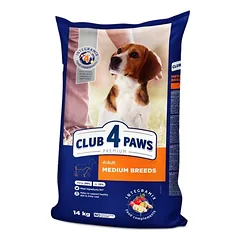
2,14 €/kg
30,00 € / 14 kg
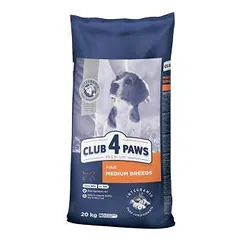
Club 4 Paws
2,15 €/kg
42,99 € / 20 kg