

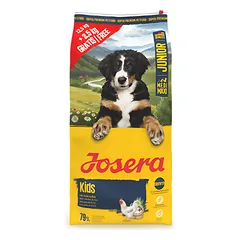
Josera
Josera Kids 12,5kg + 2,5kg = 15 kg
1,38 €/kg
37,89 € / 27,5 kg

The American Foxhound descends from English Foxhounds brought to America, further refined in the 18th century by George Washington himself, who wanted a faster, leaner hound type suited to running fox across Virginia's open fields. Its build runs leaner and longer-legged than its English relative, favoring speed over endurance in dense cover. The short, hard coat needs minimal grooming. A male weighs up to 34 kilograms, high-energy and vocal, carrying a far-reaching bay in the field that helps hunters track the pack's position. The breed does best in the company of other dogs and is rarely content as a solitary house pet. Life expectancy runs 11 to 13 years.
Browse dog food sized right for this breed
American Foxhound: how old in human years?
Energy level
Trainability
Family friendly
Grooming need
Males 56–64 cm
Females 53–61 cm
Males 29–34 kg
Females 25–32 kg
American Foxhound's average temperament and family-life score for this breed is moderate.
American Foxhound's energy and exercise needs are high.
American Foxhound's guarding and alertness traits are low.
American Foxhound's grooming needs are low.
When an American Foxhound lifts his nose and catches a trail, the world narrows to a single smell and your voice becomes distant background noise. He is an endurance dog, bred to follow game for hours, so half an hour around the block is merely his warm-up. Every day he needs long hikes, runs beside a bike, or free running in a well-fenced space, and a flat with no garden and no such outlet will feel far too small.
He is clever but independent: a hunting hound was bred to make his own decisions, not to wait for orders. He can be trained, with patience, short sessions and treats good enough to outweigh the world of smells for a moment. Don't trust his recall anywhere near wildlife; in open country a long line is your friend. And be ready for his voice: a foxhound doesn't just bark, he bays, and the whole street will hear it.
At home he is gentle, easygoing and friendly: devoted to his family, patient with children, and easy with other dogs, since his ancestors lived in packs. He meets strangers politely but makes a poor guard. Cats and small pets may look like quarry to him, and he dislikes being alone, so he is happiest with a family that spends a lot of time outdoors, or with another dog for company.
An American Foxhound's coat is short, hard and close-lying, made for pushing through brush rather than lounging in a salon. A weekly once-over with a rubber brush or grooming mitt collects the loose hair, brings up the shine and takes a few minutes. He sheds moderately, so you will still find short hairs on the sofa and on dark trousers, more so when the seasons turn. Baths are rarely needed, unless he has rolled in something that smells wonderful only to him.
After a walk through fields or woods, run your hands over his whole body: in a coat this short you can easily feel scratches, ticks or sore patches of skin. Once a week, lift those long ears and look inside: the ear should be clean, pink and smell of nothing much, and after a swim or a downpour it is worth drying. Check the eyes too, for redness, discharge or seeds caught after a run through long grass, and keep the nails trimmed.
The American Foxhound was bred to follow a scent across the Virginia hills for days on end, and his body shows it: light, long-legged, with no wrinkles or exaggerations to speak of. There are still a few areas worth watching: the hips, blood clotting, and those long, hanging ears. Learn their signs and you will notice changes in time to talk them over with your vet.
This is general information, not veterinary advice. For your own dog's health, tests and treatment, see a vet.
The hip joint forms unevenly, so the ball at the top of the thigh bone doesn't move as smoothly in its socket as it should. You might notice your foxhound getting up more slowly after a long run, bunny-hopping with both hind legs together, or thinking twice about jumping into the car. For a dog whose whole life is movement, sound hips matter, so ask the breeder about the parents' health testing.
Platelets are tiny blood cells that help blood clot, and in thrombocytopathy there may be enough of them but they don't work properly. You might notice a small cut on a paw bleeding longer than you'd expect, bleeding gums or a nosebleed, or bruises on the skin with no obvious cause. A foxhound crashing through brambles will collect scratches, so if bleeding seems to go on too long, have your vet take a look, and ask the breeder about the parents' health testing.
An inflammation of the ear canal, and a foxhound's long, hanging ears let little air in, so warmth and moisture linger inside. He shakes his head, scratches at the ear with a paw or rubs it along the ground, and the ear smells bad, looks red or has discharge. If you see these signs, don't wait for it to pass on its own; have your vet look at the ear.
This list is chosen by the breed's weight (34 kg) rather than the breed itself: shops label food by dog size, so every breed of the same size gets the same list. Prices are updated daily.
≈ 380 g of dry food a day, from €20,73 a month For a neutered, normally active 30 kg dog. Calculate for your dog
Josera
1,38 €/kg
37,89 € / 27,5 kg

Sam's Field
1,80 €/kg
26,99 € / 15 kg

Country Dog
1,89 €/kg
28,29 € / 15 kg

Club 4 Paws
1,92 €/kg
26,94 € / 14 kg
Diamant
1,93 €/kg
28,99 € / 15 kg
Gemon
1,94 €/kg
2,42 € / 1,3 kg

BIO FORM
2,00 €/kg
40,00 € / 20 kg

BIO FORM
2,00 €/kg
40,00 € / 20 kg