


Real Dog
Real Dog sausas maistas suaugusiems, didelių-milžiniškų veislių, šunims su vištiena ir ryžiais 20kg
2,11 €/kg
42,15 € / 20 kg

Also known as: Akita Inu, Japanese Akita, Akitas, Kuma Inu, Akita Shepherd
The American Akita descends from Japanese Akitas that American servicemen brought home after World War II, and over time a bigger, more color-varied type developed in the US before eventually being recognized as its own breed. A male can weigh up to 59 kilograms on a heavy-boned, powerful frame, and the medium-length double coat blows out heavily twice a year. Unlike the Japanese Akita, the American type allows any color, including black with a white mask. The breed is known for a strong territorial streak and can be intolerant of other dogs of the same sex, so early socialization matters a great deal. It tends to be intensely loyal to its own family, sometimes to the point of being a one-person dog. It stays naturally reserved with strangers. Life expectancy runs 10 to 13 years.
Browse dog food sized right for this breed
American Akita: how old in human years?
Energy level
Trainability
Family friendly
Grooming need
Males 66–71 cm
Females 61–66 cm
Males 45–59 kg
Females 32–45 kg
American Akita's average temperament and family-life score for this breed is moderate.
American Akita's energy and exercise needs are moderate.
American Akita's guarding and alertness traits are moderate.
American Akita's grooming needs are moderate.
The American Akita developed from Japanese akitas brought to the United States and grew bigger and heavier-boned, with a broad, bear-like head. At home it doesn't push itself into the spotlight: it settles somewhere with a view of the door and quietly keeps an eye on things. Two good walks a day and some freedom in a fenced garden suit it; it doesn't ask for marathons, but if bored for long it may start rearranging your home to its own taste.
Clever and independent, an akita learns fast when it sees the point and very slowly when it doesn't. Train it calmly, consistently and respectfully from the start, and put real effort into socialisation. It finds other dogs hard going, especially of the same sex, so a free-for-all at the dog park is not its scene.
Its reputation is stern, but the truth is simpler: this is a dog for an experienced, calm owner. It is devoted to its family and can be gentle with its own children, but given its size and strength, leave it with small children only under supervision, especially when visiting children come round. With strangers it is reserved and watchful and guards its home seriously, yet it rarely barks, so if an akita does bark, go and see who's there.
The American Akita has a double coat: a dense, soft undercoat and straight, harsher guard hairs. In an ordinary week, a brush-out once or twice is enough, but when the undercoat changes the hair comes out in such quantities that you could seemingly build a second dog from it; then a brush and a wide-toothed comb are daily tools. There's no need to shave this coat, and as you brush, part it down to the skin: flakes, scales or thin patches stay invisible under that thick undercoat until you go looking.
The small, upright ears air well, so a weekly look is enough: clean, pink and odour-free. Check the eyes in daylight; watering, redness or squinting is a reason to see a vet. Trim a big dog's nails regularly, and start every grooming ritual while it is still a puppy: talking a fifty-kilo akita that dislikes having its paws handled into anything is hard work.
Fifty kilos of dignity and dense fur put real demands on joints, skin and stomach, and it's worth knowing what to watch for. The American Akita lives ten to thirteen years, and the five things below are not a prophecy but a map to help you spot changes in time. One of them, bloat, needs urgent veterinary help, so it pays to know its signs in advance.
This is general information, not veterinary advice. For your own dog's health, tests and treatment, see a vet.
Hip dysplasia is a fault in how the hip joint develops: the ball of the thigh bone sits loosely in its socket, and the joint wears over time. You might notice your dog getting up slowly after sleep, reluctant on the stairs or swaying its hindquarters as it walks. An akita is not one to complain loudly, and it puts a lot of weight on its joints, so even a small change in gait is worth showing a vet.
The thyroid makes too little hormone, and the whole body seems to slow down. You might notice your dog becoming more sluggish, gaining weight, seeking warm spots, and its thick coat thinning or losing its shine. An akita is calm to begin with, so it's easy to miss calm turning into lethargy; let a vet find the cause.
This covers a range of eye troubles, from eyelids that roll inwards and rub the eye to diseases of the retina that slowly weaken sight. You might notice watering, squinting, redness or your dog moving hesitantly at dusk. An akita's small, deep-set, triangular eyes can hide changes, so when in doubt, see a vet.
Sebaceous adenitis is inflammation that damages the skin's oil glands, which keep skin and coat healthy. You might notice dandruff, scales stuck to the hairs, a faded, thinning coat or bald patches. An akita's thick undercoat can hide such changes for a long time, so look at the skin as you brush, and let a vet work out what it is.
Bloat is when the stomach fills with gas and can twist on itself, cutting off its blood supply. The dog becomes restless, tries to vomit but brings nothing up, its belly is swollen and tight, and it drools or can't settle. This is an emergency: if you see these signs, get your akita to a vet immediately, because every minute counts.
This list is chosen by the breed's weight (59 kg) rather than the breed itself: shops label food by dog size, so every breed of the same size gets the same list. Prices are updated daily.
≈ 515 g of dry food a day, from €28,33 a month For a neutered, normally active 45,3 kg dog. Calculate for your dog
Real Dog
2,11 €/kg
42,15 € / 20 kg

Sam's Field
2,56 €/kg
33,26 € / 13 kg
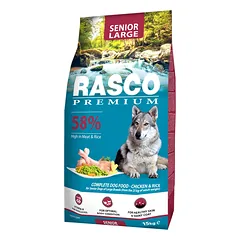
Rasco
2,67 €/kg
39,99 € / 15 kg
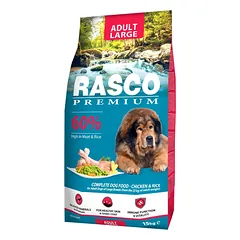
Rasco
2,67 €/kg
39,99 € / 15 kg
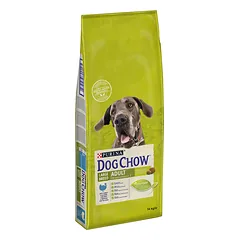
Purina
2,71 €/kg
37,96 € / 14 kg
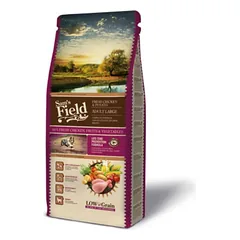
Sam's Field
2,77 €/kg
35,99 € / 13 kg
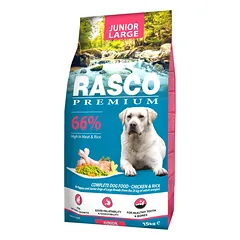
Rasco
2,80 €/kg
41,99 € / 15 kg
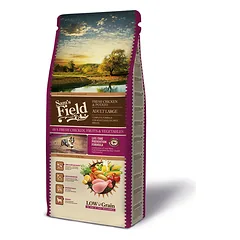
Sam's Field
2,85 €/kg
37,04 € / 13 kg