

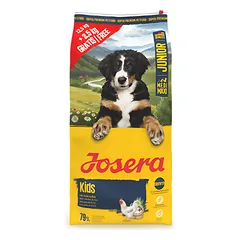
Josera
Josera Kids 12,5kg + 2,5kg = 15 kg
1,38 €/kg
37,89 € / 27,5 kg

Also known as: Kumano Ken, Taichi Ken, Kishu Ken
The Kishu comes from the mountainous Wakayama and Mie region of Japan, where it hunted boar, and sometimes even deer or bear, working in small groups alongside a hunter. A male can weigh up to 27 kilograms on a compact, muscular frame with a short, harsh outer coat, usually white today though other colors existed historically. Japan designated the breed a national natural monument in 1934, and white gradually became the dominant color as show standards took hold. The Kishu kept a quiet, focused hunting temperament: it rarely barks without reason but can be stubborn about deciding when to obey a command. It tends to bond intensely with one handler, sometimes to the point of being a one-person dog. It stays naturally distrustful of strangers. Life expectancy runs 11 to 13 years.
Browse dog food sized right for this breed
Kishu: how old in human years?
Energy level
Trainability
Family friendly
Grooming need
Males 49–55 cm
Females 46–52 cm
Males 18–27 kg
Females 14–23 kg
Kishu's average temperament and family-life score for this breed is moderate.
Kishu's energy and exercise needs are high.
Kishu's guarding and alertness traits are moderate.
Kishu's grooming needs are low.
The Kishu comes from the mountains of Japan, where it hunted big game, and you feel that heritage the moment it catches a scent at the edge of a wood: the body freezes, the curled tail goes up, and you become a supporting character. It has energy and stamina to spare, so it needs long walks, runs or hikes every day, and better still, tasks that occupy its head as well.
It is clever, but it won't please you at any price: a Kishu's first question is "what's in it for me?", and the answer had better be convincing. Short, consistent sessions with praise and treats get the best results, while harshness only damages the relationship. The hunting drive is very strong, so off-lead running belongs in fenced areas, and cats and small pets may be too much temptation. With other dogs, especially of the same sex, it can be short-tempered, so early socialisation pays off.
At home the Kishu is reserved, clean and quiet, a dog that rarely barks but notices everything. It is loyal to its own people and cool and wary with strangers, which can make it a decent guard. A flat is not the ideal place for such a child of nature; it is better suited to a house with a good fence and an owner who is put off neither by long walks nor by a dog with opinions of its own.
The Kishu wears a double coat: harsh, short outer hairs over a soft, dense undercoat. For most of the year a weekly brush right down to the skin is enough, but twice a year the "snowfall" begins: the undercoat comes out in tufts, and then you brush daily, preferably outside. The coat needs no clipping, and baths only when truly necessary, since frequent washing dries the skin.
While brushing, look at the skin as well as the coat: red patches, flakes, thinning spots, or ticks after a walk in the woods. Check the upright ears once a week and wipe the outer part if needed; take any bad smell or redness to a vet. Give the eyes a quick daily glance: bright, clean eyes without tearing are a good sign.
The Kishu is a sturdy mountain hunter that can live eleven to thirteen years, and its owners tend to spend more thought on its energy than on its health. Still, a few conditions are linked to the breed, some of which develop quietly and slowly, so it pays to know your dog well and notice when it starts behaving differently. When in doubt, see a vet, and if you are getting a puppy, ask the breeder about the parents' health testing.
This is general information, not veterinary advice. For your own dog's health, tests and treatment, see a vet.
When the immune system mistakenly attacks the thyroid gland, the gland gradually produces too little hormone and the whole body seems to slow down. You might notice a normally tireless Kishu dragging its feet on walks, putting on weight without eating more, or its dense coat thinning or losing its shine. The changes creep in, so if your dog is changing for no obvious reason, show it to a vet.
In this disease the adrenal glands stop producing enough of some vital hormones. The signs are vague and come in waves: listlessness, poor appetite, vomiting or diarrhoea that clears up and then returns. If a Kishu suddenly turns weak, collapses or can barely stand, it needs a vet immediately.
Entropion is when the edge of an eyelid rolls inwards, so the lashes or hair rub against the surface of the eye. You might see a Kishu squinting, with a watery or red eye, or rubbing its face on the ground or with a paw. Show an eye like that to a vet promptly, as constant rubbing can damage the cornea.
This is a joint development problem: as the puppy grows, the parts of the elbow joint don't fit together precisely, and over time the joint wears. You might notice a Kishu limping on a front leg after a long run, getting up stiffly or being less keen to jump. For an athletic hunter like this, sound joints matter a great deal, so if you are getting a puppy, ask the breeder about the parents' health testing.
This list is chosen by the breed's weight (27 kg) rather than the breed itself: shops label food by dog size, so every breed of the same size gets the same list. Prices are updated daily.
≈ 285 g of dry food a day, from €15,58 a month For a neutered, normally active 20,5 kg dog. Calculate for your dog
Josera
1,38 €/kg
37,89 € / 27,5 kg

Sam's Field
1,80 €/kg
26,99 € / 15 kg

Country Dog
1,89 €/kg
28,29 € / 15 kg
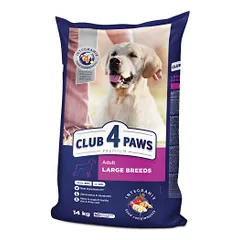
Club 4 Paws
1,92 €/kg
26,94 € / 14 kg
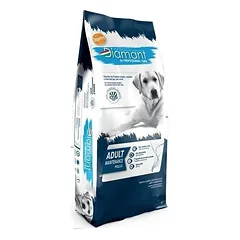
Diamant
1,93 €/kg
28,99 € / 15 kg
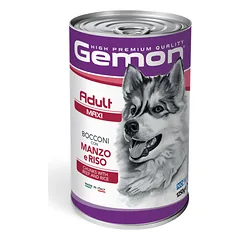
Gemon
1,94 €/kg
2,42 € / 1,3 kg

BIO FORM
2,00 €/kg
40,00 € / 20 kg

BIO FORM
2,00 €/kg
40,00 € / 20 kg