


Real Dog
Real Dog sausas maistas suaugusiems, didelių-milžiniškų veislių, šunims su vištiena ir ryžiais 20kg
2,11 €/kg
42,15 € / 20 kg

Also known as: Esquimaux dog, Greenland husky, Greenland sled dogs
The Greenland Dog has pulled sleds across Arctic ice alongside Inuit communities for centuries, and genetic studies suggest the breed has changed little in at least a thousand years, making it one of the closest living relatives of ancient sled dogs. The thick, medium-length double coat with its dense undercoat lets the dog sleep outdoors in temperatures well below freezing. A male can weigh up to 47 kilograms, powerful and built for endurance hauling over days, not short sprints. These dogs work in packs with a strong hierarchy, so handling calls for a consistent, firm hand. Without enough physical outlet in a home setting, that energy tends to turn destructive. Life expectancy runs 10 to 12 years.
Browse dog food sized right for this breed
Greenland Dog: how old in human years?
Energy level
Trainability
Family friendly
Grooming need
Males 60–65 cm
Females 55–60 cm
Males 32–47 kg
Females 27–41 kg
Greenland Dog's average temperament and family-life score for this breed is moderate.
Greenland Dog's energy and exercise needs are moderate.
Greenland Dog's guarding and alertness traits are low.
Greenland Dog's grooming needs are moderate.
A loaded sled, thirty below and another hundred kilometres to the next settlement: that is the work the Inuit bred the Greenland Dog for over centuries. Its stamina hasn't gone anywhere just because you live in the suburbs. A half-hour stroll around the block is a warm-up; it needs long, hard exercise every day, and ideally a sled, a bike or canicross, something it can pull against with everything it has.
You can train it, just not the way you would train a sheepdog. It is clever, but it uses its brains for its own projects, and "sit" sounds to it like a suggestion rather than an order. Patience, short sessions and a sense of humour will get you further than a firm hand. A strong prey drive means that neighbouring cats, hens and rabbits may come to a sad end, and off the lead in open country it may simply head for the horizon.
With its own people it is friendly without being fawning, and it is no guard dog: a visitor is more likely to be sniffed than barked at. It can be rough with other dogs, so choose its company with care. A flat and long days alone won't suit it; if you have a yard with a high, solid fence and enjoy winter yourself, it will make a superb companion.
A Greenland Dog's coat was built for an Arctic winter: thick, double, medium length, with a dense undercoat that holds in warmth even while the dog sleeps in the snow. In ordinary weeks a thorough comb right down to the skin once or twice a week is enough, paying attention to the neck, behind the ears and the hind legs. When the coat blows, though, the undercoat comes out in clumps, and a daily session is the only way to stop fluff from turning up in rooms the dog has never even entered.
Baths are hardly ever needed: the coat sheds dirt on its own, and once soaked it is heavy and slow to dry. While you comb, check the skin and paw pads, and tip back the edge of the upright ears for a look inside. Remember that this coat is made for cold, so on a hot summer day your dog belongs in the shade, not out running in the sun.
We don't have reliable health information specific to this breed, so we don't list conditions here. Keep up regular vet check-ups, and if you are getting a puppy, ask the breeder about the parents' health testing.
This is general information, not veterinary advice. For your own dog's health, tests and treatment, see a vet.
This list is chosen by the breed's weight (47 kg) rather than the breed itself: shops label food by dog size, so every breed of the same size gets the same list. Prices are updated daily.
≈ 440 g of dry food a day, from €24,15 a month For a neutered, normally active 36,8 kg dog. Calculate for your dog
Real Dog
2,11 €/kg
42,15 € / 20 kg

Sam's Field
2,56 €/kg
33,26 € / 13 kg
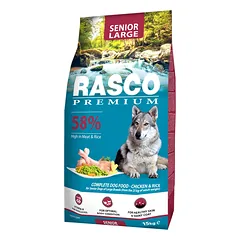
Rasco
2,67 €/kg
39,99 € / 15 kg
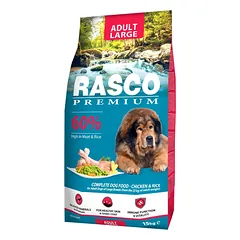
Rasco
2,67 €/kg
39,99 € / 15 kg
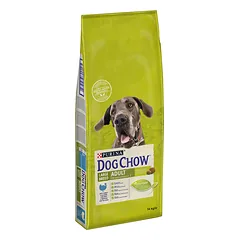
Purina
2,71 €/kg
37,96 € / 14 kg

Sam's Field
2,77 €/kg
35,99 € / 13 kg
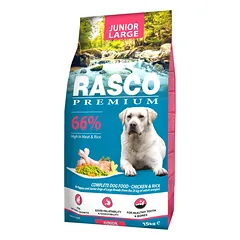
Rasco
2,80 €/kg
41,99 € / 15 kg

Sam's Field
2,85 €/kg
37,04 € / 13 kg